Key takeaways
- Foot glides. Plastic caps on chair feet are the first failure — usually within a season of dragging. Replaceable nylon glides cost a few dollars and prevent both wobble and deck scratches.
- Folding joints. Rivets loosen and powder coat chips exactly at the fold points, which is where rust starts on steel. Tighten hardware each spring; touch up chips before they bloom.
- Sling and textilene seats. Expect visible sagging by season three or four; sling chairs are replaceable-fabric designs only on higher-end sets.
- Wood surfaces. Acacia and eucalyptus gray within a year unoiled — cosmetic, but water then sits in raised grain. Two coats of teak oil per season keeps slats smooth.
- Cushions. Budget sets ship with thin polyester pads that flatten in weeks. If cushions matter, buy the frame bare and add quick-dry foam cushions separately.
The short answer: a balcony 3 ft deep can only take a railing-mounted ledge or a single café chair setup; 4 ft fits a 20–24 in folding bistro set; 5 ft handles a standard two-person small balcony table and chairs; and at 6 ft you can finally seat four around a 30–32 in round table — if two chairs tuck hard against the rail. Depth, not length, is the dimension that decides everything, so measure wall-to-rail before you shop.
Our top picks

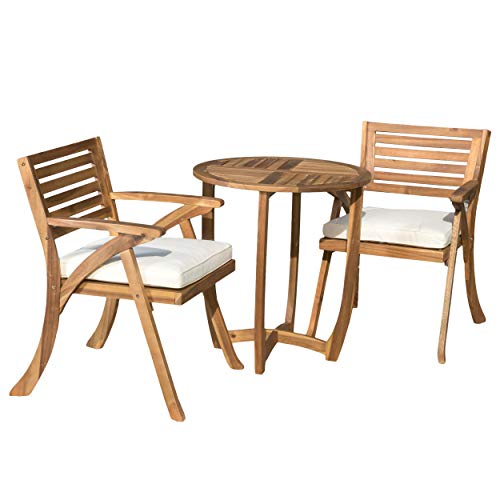


As an Amazon Associate we earn from qualifying purchases at no extra cost to you. Ratings are shown as listed on Amazon.
Measure first: footprint math for 3–6 ft balconies
Usable depth is always less than the tape measure says. Subtract the rail profile itself (1–3 in), leave at least 6 in of buffer so chair backs don’t press the railing, and keep a 12 in minimum squeeze path if anyone needs to walk past a seated person. A dining chair needs roughly 18–20 in of depth including the seated person, and ideally 12–18 in of pull-out space behind it to sit down without a shuffle.
| Measured depth | What realistically fits | Max table size | Seats |
|---|---|---|---|
| 3 ft (36 in) | Clamp-on railing ledge + stools, or one chair + side table | 10–14 in deep rail shelf | 2 (perched) |
| 4 ft (48 in) | Two-person folding bistro set, chairs under table | 20–24 in round or square | 2 |
| 5 ft (60 in) | Standard bistro set, or slim rectangle against the rail | 24–28 in round, or 20 × 30 in rect | 2–3 |
| 6 ft (72 in) | Small round table with 4 chairs, or a 3-seat set with elbow room | 30–32 in round | 4 (tight) |
One height note most listings skip: apartment code railings typically sit 36–42 in tall. A standard 29 in dining table leaves the rail at mid-chest when seated — usable, but counter- or bar-height sets (36 in and 40–42 in tops) raise your eye line above the rail and improve the view, which is half the point of a balcony.
Match the set type to your footprint
Bistro sets: the default for 4–5 ft depths
The classic small bistro table and chairs — a 24 in round top with two 16–18 in wide chairs — occupies about 30 × 60 in parked lengthwise against a rail, which is why it fits almost every apartment balcony. Look for chairs that slide fully under the top; some designs stop 3–4 in short because the seat is deeper than the table diameter, and that lost clearance matters on a 4-ft slab. Cast aluminum and steel versions dominate this category, usually $80–$250 for a three-piece set.
Folding sets: for renters, winter, and shared balconies
Folding versions collapse to 3–5 in thick and hang on wall hooks, which solves both lease restrictions and off-season storage. The IKEA TÄRNÖ (steel frame, acacia slats) and the Fermob Bistro line (French powder-coated steel, the design the style is named after) are the reference points; Fermob runs several hundred dollars for a set, while generic folding bistro sets usually land at $60–$200. Check the stated chair weight rating — most are rated 220–265 lb — and expect to snug the folding rivets once a season as they work loose.
Railing-mounted: the only answer for a 3-ft balcony
Clamp-on railing tables are ledges 24–48 in wide and 10–14 in deep that bracket onto the rail itself, leaving the floor completely clear. Two things to verify before buying: rail profile compatibility (most brackets fit square or flat rails 1.5–6 in deep; round tubular rails need a different clamp) and load rating, which is typically just 15–30 lb. That means drinks, plates, and a laptop — not elbows, leaning, or a cat. Pair the ledge with backless stools at 24–28 in seat height that tuck fully underneath, and the whole setup vanishes when not in use. Half-round (demilune) tables and wall-hung drop leaves work the same trick where the building allows a wall fixing.
Six feet deep? A small round table with 4 chairs is possible
Four adults genuinely need a 32–36 in top for plates and elbows, but a 30–32 in round works if the chairs are armless and 16–18 in wide. Choose a pedestal base over four legs — it frees roughly 4 in of knee clearance all around, which is the difference between comfortable and cramped at this scale. On a long, narrow balcony, a 24 × 36 in rectangle pushed against the rail with two chairs and a bench often seats four more comfortably than a circle that forces everyone into the walkway.
Materials for an exposed rail: what survives outdoors
Every small metal table and chairs set is some mix of steel, iron, or aluminum, and the difference is rust behavior and weight — both of which matter more on an unsheltered balcony than in a garden.
| Material | Typical chair weight | Rust behavior | Wind stability | Upkeep | Typical set price |
|---|---|---|---|---|---|
| Powder-coated steel | 10–18 lb | Rusts where coating chips (fold points first) | Moderate | Touch-up paint yearly | $60–$200 |
| Wrought iron | 25–40 lb | Rust blooms at weld scratches; needs sanding + paint | Excellent — stays put in gusts | Inspect welds each spring | $150–$500 |
| Cast aluminum | 8–15 lb | Cannot rust; finish is cosmetic | Light — can migrate on high floors | Hose off, done | $100–$350 |
| Acacia / eucalyptus wood | 12–20 lb | No rust; grays without oil | Moderate | Oil 2× per season | $80–$250 |
| HDPE wicker on aluminum | 10–16 lb | Frame rust-proof; weave outlasts PVC | Moderate | Brush out debris | $150–$400 |
A small wrought iron table and chairs is the right call for windy upper floors — a 30 lb chair won’t relocate overnight — but accept the maintenance contract: anywhere the finish chips, rust follows, so budget a sanding sponge and matching enamel. If you want the look without the upkeep, cast aluminum imitates iron scrollwork at a third of the weight and zero rust risk, which also makes it the pick for coastal air and pool-adjacent balconies. For galvanized-plus-powder-coated steel, you get near-aluminum corrosion resistance at iron-like weight — the best compromise for exposed rails. Skip cheap PVC wicker entirely; it cracks under UV in two to three seasons, while HDPE resin holds up roughly twice as long.
Pick by situation, not by photo
| Your situation | Best pick | Why |
|---|---|---|
| 3-ft balcony, no usable floor | Railing ledge + 2 backless stools | Zero floor footprint; stows flat |
| Renter, no drilling allowed | Folding bistro set | Fully freestanding, stores in a closet |
| Windy floor, 10+ stories | Wrought iron or heavy steel | 25+ lb chairs don’t become projectiles |
| Coastal or poolside air | Cast aluminum or HDPE wicker | Salt kills steel coatings fast |
| Feeding four on a 6-ft balcony | 30–32 in pedestal-base round | Only footprint that seats four |
| Budget under $150 | Powder-coated folding set | Trade lifespan for price knowingly |
What actually wears out first
- Foot glides. Plastic caps on chair feet are the first failure — usually within a season of dragging. Replaceable nylon glides cost a few dollars and prevent both wobble and deck scratches.
- Folding joints. Rivets loosen and powder coat chips exactly at the fold points, which is where rust starts on steel. Tighten hardware each spring; touch up chips before they bloom.
- Sling and textilene seats. Expect visible sagging by season three or four; sling chairs are replaceable-fabric designs only on higher-end sets.
- Wood surfaces. Acacia and eucalyptus gray within a year unoiled — cosmetic, but water then sits in raised grain. Two coats of teak oil per season keeps slats smooth.
- Cushions. Budget sets ship with thin polyester pads that flatten in weeks. If cushions matter, buy the frame bare and add quick-dry foam cushions separately.
On logistics: a three-piece bistro set typically ships in one box of 30–50 lb that clears any standard 32 in doorway; a small wrought iron table and chairs set may arrive in three boxes totaling 100+ lb, and single iron chairs are awkward on spiral stairs. Folding pieces are the only realistic option for tight switchback stairwells.
Common follow-up questions
Can a 4-chair set fit a 5-ft balcony?
No — a 32 in top plus two 18 in chair depths needs 68 in minimum before any pull-out room. On 5 ft, run three chairs around a 28 in table, or switch to a rail ledge with stools.
Do I want the umbrella hole?
Rarely on a narrow balcony. A proper freestanding umbrella base eats a 15–18 in footprint and 40+ lb of floor space. A rail-clamping half-umbrella gives shade with zero footprint.
Bar height or dining height?
If your rail is 42 in, bar height lifts your sightline above it and stools tuck fully under a smaller top — the more space-efficient choice. Dining height wins only if you’ll also use the table as a work desk, where standard chair ergonomics matter.