Key takeaways
- Upgrade technology ensure amazing showering experience, compare with…
- Larger coverage shower heads with handheld spray combo,…
- Rainforest experience in home, our high pressure shower…
The best rainfall showerhead for most bathrooms is a 12-inch round or square head with a 2.0 gpm flow restrictor, a brass swivel ball joint, and a PVD or brushed-nickel finish, mounted on a wall arm so the face sits 78–84 inches above the floor. That combination throws a 36-inch-wide spray pattern that covers a standing adult without soaking the whole room, works with the 40–80 psi found in most homes, and survives hard water far better than a chrome-plated plastic body. The rest of this guide explains when to step up to 16 or 20 inches, when a 1.75 gpm head is the smarter buy, why a ceiling mount changes the entire project budget, and which finishes stay clean and which ones turn chalky within a year.
Our top picks
 Rain Shower Head with Handheld Showerhead
- Upgrade technology ensure amazing showering experience, compare with…
- Larger coverage shower heads with handheld spray combo,…
- Rainforest experience in home, our high pressure shower…
 Rain Shower Head with Handheld Showerhead
- Upgrade technology ensure amazing showering experience, compare with…
- Larger coverage shower heads with handheld spray combo,…
- Rainforest experience in home, our high pressure shower…
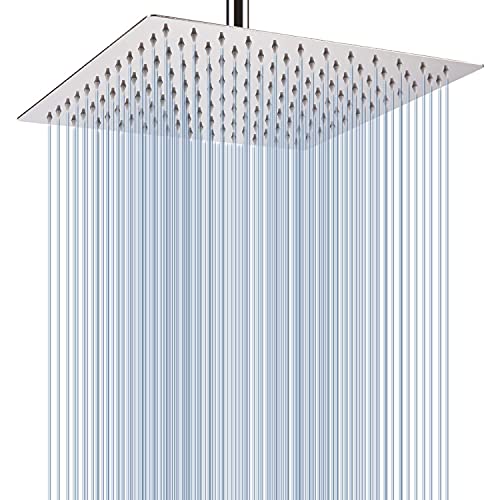 Voolan Rain Shower Head
- Oversize showerhead enough to cover your whole body
- Our square shower head is made of high…
- No more to worry about the cleaning of…
| Product | Key specs | |
|---|---|---|
| Rain Shower Head with Handheld Showerhead | Upgrade technology ensure amazing showering experience, compare with… Larger coverage shower heads with handheld spray combo,… Rainforest experience in home, our high pressure shower… | Check price |
| Rain Shower Head with Handheld Showerhead | Upgrade technology ensure amazing showering experience, compare with… Larger coverage shower heads with handheld spray combo,… Rainforest experience in home, our high pressure shower… | Check price |
| Voolan Rain Shower Head | Oversize showerhead enough to cover your whole body Our square shower head is made of high… No more to worry about the cleaning of… | Check price |
 Rain Shower Head with Handheld Showerhead Rain Shower Head with Handheld Showerhead | Upgrade technology ensure amazing showering experience, compare with… Larger coverage shower heads with handheld spray combo,… Rainforest experience in home, our high pressure shower… | Check price |
As an Amazon Associate we earn from qualifying purchases at no extra cost to you.
Diameter and spray coverage: the number that decides everything
Diameter is the first spec to fix, because it determines where the water lands and how much of the shower floor gets wet. A rain head is a flat plate with dozens of small nozzles, so the spray pattern is essentially a scaled copy of the face. In practice, the wetted circle on the floor at standing height runs roughly three times the head diameter. An 8-inch head wets about 24 inches of floor; a 12-inch head wets about 36 inches; a 16-inch head wets close to 48 inches.
That relationship matters because shower stalls come in fixed sizes. A 32-inch stall is common in apartments and RVs, a 36-inch stall is the standard residential minimum, and a 48-inch or larger walk-in is typical in primary bathrooms. If you fit a 16-inch head over a 32-inch stall, water lands on the walls, runs down the tile, and pools outside the curb. If you fit an 8-inch head in a 5×5 walk-in, you end up stepping side to side to rinse your shoulders.
Square heads deliver more usable area for the same nominal size than round ones. A 12-inch square is 144 square inches of face; a 12-inch round is about 113 square inches. The square version feels noticeably broader, but it also throws water into the corners of a narrow stall. Round heads are more forgiving in tight footprints.
| Head size and shape | Face area | Wetted footprint at standing height | Fits best in | Minimum ceiling height for a ceiling mount |
|---|---|---|---|---|
| 6 in round | ~28 sq in | ~18 in | RVs, boats, 24–28 in stalls | Not recommended |
| 8 in round | ~50 sq in | ~24 in | 32–36 in stalls, small apartments | 92 in |
| 10 in round | ~79 sq in | ~30 in | 36 in stalls, tub-shower combos | 94 in |
| 12 in round | ~113 sq in | ~36 in | 36–42 in stalls, 5×8 bathrooms | 96 in |
| 12 in square | 144 sq in | ~40 in | 42–48 in stalls, square showers | 96 in |
| 16 in round | ~201 sq in | ~48 in | 5×5 walk-ins and larger | 100 in |
| 16 in square | 256 sq in | ~52 in | 5×5 to 6×6 walk-ins | 100 in |
| 20 in square | 400 sq in | ~60 in | 6×6 and larger wet rooms | 104 in |
| 24 in square | 576 sq in | ~72 in | Open wet rooms, dual-head installs | 108 in |
Two measurements decide whether a given size works in your room. First, the arm length: wall-mounted heads sit on arms of 12, 16, or 18 inches, measured from the wall outlet to the head’s center. A 16-inch arm on a 12-inch head pushes the spray center 16 inches off the wall, which is roughly where an adult stands in a 36-inch stall. Second, the height above finished floor: the head face should land between 78 and 84 inches. Below 76 inches you have to duck; above 88 inches the water cools as it falls and the spray spreads so wide that it loses force.
Flow rate: why a 2.0 gpm rain head feels weaker than a 2.0 gpm standard head
Federal rules cap showerheads at 2.5 gpm nationwide, and the WaterSense program certifies heads at 2.0 gpm or less. Several states — California, Colorado, New York, Hawaii, and Washington among them — restrict fixtures to 1.8 gpm. Those are the legal ceilings, not necessarily what you want.
The counterintuitive part is that a rain head at the same flow rate feels weaker than an angled standard head. A standard head forces water through a venturi and mixes in air, so the stream hits your skin at higher velocity. A rain head spreads the same volume across a much larger plate, so each individual nozzle releases a slow drip. A 12-inch head with 100 nozzles at 2.0 gpm delivers 0.02 gallons per minute per nozzle. That is why a rain head rated 2.0 gpm can feel like a light drizzle while a handheld at 2.0 gpm feels brisk.
The fix is either more pressure, fewer nozzles, or a larger nozzle bore — not simply removing the restrictor. Removing a flow restrictor voids the WaterSense listing, can void a warranty, and in some jurisdictions violates local code. It also does nothing if your supply pressure is the actual bottleneck.
| Flow rate | Time to fill a 5-gallon bucket | How it feels on a 12 in head | Where it is required or common | Estimated annual hot-water energy cost, two 10-minute showers a day |
|---|---|---|---|---|
| 2.5 gpm | 2 min 00 s | Full, heavy rain | Pre-1992 fixtures still in service | ~$320 |
| 2.0 gpm | 2 min 30 s | Steady, satisfying rain | Federal maximum; WaterSense threshold | ~$255 |
| 1.8 gpm | 2 min 47 s | Noticeably lighter, still usable | CA, CO, NY, HI, WA | ~$230 |
| 1.75 gpm | 2 min 51 s | Light rain; fine on small heads | Many WaterSense listings | ~$225 |
| 1.5 gpm | 3 min 20 s | Mist; frustrating on large plates | Ultra-low-flow designs | ~$190 |
Those cost figures are illustrative estimates assuming electric water heating at roughly $0.16 per kWh, a 45°F temperature rise, and two 10-minute showers daily. Gas heating cuts the number substantially; a colder incoming supply raises it. The useful takeaway is the spread: dropping from 2.5 to 1.75 gpm saves roughly $95 a year in energy alone for a two-person household, before any water or sewer savings. In a four-person household, double it.
The practical rule: match flow rate to head size. A 6- to 8-inch head is comfortable at 1.5–1.75 gpm. A 10- to 12-inch head wants 1.8–2.0 gpm. A 16-inch head or larger really wants 2.0–2.5 gpm, or multiple nozzles with a wider bore. Buying a 20-inch plate rated 1.5 gpm is the single most common mistake in this category.
Water pressure: what your plumbing needs to deliver
A rain head is essentially a gravity-fed fixture. Water has to travel from the supply, up or through the wall, and then fall out of a horizontal plate. That last step costs you pressure. Compared with a standard angled head at the same supply, expect a rain head to feel about 10–15 psi weaker.
You can measure your static pressure with a $12 hose-bib gauge screwed onto a laundry sink faucet or an outdoor spigot. Static pressure is what the gauge reads with no water running. It is not the same as dynamic pressure, which drops when other fixtures run, but it is close enough for this decision.
| Static pressure | What a rainfall head will do | Recommended head size | Recommended flow rate | Notes |
|---|---|---|---|---|
| Under 20 psi | Weak dribble, no coverage | Not viable | — | Fix the supply first: booster pump, new PRV, or clear a clogged aerator/screen |
| 20–30 psi | Light rain, thin coverage | 6–8 in | 1.5–1.75 gpm | Fewer, larger nozzles beat many small ones |
| 30–45 psi | Acceptable on small heads | 8–10 in | 1.75–2.0 gpm | Wall mount preferred; ceiling runs lose more |
| 45–65 psi | The sweet spot | 10–12 in | 2.0 gpm | Most municipal systems land here |
| 65–80 psi | Strong, full coverage | 12–16 in | 2.0–2.5 gpm | Watch for splash outside the shower |
| Above 80 psi | Very strong | 16–20 in | 2.0–2.5 gpm | Install or adjust a pressure-reducing valve; over 80 psi stresses supply lines |
Three situations quietly wreck rain-head performance. First, shared-wall plumbing in apartments and hotels, where a neighbor’s shower drops your dynamic pressure by 10–20 psi. Second, well systems with a 30/50 pressure switch, which cycle between 30 and 50 psi — the low end is what you feel. Third, long pipe runs from a distant water heater, which do not reduce pressure but do reduce temperature, so you compensate by turning the handle hotter and lose flow to the mixing valve.
If your pressure sits in the 30s and you want a big head anyway, the realistic options are a booster pump (usually $300–$900 installed) or a head with fewer, larger nozzles. A 12-inch plate with 60 nozzles will outperform a 12-inch plate with 200 nozzles at the same pressure, because each nozzle gets more volume and the drops fall heavier.
Installation types, ranked by how much of your bathroom they disturb
Installation is where budgets blow up. The head itself is often the cheapest part of the job. Here is how the main configurations compare.
| Configuration | Work required | Ceiling height needed | Renter friendly | Typical total cost |
|---|---|---|---|---|
| Wall-mount on existing arm | Unscrew old head, screw on new one | Any | Yes | $40–$250 |
| Wall-mount with a longer arm | Swap the arm at the wall outlet; one threaded joint | Any | Yes, if you keep the original arm | $60–$300 |
| Slide-bar or rail system | Two or three screw holes in tile; no pipe work | Any | Yes, with tile-safe anchors | $80–$400 |
| Dual rain head plus handheld with diverter | Add a 3-way diverter at the arm, or replace the valve trim | Any | Partly | $120–$550 |
| Shower panel or tower | Connect to existing hot/cold stub-outs; often surface-mounted | 84 in | Partly | $250–$1,200 |
| Ceiling-mount arm | Open the ceiling or run pipe from the wall; patch and paint | 96 in | No | $300–$900 including labor |
| Recessed flush ceiling head | Cut a 6–12 in hole, frame it, run pipe, waterproof the ceiling | 96 in, ideally 108 in | No | $500–$1,800 |
| Exposed-pipe retrofit | Surface-mounted pipe up the wall and across the ceiling; no wall opening | 90 in | Partly | $300–$1,000 |
The ceiling height column is not arbitrary. A ceiling-mounted head needs its face at 78–84 inches. If your ceiling is 96 inches (8 feet), a flush head with a short drop tube works but leaves only 12–18 inches of clearance above a tall bather’s head — fine, but tight. At 90 inches (7.5 feet) you need a very short drop, and anyone over 6 feet will feel crowded. Below 90 inches, stay with a wall mount on a long arm, which puts the head at the same effective height without touching the ceiling.
Renters have three workable paths. Swapping just the head onto the existing arm is the safest and takes five minutes with a wrench and a roll of thread tape. Adding a slide-bar rail means drilling tile, which is reversible but leaves holes. A ceiling-mounted head is essentially off the table unless you negotiate it in writing and are prepared to patch on move-out.
Materials and finishes: what actually resists mineral buildup
Almost every complaint about a rainfall showerhead traces back to two things: the body material and the finish. Chrome plating over ABS plastic is the cheapest combination and the first to fail. Water sits in the nozzle recesses, minerals precipitate, the plating lifts at the edges, and the head starts to look permanently dirty.
| Body and finish | Buildup resistance | Typical weight | Expected service life | Typical price band |
|---|---|---|---|---|
| ABS plastic, chrome plated | Poor — plating pits and flakes at nozzle edges | 0.6–1.2 lb | 3–7 years | $25–$70 |
| Zinc alloy, chrome plated | Moderate — heavier, but still a plated surface | 1.5–2.5 lb | 5–10 years | $40–$120 |
| 304 stainless steel | Good — no plating to lift, tolerates descaling acids | 2–4 lb | 10–20 years | $70–$250 |
| Brass body, chrome plated | Good — the plating is over a stable substrate | 3–6 lb | 12–20 years | $120–$400 |
| Brass body with PVD finish | Excellent — PVD is a molecular bond, not a coating | 3–6 lb | 15–25 years | $150–$600 |
| Brushed nickel, electroplated | Good — hides water spots better than chrome | — | 8–15 years | $60–$250 |
| Matte black, powder coated | Fair — chips expose a lighter substrate that reads as a scratch | — | 4–10 years | $50–$200 |
| Matte black, PVD | Excellent — the most durable dark finish available | — | 12–20 years | $150–$500 |
| Brushed gold or bronze, PVD | Excellent, but soft-toned finishes show soap film more | — | 12–20 years | $180–$600 |
PVD stands for physical vapor deposition. A thin film of metal is bonded to the substrate at a molecular level rather than deposited electrochemically. The result resists chipping, abrasion, and the mild acids in descalers far better than electroplating. If you live in a hard-water area and want a dark finish, PVD matte black is the only version worth buying. Standard powder-coated matte black will show white crust in the recesses within months and cannot be scrubbed hard without dulling.
Weight matters for a different reason: a heavy brass head on a long arm puts torque on the wall fitting. A 5-pound head on an 18-inch arm creates meaningful leverage. If you are mounting to drywall rather than a stud or blocking, use a heavy-duty toggle anchor rated for at least 50 pounds, or step down to a stainless head in the 2–3 pound range.
Nozzles, swivels and the small parts that fail first
The nozzles are where buildup actually starts, so their material matters as much as the body. Silicone and TPE (thermoplastic elastomer) nozzles are flexible: you rub them with a thumb and the mineral flakes off. They are the easiest to maintain and the most common on modern heads. Rubber nozzles behave similarly but harden over years. Brass nipples resist abrasion but scale quickly because minerals bond tightly to metal, and they are hard to clean without a pick. Some heads use a nozzle-free design where water exits through laser-drilled holes in a stainless plate — these look clean and never clog visibly, but they are difficult to descale when they eventually do.
The swivel ball joint is the second failure point. A brass ball joint with a nylon or PTFE seat lasts decades. A plastic ball joint on a zinc stem cracks, usually right where the threads meet the housing, and the head starts drooping. If the joint is not serviceable, a drooping head means replacing the whole unit.
Threads deserve a mention. Standard US shower arms use 1/2-inch NPT (National Pipe Taper) threads. Imported heads occasionally ship with 1/2-inch BSP (British Standard Pipe) threads, which are close enough to start by hand but leak under pressure. If your new head weeps at the joint no matter how much tape you use, check whether the threads are G1/2 (BSP) rather than NPT. An adapter costs a few dollars.
Decision matrix: match the head to your situation
| Your situation | Best configuration | Why it works |
|---|---|---|
| Renting, cannot alter plumbing | 8–10 in wall-mount head on the existing arm, 1.75–2.0 gpm | Five-minute swap, fully reversible, no drilling |
| Small apartment, 32–36 in stall | 8 in round, 1.75 gpm, silicone nozzles | Keeps spray inside the stall; low flow compensates for limited pressure |
| Standard 36×60 tub-shower combo | 10–12 in head on a 16 in arm, 2.0 gpm | Spray center lands where you stand; arm clears the shower curtain |
| Large walk-in, 5×5 or bigger | 16 in square, ceiling mount or 18 in arm, 2.0–2.5 gpm | Full-shoulder coverage without stepping around |
| Low water pressure under 40 psi | 8 in head, 1.5–1.75 gpm, 50–70 large nozzles | Fewer, larger nozzles preserve velocity where many small ones would dribble |
| Hard water or private well | Brass body, PVD finish, silicone nozzles, inline filter | Survives descaling; filter catches sediment before it reaches the nozzles |
| Kids and pets in the house | Dual rain plus handheld on a slide bar with a thermostatic valve limited to 100°F | Handheld reaches kids and dogs; thermostatic limit prevents scalding |
| Aging in place or limited mobility | Handheld on a slide bar plus a fixed rain head; add grab bars | Adjustable height without tools; no reaching overhead |
| Two people showering together | Two 8–10 in heads on a shared thermostatic valve, or one 20 in head | Two heads give full pressure to each bather; one large head shares the flow |
| Tankless water heater | 2.0 gpm or lower per head | Stays inside the heater’s flow-activation window; oversized flow can cause cycling |
| High-rise with a booster pump | 12–16 in head, 2.5 gpm acceptable above 65 psi | Plenty of pressure; watch for splash beyond the shower enclosure |
| Cold climate, cold incoming water | 1.75–2.0 gpm with a thermostatic valve | Lower flow means less hot water drawn, so temperature holds steadier |
Sizing the head to the room
Here is how the arithmetic works in three real layouts.
A 5×8 foot bathroom with a 36×36 inch shower. The stall’s interior is 36 inches wide. A 10-inch round head throws a 30-inch pattern — comfortably inside. A 12-inch round throws 36 inches, which is exactly the stall width, so any splash or drift lands on the walls. If the shower has a curtain rather than a door, stay at 10 inches. If it has a fixed glass panel and a curb, 12 inches is fine.
A 10×12 foot bathroom with a 48×60 inch walk-in. The short dimension is 48 inches, so a 16-inch square head (52-inch pattern) is marginally too wide and a 12-inch square (40-inch pattern) leaves you moving around. A 14-inch square is the natural fit if the manufacturer offers one; otherwise a 16-inch round at 48 inches of pattern is the closest match. Mount the arm so the spray center sits 20–24 inches off the back wall, which puts it over the standing zone rather than the drain.
A 4×6 foot apartment bathroom with a 32×32 inch stall. The stall is 32 inches. An 8-inch round head at 24 inches of pattern leaves a 4-inch margin on each side. That is the correct answer here, and a 10-inch head will soak the floor. Pair it with a 1.75 gpm rating; at 2.0 gpm the narrower stall fills with steam and splash quickly.
What each budget tier buys
| Budget | What you realistically get | What you give up |
|---|---|---|
| $25–$70 | 6–8 in head, ABS or zinc body, chrome plate, rubber nozzles | Finish life, weight, and often a plastic ball joint |
| $70–$150 | 10 in head, stainless or heavy zinc, silicone nozzles, brass swivel | Still a plated finish; limited size options |
| $150–$300 | 12 in brass body, PVD or quality electroplate, serviceable swivel | Nothing important at this size |
| $300–$600 | 16 in square, all-brass, PVD, thermostatic-ready, 2.5 gpm capable | Installation cost is now the bigger line item |
| $600–$1,200 | 20 in or larger, dual valves, ceiling-mount hardware included | Requires ceiling work; not renter-friendly |
| $1,200 and up | Recessed flush ceiling heads, multiple heads on a shared thermostatic valve, custom trim | Professional installation is mandatory |
The picks, by type and spec
Below, each entry describes a configuration rather than a specific catalog number, because the same specification appears across several manufacturers. Where a brand is named, it is a long-established maker whose product lines have included that configuration for years — but always check the current spec sheet before buying, since finishes, flow ratings, and included hardware change between production runs.
1. The 12-inch round wall-mount in brushed nickel — the default choice
This is the head to buy if you want one decision and no regrets. Twelve inches of face throws a 36-inch pattern, which suits 36- to 42-inch stalls and tub-shower combos. Brushed nickel hides water spots far better than polished chrome and does not show the fingerprint smudging that matte finishes do. Look for a brass body in the 3–4 pound range, a brass swivel ball joint with a nylon seat, and silicone nozzles on roughly 90–120 openings.
Flow: 2.0 gpm. Arm: 16 inches, sold separately or included. Pressure needed: 45 psi or better for a full feel. Price band: usually $150–$300 for a brass-bodied version, $70–$120 for a stainless one. The failure mode to avoid is a zinc-bodied head with a plastic swivel — it will droop within two years.
2. The 16-inch square ceiling-mount in PVD matte black
Built for a 5×5 or larger walk-in with a 9-foot ceiling or higher. The square face gives 256 square inches, which covers both shoulders and the upper back at once. PVD matte black is the only dark finish worth considering in a hard-water area; powder-coated versions show white crust in the nozzle recesses and cannot be scrubbed aggressively.
Flow: 2.5 gpm preferred, 2.0 gpm acceptable above 65 psi. Ceiling requirement: 100 inches minimum, 108 inches ideal. Installation involves running a pipe from the wall valve up into the ceiling cavity, plus patching and painting. Expect $300–$900 in labor on top of $300–$600 for the head and drop tube. Weight is 4–6 pounds, so the ceiling framing needs real blocking, not a drywall anchor.
3. The 8-inch round compact for small stalls and rentals
The correct answer for a 32-inch stall, an RV, a basement bathroom, or any situation where you cannot modify plumbing. It swaps onto the existing 1/2-inch NPT arm with a wrench and thread tape. Silicone nozzles let you descale by rubbing with a thumb. At 1.75 gpm it sips water, which matters if the shower shares a supply line with a kitchen or laundry.
Look for a metal body rather than ABS — a stainless or zinc 8-inch head costs $40–$100 and will outlast a plastic one by years. Avoid heads under 1.5 pounds with visible plastic seams; those crack at the thread collar. Pressure needed: 30 psi is enough at this size.
4. The dual rain-plus-handheld combo on a slide bar
Two fixtures on one valve, connected by a three-way diverter. The rain head handles the rinse; the handheld handles everything else — rinsing shampoo from long hair, washing a dog, cleaning the shower walls, reaching a child. The slide bar lets you set the handheld height anywhere from about 40 to 78 inches.
Two configurations exist. The cheaper version uses a diverter that sits at the shower arm and shares one water supply, so only one fixture runs at a time. The better version uses a two-outlet thermostatic or pressure-balance valve, which allows both to run simultaneously — useful in a two-person household but it roughly doubles the flow demand. Price: $120–$350 for the shared-supply type, $350–$700 for the two-outlet valve version. Renters should stick to the first type.
5. The shower panel or tower with body jets
A surface-mounted column containing a rain head at the top, a handheld in the middle, and three to six body jets down the sides. It connects to existing hot and cold stub-outs, so no wall opening is needed, but it does require 84 inches of vertical clearance and a stub-out spacing that matches the panel — usually 5.9 or 6.0 inches on center. If your existing valve is off-center, the panel will not fit without re-plumbing.
Body jets are the weak point. They consume flow that would otherwise reach the rain head, so a 2.5 gpm total supply split five ways delivers 0.5 gpm per outlet. Expect a noticeably softer rain head whenever the jets are open. Price: $250–$1,200. Best suited to a large walk-in with a dedicated supply line and pressure above 55 psi.
6. The low-pressure specialist: 8-inch head, 1.75 gpm, 60 large nozzles
Designed for homes in the 25–40 psi range — older neighborhoods, gravity-fed systems, well systems with a 30/50 switch, and upper floors of buildings without a booster. The trick is nozzle count: 60 nozzles at 1.75 gpm gives each one 0.029 gpm, nearly 50 percent more per nozzle than a 100-nozzle head at the same flow. The drops fall heavier and the spray feels denser despite using less water.
Pair it with a 1.75 gpm rating and a 10-inch arm rather than 16 inches, which shortens the vertical drop and reduces spread. Price: $60–$150. If you are below 25 psi, no head will fix it — address the supply first.
7. The high-flow 2.5 gpm head for strong-pressure homes
Where supply pressure exceeds 65 psi and the shower has a 48-inch or larger footprint, a 2.5 gpm head is legal at the federal level and delivers the heaviest rain feel available. A 12- to 16-inch plate at 2.5 gpm is genuinely spa-like: full coverage, heavy drops, no drizzle.
Two caveats. Some states and many new construction permits restrict fixtures to 2.0 gpm or less regardless of what the head is rated, so verify locally. And at 2.5 gpm a 50-gallon water heater delivers roughly 30 minutes of continuous hot water before recovery becomes the limit — a 20-minute shower for two people will exhaust it. Price: $120–$400.
8. The recessed flush ceiling head
The cleanest look available: a square or round plate that sits nearly flush with the ceiling, with a 6- to 12-inch housing above it. No visible arm, no drop tube. It requires cutting into the ceiling, framing a box, running pipe from the valve, and re-waterproofing around the opening — which in a tiled shower means the ceiling tile has to be cut and re-sealed.
Practical requirements: a 96-inch ceiling minimum (108 inches preferred), access above the ceiling from an attic or a removable panel, and a head whose housing fits the joist bay. Most units need 4–8 inches of depth above the ceiling plane. Price: $200–$900 for the fixture, plus $300–$900 in labor. Not appropriate for apartments or any ceiling with no access.
9. The adjustable-arm 10-inch for tub-shower combos
A 10-inch head on a 12- to 16-inch arm is the sweet spot for the ubiquitous 36×60 tub-shower, especially when a shower curtain is involved. The arm can be angled downward slightly so the spray center lands closer to the drain and further from the curtain, which reduces the amount of water that escapes over the rod.
Angle matters more than people expect. Tilting the head 10 degrees off horizontal moves the spray center 3–5 inches toward the drain and cuts curtain splash noticeably. Look for a head with a locking swivel that holds an angle under pressure; cheap ball joints sag back to horizontal within weeks. Flow: 1.8–2.0 gpm. Price: $90–$250.
10. The all-brass premium head with a serviceable swivel
The buy-once option. Solid brass body, brass swivel with replaceable PTFE seat, PVD finish, silicone nozzles, and a manufacturer that sells replacement parts. Weight runs 4–6 pounds, service life 15–25 years, and every wearing component can be replaced rather than discarded.
Price: $250–$600 depending on size and finish. The value case is straightforward: two $80 zinc heads over fifteen years cost more than one $300 brass head, and the brass one never looks shabby. The catch is mounting — 6 pounds on an 18-inch arm needs solid blocking behind the wall.
11. The filtered rainfall head
A head with a removable inline cartridge that reduces chlorine, sediment, and some heavy metals before the water exits. Useful for well water with iron or sulfur, for municipal water with a strong chlorine smell, and for anyone with sensitive skin or color-treated hair. Cartridges typically last 3–6 months and cost $15–$40 each.
The trade-off is pressure loss. A filter housing adds resistance, typically 3–8 psi, which matters if you are already below 45 psi. Look for a bypass option so you can remove the cartridge if pressure drops too far. Price: $80–$250 for the head plus ongoing cartridge costs of roughly $60–$150 a year.
12. The handheld rain head with a 6-inch face
A hybrid: a small round plate on a handheld body, so you get rain-style coverage in a fixture you can hold. Face diameter of 4–6 inches, three spray settings, a 59- to 72-inch hose. Flow 1.75–2.0 gpm.
This is the best single-fixture answer for renters, for anyone who needs to rinse children or pets, and for bathrooms where a fixed head would be awkward. It is not a true rainfall experience — the face is too small for full-body coverage — but it is dramatically more versatile. Price: $40–$150. Look for a metal hose nut; plastic ones strip at the threads.
13. The budget ABS-body 6-inch for utility bathrooms
Laundry rooms, basement showers, pool baths, and guest bathrooms that get light use. A 6-inch plate, ABS body, chrome plate, 1.5 gpm, and roughly $25–$50. It does the job and there is no reason to spend more in a shower that runs twice a month.
Two things to accept: the plating will pit within 3–7 years, and the plastic swivel will loosen. Neither matters in a utility context. Do not put one in a primary bathroom in a hard-water area.
14. The oil-rubbed bronze traditional head for period bathrooms
A 10- to 12-inch round head with a deep bronze finish, a curved arm, and a decorative escutcheon, styled for Victorian, craftsman, and traditional bathrooms. The visual difference from a modern flat plate is significant — bronze reads warmer and softer against tile and stone.
The maintenance reality is worth knowing. Genuine oil-rubbed bronze is a living finish: it darkens and develops a patina where water and hands touch it, and cleaning with an abrasive removes the lacquer and changes the color unevenly. Modern versions are usually lacquered bronze or bronze-toned PVD, which hold color better but show water spots more than brushed nickel. Price: $150–$450. Expect to wipe it dry after each use to keep it even.
15. The matte black modern square head for contemporary bathrooms
A 12- to 16-inch square plate in matte black, usually paired with a straight arm and a matching valve trim. It reads as a design statement against large-format tile and pairs well with black-framed glass. The critical spec is the finish method: PVD matte black at $150–$500 lasts 12–20 years, while powder-coated matte black at $50–$200 chips and shows white mineral crust in the recesses.
If you are set on matte black in a hard-water area, budget for a PVD version and a weekly wipe-down. Water spots are far more visible on black than on nickel or chrome.
16. The 20-inch head for large wet rooms and dual installations
Twenty inches of square face is 400 square inches and a 60-inch spray pattern — enough to cover two people standing side by side or one person who wants water from every angle. It demands a lot: 2.0–2.5 gpm, 65 psi or better, a 104-inch ceiling for ceiling mounting, and a 24-inch arm for wall mounting.
Wall-mounting a 20-inch head puts serious torque on the fitting. A 20-inch plate weighs 6–10 pounds; on a 24-inch arm that is real leverage. Use blocking or a heavy-duty toggle rated well above the load. Price: $300–$800. Realistically, this belongs in a 6×6 or larger wet room with a linear drain.
17. The slide-bar rain head system for renters
A rail that mounts to the wall with two or three screws, holding a handheld on a sliding bracket and sometimes a small rain head at the top. It connects to the existing shower arm with a flexible hose, so no pipe work and no valve change.
The rain head on these systems is typically 6–8 inches, which is small, but the system solves the two problems renters actually have: adjustable height and a handheld for cleaning. Use tile-safe anchors and silicone in the holes on move-out. Price: $80–$250.
18. The two-head thermostatic system
Two heads — commonly one 10-inch rain head and one handheld, or two 8-inch heads — on a single thermostatic valve with separate volume controls. The thermostatic cartridge holds outlet temperature within about 1–2°F regardless of what else runs in the house, which prevents the classic scald when someone flushes a toilet.
Requirements: a valve body that fits your wall depth (typically 2–3 inches), a supply capable of feeding both heads simultaneously (3.5–4.0 gpm