Key takeaways
- Long Press Function and Motion Sensor: Unlike the…
- Super Bright and Rechargeable: The headlamp flashlight camping…
- Ultra-light and Adjustable: The hand-free headlamp is only…
Best Rechargeable Headlamps: The Direct Answer
The best rechargeable headlamp for most people is a USB-C model in the 400–800 lumen class that weighs under 100 g and runs on either a swappable 18650 cell or a manufacturer-specific rechargeable pack — but that answer splits three ways the moment you name the job. Running rewards weight under 80 g and a wide, even beam with no hot spot. Camping rewards a red mode and 20-plus hours at low output. Trade work rewards 500+ regulated lumens, a hard-hat mount, and a battery you can swap in under 30 seconds without tools.
Everything below is built around the four numbers that actually decide whether you’ll like a lamp: rated output, beam distance in metres, runtime at a realistic working brightness (not the turbo figure on the box), and weight in grams. Charging port, IP rating, and headband geometry are the tiebreakers.
Our top picks
 LHKNL Headlamp Flashlight
- Long Press Function and Motion Sensor: Unlike the…
- Super Bright and Rechargeable: The headlamp flashlight camping…
- Ultra-light and Adjustable: The hand-free headlamp is only…
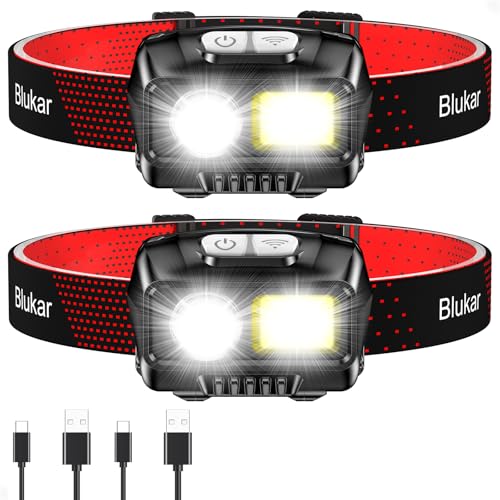 Blukar LED Headlamp Rechargeable
- 【Super Bright and Stepless Dimming】Adopts first-class LED chips,…
- 【8 Lighting Modes and Motion Sensor】5 normal modes:…
- 【Rechargeable and IPX5 Waterproof】Built-in 1200mAh large-capacity battery, easily…
 ATFIXM Rechargeable Headlamp
- Super Bright & Motion Sensor: Equipped with brightness-upgraded…
- Adjustable & 6 Lighting Modes: Bright headlamp features…
- Lightweight & Comfortable Wearing: Designed with an ultra-light…
| Product | Key specs | |
|---|---|---|
| LHKNL Headlamp Flashlight | Long Press Function and Motion Sensor: Unlike the… Super Bright and Rechargeable: The headlamp flashlight camping… Ultra-light and Adjustable: The hand-free headlamp is only… | Check price |
| Blukar LED Headlamp Rechargeable | 【Super Bright and Stepless Dimming】Adopts first-class LED chips,… 【8 Lighting Modes and Motion Sensor】5 normal modes:… 【Rechargeable and IPX5 Waterproof】Built-in 1200mAh large-capacity battery, easily… | Check price |
| ATFIXM Rechargeable Headlamp | Super Bright & Motion Sensor: Equipped with brightness-upgraded… Adjustable & 6 Lighting Modes: Bright headlamp features… Lightweight & Comfortable Wearing: Designed with an ultra-light… | Check price |
 LHKNL Headlamp Flashlight LHKNL Headlamp Flashlight | Long Press Function and Motion Sensor: Unlike the… Super Bright and Rechargeable: The headlamp flashlight camping… Ultra-light and Adjustable: The hand-free headlamp is only… | Check price |
As an Amazon Associate we earn from qualifying purchases at no extra cost to you.
Quick picks by situation
| Situation | Prioritise | Spec target | Typical price range |
|---|---|---|---|
| Trail running, road running | Weight, beam width, no bounce | Under 80 g, 300–600 lm, 60–90° flood | $45–$120 |
| Car camping, backpacking | Runtime at low modes, red light, hybrid battery | 20+ h at 30–50 lm, IPX4 or better | $40–$90 |
| Electrician / industrial | Regulated output, hard-hat mount, non-metallic clips | 500–1,000 lm, IP54+, swap-in cell | $70–$150 |
| Mechanic / auto tech | Flood beam, chemical resistance, magnetic charging | 400–800 lm, 90° flood, IP67 | $60–$140 |
| Winter and cold-weather use | Rear-mounted cell, cable option, Li-ion not alkaline | Any output, cell kept warm | $60–$180 |
| Emergency kit / power outage | Long shelf life, standard cells, pass-through charging | Low-mode runtime measured in days | $30–$80 |
| Hazardous locations (ATEX / Class I Div 1) | Intrinsic safety certification | Certified body, sealed cell | $200–$500 |
How to Read a Headlamp Spec Sheet Without Getting Fooled
Lumens measure total light output in every direction the lamp emits. They say nothing about how far the light travels. A 1,000-lumen flood lamp and a 1,000-lumen spot lamp put out the same total light, but the spot concentrates it into a cone maybe 15° wide while the flood spreads it across 90°. On a trail at night, the flood is more useful. On a fence line 80 m away, the spot is.
Throw is measured in candela, and the industry standard (ANSI/PLATO FL1) defines “beam distance” as the point where illuminance drops to 0.25 lux — roughly the light of a full moon on a clear night. Because light falls off with the square of distance, beam distance is proportional to the square root of candela:
Beam distance (m) = 2 × √candela
That single formula explains why doubling candela only adds about 41% more reach, and why the jump from a 400-lumen lamp to a 1,500-lumen lamp rarely feels four times better.
| Peak intensity (candela) | Calculated beam distance | Typical beam angle | What it realistically lights up |
|---|---|---|---|
| 400 cd | 40 m | 80–100° flood | Camp site, tent interior, cooking area |
| 1,600 cd | 80 m | 50–70° hybrid | Running trail, walking pace on rough ground |
| 4,000 cd | 126 m | 30–45° hybrid | Fast running, bike commuting, close work inspection |
| 10,000 cd | 200 m | 15–25° spot | Trail markers, animals at the treeline, attic rafters |
| 25,000 cd | 316 m | 10–15° spot | Search-and-rescue sweeps, distant structures |
| 40,000 cd | 400 m | 8–12° spot | Specialist long-throw lamps only |
Two caveats matter more than the numbers. First, beam distance is quoted at peak intensity, which usually means turbo mode — the mode that runs for 60 to 180 seconds before thermal regulation kicks in. Second, a lamp with a 100 m rating may only hold that intensity for a fraction of its runtime. A lamp with a 60 m rating that holds it for six hours is often the better tool.
The Runtime Math Nobody Prints on the Box
Battery energy is the hard ceiling on everything. A single 18650 lithium-ion cell rated 3,500 mAh at 3.6 V holds 12.6 watt-hours. A modern LED plus driver converts roughly 90–120 lumens per watt at low and medium outputs, dropping to 60–80 lumens per watt at maximum. That gives you a usable budget of roughly 900–1,100 lumen-hours from one quality 18650 — meaning 1,000 lumens for about an hour, or 100 lumens for about 10 hours, or 30 lumens for more than a day.
| Output setting | Approx. power draw | Runtime, one 3,500 mAh 18650 | Runtime, 1,250 mAh built-in pack |
|---|---|---|---|
| 30 lm | 0.3 W | 35–40 h | 11–13 h |
| 100 lm | 1.0 W | 11–12 h | 3.5–4 h |
| 250 lm | 2.3 W | 5–5.5 h | 1.5–1.8 h |
| 500 lm | 4.5 W | 2.5–2.8 h | 45–55 min |
| 1,000 lm | 11 W | 55–70 min (with step-down) | 20 min or less |
| 1,500 lm+ | 18 W+ | 25–35 min before throttling | Not achievable |
This is why the small, light lamps people love for running are the wrong choice for an eight-hour shift, and why a work lamp with a 12.6 Wh cell is genuinely worth carrying at 150 g instead of 60 g. If you need light for a full shift, do the arithmetic before you buy: multiply the lumens you actually want by the hours you need, and compare the result to 900–1,100 lumen-hours per 18650.
Batteries and Charging Ports: The Decision That Outlives the Lamp
Rechargeable headlamps come in four battery architectures, and this choice affects you more than any lumen figure.
| Architecture | Typical capacity | Swap time | Strengths | Weaknesses |
|---|---|---|---|---|
| Built-in sealed pouch cell | 1,000–3,000 mAh | None — not user-replaceable | Lightest, cheapest, most waterproof | Lamp dies with the cell; 300–500 charge cycles |
| Manufacturer-specific rechargeable pack | 1,250–3,000 mAh | 10–20 seconds | Swap mid-shift, sealed connector, decent weight | Proprietary; replacement packs cost $20–$40 |
| Standard 18650 / 21700 li-ion | 2,600–5,000 mAh | 10–30 seconds | Cheapest per watt-hour, widely available, highest energy density | Heavier lamp, needs a charger or in-lamp charging, cells must be matched |
| Hybrid: rechargeable pack plus AAA/AA tray | Varies | 15–40 seconds | Emergency fallback anywhere on earth | Alkaline sags badly in cold and at high drain |
On charging ports, USB-C is now the default on anything designed in the last few years, and it is worth paying a premium for. Three reasons: the connector is rated for roughly 10,000 insertions versus about 5,000 for micro-USB, the cable is the same one your phone uses, and USB-C Power Delivery can charge a 3,500 mAh cell in roughly 1.5–2 hours instead of the 4–5 hours a 1 A micro-USB port takes. If a lamp still ships with micro-USB, that tells you the platform is a few years old.
Two features are worth hunting for. Pass-through charging lets the lamp run while plugged into a power bank, which effectively converts a 10,000 mAh power bank into a 36 Wh external battery — around three extra full charges. Port flaps are the number one failure point on wet-weather lamps: a rubber flap that has lost its tension after two winters will let water in even on an IPX7-rated body. Look for a recessed port with a captive gasket rather than a flat flap.
Weather Resistance: What IP Ratings Actually Promise
| Rating | Test condition | Real-world meaning |
|---|---|---|
| IPX4 | Splashing water, 10 minutes, any direction | Rain and sweat are fine. Do not drop it in a stream. |
| IPX6 | Powerful water jets, 3 minutes | Heavy rain, hose spray, boat spray |
| IPX7 | Immersion at 1 m for 30 minutes | Dropped in a puddle or shallow creek, retrievable |
| IP54 | Dust protected, splashing water | Dusty job sites, light rain |
| IP67 | Dust tight, immersion 1 m / 30 min | The practical sweet spot for trade and outdoor use |
| IP68 | Dust tight, immersion deeper or longer per manufacturer | Read the fine print — the depth and duration vary by brand |
IP ratings say nothing about drops, salt-water corrosion, or solvent exposure. For coastal and saltwater use, rinse the lamp in fresh water after each trip and dry the headband separately — the elastic and the neoprene padding degrade faster in salt than the electronics do.
Cold weather changes the arithmetic
| Temperature | Li-ion usable capacity | Alkaline AAA capacity | NiMH capacity |
|---|---|---|---|
| +20 °C | 100% | 100% | 100% |
| 0 °C | 90–95% | 80–85% | 90% |
| −10 °C | 75–85% | 50–60% | 75% |
| −20 °C | 60–70% | 25–40% | 55–65% |
The practical fix is simple: keep the cell warm. A lamp with a rear-mounted battery sits against the back of your skull under a hat, which is the warmest part of the head. A lamp with the cell in the front housing sits in the coldest air. Failing that, carry a spare cell in an inside jacket pocket and swap when output starts sagging — a warm cell recovers most of its capacity, while a cold one appears “dead” and recovers fully once warmed.
Weight and Comfort: The Numbers Behind Bounce
Weight is the single best predictor of whether you’ll actually wear a headlamp for four hours. The thresholds are consistent across designs:
| Total weight | Headband needed | Running | All-day work | Notes |
|---|---|---|---|---|
| Under 50 g | Single elastic band, 18–25 mm | Excellent | Poor — small cell | Runtime capped at 3–5 h at useful output |
| 50–100 g | Single band, 25–32 mm, silicone grip strip | Excellent to good | Fair | The practical sweet spot for most buyers |
| 100–180 g | Top strap recommended | Acceptable, mild bounce | Good | Rear-mounted battery improves balance markedly |
| 180–300 g | Top strap essential, or hard-hat clips | Not recommended | Excellent | Best energy-to-cost ratio of any class |
| 300 g+ | Hard hat or helmet mount | No | Excellent, stationary | Usually multi-cell or intrinsically safe |
Three comfort details matter more than raw grams. Strap width: a 38 mm band spreads pressure across the occipital bone and is dramatically more comfortable over six hours than a 20 mm band, even at identical weight. Silicone grip strips: the inside of the band should have them; without them the lamp slides on a hard hat, on a beanie, and on a sweaty forehead. Front-to-back balance: a lamp with the battery at the back sits far more stably than one with all the mass up front, which is why rear-battery designs feel lighter than they measure.
If you wear a hard hat, check the mounting method before anything else. Adhesive mounts are permanent and fail in heat; clip mounts are removable but only fit specific shell slots; strap mounts fit almost anything but can interfere with a chin strap. For electrical work, choose non-metallic clips and a lamp that does not compromise the shell’s electrical class rating — adding a headlamp does not upgrade a hard hat, and a metal bracket can create a path you don’t want.
The Lamps, One by One
The sections below cover the models that define each category. Manufacturer figures are quoted as class ratings and vary by mode, cell age, and temperature; treat them as comparison anchors rather than promises. Prices are general market ranges in US dollars.
1. Petzl Actik Core — the default all-rounder
- Rated output: 600-lumen class
- Beam: roughly 95 m, hybrid spot/flood
- Weight: about 75 g with the Core pack
- Battery: rechargeable Core pack (about 1,250 mAh) or 3 × AAA
- Weather: IPX4
- Price range: $65–$85
If you want one lamp that does camp chores, a night hike, and a car emergency kit without thinking about it, this is the shape to buy. The hybrid battery architecture is the selling point: the Core pack recharges over USB, and if it dies at 11 p.m. you drop in three AAA cells from a petrol station. Output is genuinely usable rather than turbo-inflated, and the red mode is bright enough to read a map without waking a tentmate.
The trade-offs are real. At 1,250 mAh the pack holds roughly 4.5 Wh, so at a true 100 lumens you get about 3.5–4 hours — not enough for a full work shift. IPX4 means rain is fine and submersion is not. And because Petzl has shipped both micro-USB and USB-C versions of the Core battery across revisions, confirm which connector your unit has before buying a spare cable.
2. Petzl Swift RL — reactive lighting for runners
- Rated output: 1,100-lumen class
- Beam: roughly 150 m
- Weight: about 100 g
- Battery: USB-charged Core pack
- Weather: IPX4
- Price range: $120–$150
The distinctive feature is reactive lighting: a sensor reads reflected light and automatically drops output when you look at something close and raises it when you look into the distance. In practice this stretches runtime considerably, because you are not manually toggling between modes on a climb. For technical trail running where you need both hands and full attention, that automation is worth the price.
The cost is complexity and a sealed battery you cannot swap mid-run. If you’re doing multi-hour night races, a lamp with a swappable cell is the more robust choice; if you’re doing 60–90 minute evening runs, this class is close to ideal. Weight at about 100 g is right at the edge of noticeable bounce — the band design manages it, but it is not a featherweight.
3. Petzl Iko Core — the lightest serious option
- Rated output: 500-lumen class
- Beam: roughly 100 m
- Weight: about 79 g
- Battery: USB-charged Core pack
- Weather: IPX4
- Price range: $90–$110
The Iko Core uses a thin, semi-rigid band with a split rear section rather than a traditional wide elastic strap, which distributes load without a top strap. The result is a lamp that disappears on your head — a genuine advantage for runners and for anyone wearing a lamp over a hat or a thin beanie.
Two honest limitations. First, the thin band has less surface area, so it can dig in if you wear it over a bare head for many hours. Second, the sealed pack cannot be swapped, so long unsupported outings need a power bank and a cable. Treat it as a fast-and-light lamp, not an expedition lamp.
4. Petzl NAO RL — the premium reactive model
- Rated output: 1,500-lumen class
- Beam: roughly 200 m
- Weight: about 145 g
- Battery: USB-C charged pack, app-configurable
- Weather: IPX4
- Price range: $170–$200
This is the class where you pay for configurability. Output profiles can be adjusted through a phone app, which lets you trade peak brightness for runtime in ways the preset modes don’t allow. For someone who runs the same technical loop three nights a week and wants the lamp tuned to exactly that terrain, the tuning is genuinely useful.
At about 145 g it needs the top strap, and IPX4 is modest at this price. It is also overkill for camping. Buy it if you have a specific, repeatable use case; skip it if you want a general-purpose lamp.
5. Black Diamond Spot 400-R — best value in the mid-range
- Rated output: 400-lumen class
- Beam: roughly 100 m
- Weight: about 78 g
- Battery: rechargeable pack or 3 × AAA
- Weather: IPX8
- Price range: $55–$70
The standout number here is IPX8 in a sub-$70 lamp. Immersion at 1 m for 30 minutes is a meaningful upgrade over IPX4 for anyone who wades, kayaks, or works in wet conditions. It also carries red, green, and blue secondary modes — green and blue are useful for preserving night vision and for not spooking wildlife.
Output at 400 lumens is modest, and the beam is tuned toward a broad, useful pattern rather than distance. Runtime on the rechargeable pack is the limiting factor: expect roughly 3–4 hours at 100 lumens. The hybrid AAA tray is the insurance policy that makes it a sensible travel lamp.
6. Black Diamond Storm 500-R — the weatherproof step up
- Rated output: 500-lumen class
- Beam: roughly 120 m
- Weight: about 105 g
- Battery: rechargeable pack or 3 × AAA
- Weather: IP67
- Price range: $70–$90
IP67 plus a hybrid battery plus a slightly larger pack makes this the best general-purpose outdoor lamp for wet climates. The dust-tight rating matters more than people expect — fine dust from a trail or a job site works into switchgear and causes the intermittent failures that make a lamp unreliable.
At about 105 g it benefits from a top strap for running, and the extra weight is noticeable compared to the sub-80 g class. For hiking, camping, and wet-weather work, that trade is worth it.
7. Black Diamond Icon 700 — long runtime, higher weight
- Rated output: 700-lumen class
- Beam: roughly 140 m
- Weight: about 200 g
- Battery: rechargeable pack (about 1,800 mAh) or 4 × AA
- Weather: IP67
- Price range: $100–$130
The larger pack roughly triples the low-mode runtime compared with the 1,250 mAh class, which is the whole point. At a genuine 50 lumens you’re looking at well over a full night of use, and the four-AA fallback means you can run it for days with disposable cells in an emergency.
At 200 g this is not a running lamp. It’s a winter camping, caving, night-fishing, or extended-work lamp, and it wants the top strap. The rear-mounted battery improves balance, but you will feel it after a few hours if the band isn’t snug.
8. Nitecore NU25 — the running and fastpacking benchmark
- Rated output: 360-lumen class
- Beam: roughly 120 m
- Weight: about 30 g for the body, 50–55 g complete with band
- Battery: built-in, USB-C
- Weather: IP66
- Price range: $35–$50
This is the lamp that made sub-60 g credible. The body is tiny, USB-C is standard, and the beam pattern is broad enough for trail running at moderate pace. IP66 covers heavy rain and hose spray.
The built-in cell is small — roughly 3–4 hours at 100 lumens and considerably less at higher settings — so this is a lamp for two-hour runs and weekend overnights, not for all-night efforts. It also has no swappable cell, which is the price of the weight. If you want the same form factor with a swap-in battery, look at the next entry.
9. Nitecore UT27 — dual-beam trail running with swappable cells
- Rated output: 800-lumen class
- Beam: dual — wide flood plus a spot to roughly 150 m
- Weight: about 75 g with cells
- Battery: two swappable proprietary cells or 3 × AAA
- Weather: IP66
- Price range: $60–$80
The dual-beam layout is the right answer for night running: a wide flood for foot placement and a spot you can bring up for route-finding, without having to choose one. The two swappable cells mean you can carry a spare pair and effectively double runtime without a power bank.
The proprietary cell format is the weak point — you’re buying replacements from one supplier rather than using standard 18650s. The AAA fallback covers emergencies but sags quickly at high output.
10. Nitecore HC65 v2 — high output in a small package
- Rated output: 1,750-lumen class
- Beam: roughly 150 m plus wide flood and red secondary
- Weight: about 90–100 g with cell
- Battery: one swappable 18650
- Weather: IP68 class
- Price range: $80–$100
A swappable 18650 in a 100 g lamp is the best energy-to-weight ratio in this roundup. Carry one spare cell and you have 25 Wh — roughly 2,000 lumen-hours — in a package that weighs less than a paperback. The 1,750-lumen turbo is a burst mode for a few minutes at most, but the 400–600 lumen sustained output is genuinely usable for hours.
IP68 is a strong claim for a lamp with a charging port; keep the flap gasket clean. The interface is dense, with multiple sub-modes accessed by long and short presses — a real annoyance with gloves on until you memorise it.
11. Fenix HM65R-T — the durability pick
- Rated output: 1,500-lumen class
- Beam: roughly 170 m
- Weight: about 146 g with cell
- Battery: one swappable 18650, USB-C charging
- Weather: IP68
- Price range: $110–$140
A magnesium alloy body, IP68 sealing, USB-C, and a swappable 18650 make this the most robust general-purpose lamp here. The dual-emitter design gives you a flood and a spot you can run independently or together, which is exactly what you want when you’re moving between reading a panel up close and looking down a corridor.
At 146 g it wants the top strap, and the metal body is cold against the forehead in winter — a thin liner helps. It is heavier and more expensive than a plastic lamp with the same output, and you’re paying for the housing, not the lumens.
12. Fenix HM50R v2 — light, tough, pocketable
- Rated output: 700-lumen class
- Beam: roughly 100 m
- Weight: about 80 g with cell
- Battery: one swappable 16340 li-ion, USB-C
- Weather: IP68
- Price range: $60–$80
This is the lamp for someone who wants Fenix build quality at a running-friendly weight. The 16340 cell is smaller than an 18650 — around 2.9