Key takeaways
- 【Perfect for Diy Glam Hollywood Light up Mirror】If…
- 【Professional Lights for Mirror】Different than other normal ones…
- 【Stepless Dimming】Vanity lights for mirror are controlled by…
The best bathroom mirrors with LED lighting are chosen by vanity width first, then by color accuracy, anti-fog performance, dimming, and whether your wall can support hardwired installation.
Best bathroom mirrors with LED lighting by situation
| Your situation | Best choice | Specifications to prioritize |
|---|---|---|
| Small apartment bathroom | Compact rectangular or pill-shaped mirror | 24–30 inches wide, front-lit LEDs, plug-in cord, shallow depth |
| Double vanity | One wide mirror or two matching mirrors | 60–72 inches total width, 90+ CRI, separate dimming if possible |
| Children or pets at home | Tempered-glass, rounded-corner mirror | Safety backing, concealed controls, moisture-resistant rating |
| Renter | Plug-in mirror with a nearby outlet | UL-listed power supply, cable channel, no wall opening required |
| Makeup or shaving priority | Front-lit mirror with adjustable white light | 90–95 CRI, 3,000–4,000K range, uniform edge-to-edge illumination |
| Dark, windowless bathroom | Large backlit and front-lit combination | High lumen output, dimming memory, anti-fog pad covering the center |
How wide should a bathroom mirror be?
For the most balanced appearance, choose a mirror that is about 2–6 inches narrower than the vanity. A 36-inch vanity therefore suits a 30–34-inch mirror, while a 48-inch vanity generally works with a 42–46-inch mirror. Leaving a small margin on each side keeps the mirror from looking crowded and leaves room for wall sconces or toiletries.
Our top picks
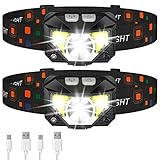
 Blikshin LED Vanity Mirror Lights
- 【Perfect for Diy Glam Hollywood Light up Mirror】If…
- 【Professional Lights for Mirror】Different than other normal ones…
- 【Stepless Dimming】Vanity lights for mirror are controlled by…
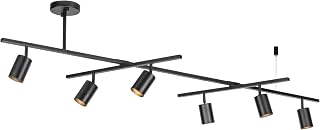
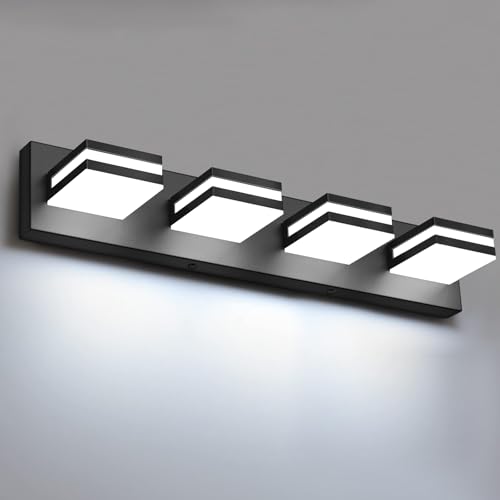 IZORRO LED Modern Bathroom Lights Fixtures
- Modern Design : The 4-light bathroom light fixtures…
- Premium LEDs & Dimmable: Flicker-free beads emit vibrant…
- 360° Rotatable: This LED black vanity light offers…
As an Amazon Associate we earn from qualifying purchases at no extra cost to you.
A mirror can be wider than the vanity, but it should not collide visually with adjacent walls, cabinets, or a shower enclosure. In a compact bathroom, measure the usable wall—not merely the vanity. Keep at least 2 inches from a side wall where possible, and allow approximately 6–8 inches between the mirror and a tall cabinet or open shelving.
For a double vanity, two mirrors often provide better task lighting than one very wide unit. Two 24-inch mirrors suit many 60-inch vanities, with roughly 4–6 inches between them. A single 60-inch mirror creates a cleaner modern look, but its center may sit behind the faucet gap and its electrical installation can be more demanding.
Height and clearance measurements that matter
Place the mirror so the main users can see their eyes comfortably without bending. A common installation places the bottom edge 5–10 inches above the backsplash, although vessel sinks may require more clearance. Leave at least 1–2 inches between the top of the faucet or backsplash and the mirror frame to simplify cleaning and prevent visual crowding.
Before ordering, check the mirror’s actual height against ceiling lights, medicine cabinets, and door swing. In an 8-foot bathroom, a 36-inch-tall mirror usually leaves practical space above for a light fixture. A 48-inch-tall model may fit, but only if the vanity top is low and the ceiling fixture is not directly above it.
Color temperature and CRI: the specifications that change how you look
Color temperature describes whether the LEDs appear warm or cool. Around 2,700–3,000K produces a soft, warm light that suits traditional bathrooms but can make white makeup, clothing, and skin tones look warmer. Around 3,500–4,000K is a useful middle range for grooming. Light above 5,000K can appear stark and bluish, especially in a small bathroom.
For makeup, skincare, shaving, and hair coloring, prioritize a color-rendering index of 90 or higher. CRI measures how faithfully light reveals colors; a mirror advertised only as “bright white” may still have mediocre color accuracy. If the listing provides an R9 value, a positive or high R9 is useful because red tones affect how skin and cosmetics appear.
Light direction matters as much as the number. Backlighting creates an attractive halo but may leave your face shadowed. Front-lit LEDs, or a mirror combining front and back illumination, put light on the face more effectively. Even diffusion is preferable to exposed LED dots, which can produce glare and harsh shadows.
Anti-fog pads: useful, but not a substitute for ventilation
An anti-fog pad is a heated section behind the glass that keeps a defined area clear after a hot shower. Look for the pad’s approximate coverage rather than assuming the entire mirror is heated. Many models clear only the central portion, so a large 48-inch mirror may still have fogged edges.
For a 30–36-inch mirror, a pad roughly 12–20 inches wide is generally practical for face-level viewing. A larger bathroom mirror benefits from a wider or dual-pad design. A wall switch or touch control that operates the heater independently from the LEDs is preferable: you can use the light without wasting energy on heat.
Anti-fog performance depends on bathroom humidity. Run the exhaust fan during the shower and for about 20 minutes afterward, keep the fan ducted outdoors, and avoid covering the mirror with towels. Heating the mirror does not correct condensation caused by inadequate ventilation.
Dimming and controls: what to look for
Choose continuous dimming rather than a simple bright/dim toggle. A useful mirror should become bright enough for detailed grooming but dim enough for nighttime use. Touch controls are convenient, although they can be difficult to activate with wet hands or when the glass is covered in steam.
- Memory function: Restores your preferred brightness and color temperature after switching the mirror off.
- Independent controls: Let you operate lighting and anti-fog heating separately.
- Color-temperature adjustment: Useful when the bathroom serves both morning grooming and relaxing evening routines.
- Physical wall switch compatibility: Better for households that do not want to touch the glass.
- Motion sensors: Convenient, but less predictable around pets, children, or a frequently used bathroom.
Some LED mirrors advertise smart-home compatibility. Treat it as an extra rather than a reason to compromise on CRI, diffusion, electrical certification, or serviceability. LED strips and control boards are the components most likely to need replacement over many years, so check whether replacement parts are available.
Hardwired versus plug-in installation
| Installation type | Best for | Advantages | Limitations |
|---|---|---|---|
| Plug-in | Renters and simple remodels | Fast installation; no new circuit or wall opening | Visible cord unless routed through a channel; outlet must be nearby |
| Hardwired | Permanent renovations and clean visual designs | No visible cord; wall switch can control the mirror | Requires electrical work and correct junction-box placement |
| Convertible | Homeowners who want flexibility | Can often be configured for either connection method | Installation instructions must be followed precisely; conversion may void coverage if done incorrectly |
A plug-in mirror is not automatically safe for a wet bathroom. Use a model with appropriate electrical certification and connect it to a properly protected bathroom receptacle, commonly a GFCI-protected outlet. Keep the plug, adapter, and excess cable away from the sink basin and areas where water can splash.
Hardwired installation should be performed by a qualified electrician. The electrician may need to install or reposition a junction box, confirm circuit capacity, and connect the mirror according to its voltage and wattage requirements. Do not assume that an existing light box can support the mirror’s weight or electrical load.
Construction, weight, and moving realities
LED mirrors combine glass, a metal or composite rear housing, heating elements, wiring, and sometimes a thicker aluminum frame. A 30-inch model may weigh roughly 15–30 pounds; a wide 60-inch model can weigh 35–70 pounds or more. Confirm the manufacturer’s stated weight and mounting requirements before selecting drywall anchors.
For a heavy mirror, fasten the mounting bar to wall studs where possible. If the studs do not align, use anchors rated above the mirror’s full weight, not merely its shipping weight, and follow the supplied spacing instructions. Never hang a large illuminated mirror from a single basic picture hook.
Measure doorways, stair turns, and the bathroom entrance before delivery. A boxed 60-inch mirror may be 65–75 inches long and several inches wider and deeper than the finished product. Carry large mirrors vertically with two people; laying them flat during transport can increase the chance of flexing and glass damage.
A practical buying checklist
- Measure vanity width, wall width, backsplash height, ceiling height, and nearby cabinets.
- Choose a mirror 2–6 inches narrower than the vanity unless a deliberately oversized design is planned.
- Target 3,000–4,000K for versatile bathroom lighting and CRI 90 or higher for accurate grooming.
- Confirm whether anti-fog heating covers the viewing area and whether it has a separate control.
- Verify continuous dimming, power-on memory, and switch compatibility.
- Decide whether a visible cord is acceptable before choosing plug-in or hardwired installation.
- Check weight, mounting hardware, electrical certification, moisture guidance, warranty terms, and replacement-part availability.
The best bathroom mirrors with LED lighting are not necessarily the largest or brightest. The right choice fits the vanity with deliberate clearances, shows skin and colors accurately, clears the part of the glass you actually use, dims comfortably, and matches the electrical work your bathroom can support.