To choose a refrigerator, measure the opening and the path to it first, pick the layout that matches how you shop and cook, then match capacity and ice-maker style to your household. A fridge that fails on size cannot be fixed later, so the tape measure comes before any feature list. This guide walks through how to choose a refrigerator for your kitchen in the order the decisions actually bite: doorways and clearances, depth style, layout, capacity, ice and water, and running-cost details.
Our top picks
 Samsung 29 Cu. Ft. Bespoke 4-Door French
- Customize the design of your french door french…
- Quick access to refreshingly cool, filtered water two…
- With 29 cu


As an Amazon Associate we earn from qualifying purchases at no extra cost to you.
Key takeaways
- Measure the cabinet opening, the doorway, the stair turns and the door swing before looking at models.
- Depth style decides how the kitchen looks and how much aisle you keep: standard depth is roomiest, counter-depth is flush but smaller inside.
- Plan roughly 4 to 6 cubic feet of fresh-food and freezer space per adult, then adjust for bulk shopping and entertaining.
- Ice makers add cost, noise and a water-line requirement; decide whether you need in-door ice and water or a simple in-freezer maker.
- Always confirm clearances and delivery dimensions on the maker’s spec sheet for the exact model.
Step 1: Measure before you shop
Most returns and delivery failures come from three numbers that were never checked. Write them down before you open a single product page.
- Opening width, height and depth. Measure at the narrowest point, not at the front edge. Measure the width at the top, middle and bottom of the cabinet gap, because walls and cabinets are rarely square.
- Clearance for airflow. Most manuals ask for a small gap at the sides, top and back so the condenser can shed heat. Typical guidance is about an inch on the sides and top and a bit more at the back, but the exact figure is in the owner’s manual or spec sheet for that model, so use it instead of a rule of thumb.
- The delivery path. Measure every doorway, hallway, stair turn and elevator on the route. Add up the narrowest point and compare it with the product’s shipping width and depth, not only the cabinet dimensions. Doors can usually be removed to gain a few inches; ask the retailer or check the manual for how.
- Door swing. Open the fridge in your mind. French doors need less swing room than a single wide door, but a fridge placed beside a wall or an island still needs the door to open far enough to pull drawers out. Check the minimum swing clearance on the spec sheet.
A quick measuring table
| What to measure | Where | Why it matters |
|---|---|---|
| Opening width | Top, middle, bottom of the gap | Smallest reading is your limit |
| Opening height | Floor to underside of cabinet | Hinges and top vents need extra room |
| Opening depth | Wall to cabinet face and to island edge | Decides standard versus counter-depth |
| Doorways | Narrowest point on delivery route | Fridge must pass through, often with doors off |
| Floor to ceiling | At the fridge location | Tall models need space to tilt in |
| Water line | Distance to the nearest cold line | Needed for in-door dispensers and some ice makers |
Step 2: Standard depth versus counter-depth
Depth style is the choice people notice most in the finished kitchen. A standard-depth fridge usually sticks out past the cabinet faces, while a counter-depth model is designed to sit closer to flush with the countertop edge. Counter-depth cabinets are typically in the mid-20-inch range without doors and handles, and standard-depth cabinets are deeper, but the real number differs by model, so check the depth with handles and doors included.
The trade-off is simple. Counter-depth looks tidier and keeps the walkway clear in a galley or an open-plan kitchen. The cost is interior volume: with less depth, makers usually make the unit wider or taller to compensate, or accept a smaller capacity. If you want the largest possible interior for the footprint, standard depth wins. If aisle space and a built-in look matter more, counter-depth is worth the smaller interior.
Real examples from current listings show the pattern. The Kenmore 17.5 cu. ft. 30-inch French door counter-depth model, the Hamilton Beach HBF1770 French door counter-depth refrigerator at 17.7 cu. ft., and the GE GYE22GYNFS 36-inch counter-depth French door with 22.1 cu. ft. total capacity all use the extra width to claw back volume. Compare those numbers with a standard-depth French door such as the Midea MRF29D6AST at 29.3 cu. ft. and you can see how much capacity depth style can cost.
Step 3: Pick the layout that fits how you cook and shop
Layout controls how easy it is to see food, how much freezer you can reach, and how wide an aisle you need.
- Top freezer. Simple, usually the lowest cost, and efficient for the size. The fresh-food section sits at chest height or lower, which means more bending for vegetables.
- Bottom freezer. Puts fresh food at eye level and the freezer in a drawer or pull-out basket. Good if you open the fridge many times a day and the freezer once or twice.
- Side by side. Narrow doors suit tight aisles, and a column of freezer at eye level is convenient. The narrow compartments can struggle with a wide pizza box or a sheet cake, so measure your largest items.
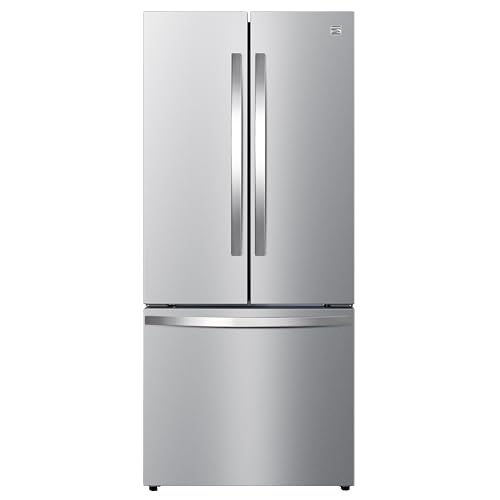
- French door. Two narrow fresh-food doors over a freezer drawer. The wide shelves fit platters and trays, and only a narrow door swings into the room. Usually the most capacity per footprint among the family styles.
- Compact and under-counter. Best for offices, bars, garages and secondary kitchens, not as a main fridge for a family.
Which layout for which kitchen
| Your situation | Layout to start with | Watch out for |
|---|---|---|
| Narrow galley, tight aisle | French door or side by side | Door and drawer clearance on both sides |
| Lots of fresh produce, small freezer needs | Bottom freezer | Freezer drawer limits tall items |
| Bulk shopper with a chest freezer elsewhere | Top freezer or French door | Do not pay for freezer volume you will not use |
| Rental or first apartment | Top freezer in standard depth | Check elevator and stair turns first |
| Open-plan kitchen with island | Counter-depth French door | Smaller interior than the width suggests |
| Basement, garage or bar | Compact or garage-ready unit | Check the temperature range on the spec sheet |
Step 4: Work out the capacity you need
Refrigerator capacity is quoted in cubic feet, and a common planning rule is about 4 to 6 cubic feet for each adult in the household, with a little extra for guests or bulk buying. A couple often does well in the mid-teens, while a family of four tends to look at the low-to-mid 20s. Treat these as starting points, then adjust to your habits.
- Add space if you cook from scratch, meal-prep in bulk, or host regularly.
- Subtract space if you live near a grocery store and shop several times a week.
- Remember that the headline cubic feet is the total, including the freezer. Check how the maker splits fresh-food and freezer volume.
- Rated capacity is not usable capacity. Door bins, crisper drawers and ice-maker buckets use volume you may not count when planning.
Examples of the range in current listings: the Sharp SJB1045SNS at 10.3 cu. ft. in a 24-inch counter-depth two-door body is a small-household or secondary-fridge size, the Hamilton Beach HBF2067 French door at 20.3 cu. ft. is a mid-range family size, and the Kenmore 26.6 cu. ft. 36-inch French door is the large end. Confirm the exact dimensions on the maker’s page before you decide.
Step 5: Ice maker and water dispenser types
Ice and water are where model prices and repair risks diverge most. The three common setups work quite differently.
- No ice maker. The cheapest option and the fewest parts to fail. You fill trays by hand. Reasonable for singles, couples and rentals.
- In-freezer ice maker. Makes ice in the freezer and drops it into a bin you scoop from. Needs a water line, takes freezer space, and the bin can clump if ice sits a long time.
- In-door ice and water dispenser. Dispenses cubes or crushed ice and filtered water through the door. Very convenient, but it needs a cold-water line, adds a filter to replace on a schedule, and the door and dispenser components add cost and potential service calls. The Kenmore 26.6 cu. ft. French door in listings, for example, is described with an internal ice and water dispenser.
Before choosing an ice-maker model, confirm that a 1/4-inch cold water supply is reachable behind the fridge location, and check whether the manual allows a flexible line to the length you need. Also read the filter replacement interval and part cost, since filters are a recurring expense.
Step 6: Features worth paying for, and ones to skip
Worth it
- Frost-free operation. Saves manual defrosting in all but the simplest compact units.
- Adjustable shelves and spill-proof glass. Lets you reconfigure around tall bottles and cakes.
- Door-ajar alarm. A cheap feature that prevents a warm fridge and spoiled food.
- Reversible or flexible door swing. Useful when the hinge side needs to match the wall.
- Separate temperature zones or a dedicated drawer. Helpful for deli meat, produce and drinks if you will really use them.
Often not worth it
- Screens, cameras and app control, unless you will genuinely use them. They add a possible failure point.
- Very large ice dispensers if you rarely use ice.
- Extra modes with fancy names that do the same job as a normal setting.
Step 7: Energy use and noise
Look for the yellow EnergyGuide label and the annual kilowatt-hour figure, and compare similar sizes rather than different capacities. A model that uses a little more power but has the layout you need is better than an efficient fridge that does not fit your food. Also consider where the fridge sits: an open-plan kitchen makes compressor noise more noticeable, and models with variable-speed compressors are often quieter, although the spec sheet or manual should state the claim. Plan on a dedicated outlet, and avoid long extension cords.
Warm garages and unheated basements are a special case. Many standard refrigerators are rated for room temperature and can struggle at the extremes. If the unit will live in a garage, look for a model that says garage-ready on its spec sheet, as the Sharp SJB1255GS counter-depth two-door in the listings does.
Step 8: Delivery, installation and the warranty
- Ask whether the retailer will remove the old unit and whether they remove doors if needed.
- Leave the new fridge standing upright for the period the manual recommends before plugging in, usually several hours, so the oil can settle in the compressor.
- Level the unit using the front feet, with a very slight tilt back so doors close on their own.
- Flush the water line and discard the first batches of ice, as the manual instructs.
- Register the product and note the warranty length for the sealed system and the parts separately.
Common mistakes to avoid
- Choosing by width alone and forgetting handles and door swing.
- Assuming a counter-depth fridge gives the same capacity as a standard-depth one.
- Ignoring the water line when ordering an ice and water model.
- Buying more freezer than the household uses and paying for the extra volume.
- Forgetting the delivery route, especially stair turns and tight doorframes.
- Leaving no ventilation gap and then wondering why the compressor runs constantly.
Gear that helps
- Hamilton Beach HBF1770 French door counter-depth refrigerator · 17.7 cu. ft. · French door with freezer drawer · counter-depth · stainless steel finish
- Kenmore 17.5 cu. ft. 30-inch French door refrigerator · counter-depth · ice maker · stainless finish · narrower 30-inch body for tighter openings
- Sharp SJB1045SNS 24-inch 2 door refrigerator · 10.3 cu. ft. · counter-depth · narrow footprint for small spaces
These are examples of how depth, width and capacity trade against each other, not a ranking. Confirm exact dimensions and clearances on each maker’s page.
FAQ
What size refrigerator do I need for a family of four?
A common rule of thumb is about 4 to 6 cubic feet per adult plus extra for children and bulk shopping, so many four-person households look at roughly the low-to-mid 20s in cubic feet. Check that the shelves fit your tallest items rather than relying on the number alone.
Is counter-depth worth it?
Counter-depth is worth it if a flush look and a clearer aisle matter more than interior volume. If you want the largest interior for the money, standard depth gives more capacity.
How much clearance does a refrigerator need?
It varies by model, but manuals typically call for a small gap around the sides, top and back for airflow. Use the figure in the owner’s manual for your exact model.
Do I need a water line for an ice maker?
Yes, in-freezer ice makers and in-door dispensers normally connect to a cold water line. If you do not have one nearby, a model without an ice maker is simpler.
French door or side by side?
French door suits wide items and gives more capacity per footprint, while side by side suits very narrow aisles and puts the freezer at eye level. Measure your largest platters and boxes before deciding.
How long does a refrigerator last?
Typical lifespans are measured in a decade or more, but they depend on the model, usage and maintenance. Cleaning the condenser coils and replacing filters on schedule helps, as does leaving the recommended clearance.
Can I put a regular refrigerator in a garage?
Only if the spec sheet says it is rated for that temperature range. Some are designed as garage-ready; most standard models are not.
The bottom line
Start with the tape measure, choose the depth style and layout that suit the room, size the interior to your shopping habits, and add an ice and water dispenser only if you will use it. A plain, correctly sized refrigerator in the right layout beats a feature-packed one that does not fit the opening or the delivery route.
More from Amazon
Programs that pair well with the guide above. Offers and eligibility are set by Amazon and may change.
Collect the home and kitchen items you want in one registry that guests can shop from.
Create a wedding registrySet up recurring deliveries of everyday items on eligible products. Terms and savings are set by Amazon.
Explore Subscribe & SaveFree shipping on eligible items, Prime Video and more. Eligible new members can start with a free trial.
Start a Prime free trialAudiobooks and podcasts to listen to on the go. Eligible new members can start with a free trial.
Try Audible freeAs an Amazon Associate we earn from qualifying purchases.