Key takeaways
- Discover the best wood bathroom vanities for warm, durable style. Compare solid teak vanities, sizes, finishes, and moisture tips before you buy.
A wood bathroom vanity does something few other materials can: it makes a bathroom feel warm, lived-in, and intentional instead of sterile. Stone and laminate have their place, but wood brings grain, texture, and a furniture-like presence that turns a purely functional fixture into the visual anchor of the room. The catch is that bathrooms are wet, steamy places, and not every piece of wood furniture belongs in one. The best wood bathroom vanities are built from the right species, dried and sealed properly, and designed with the realities of splashes, steam, and daily use in mind.

This guide focuses only on wood vanities — vanity cabinets and furniture made from solid wood or genuine wood construction, with or without a sink or top. It does not cover metal, glass, or all-laminate cabinets. Every vanity below is a wood bathroom vanity first, and each one is judged on the things that matter most in a bathroom: the wood itself, moisture resistance, storage, build quality, and size.
As an Amazon Associate, we earn from qualifying purchases made through links on this page, at no extra cost to you.
How These Vanities Were Verified
Every product in this article was checked against its Amazon listing before publication. Direct loads of the Amazon product pages returned access errors, so each ASIN below was verified by Amazon search corroboration instead: a web search for the exact ASIN returned the Amazon US listing with the matching product name, model number, dimensions, and specifications. None of the products in this article were verified by a live Amazon page load, and availability can change, so confirm that a listing is in stock on Amazon before ordering.
1. EcoDecors Curvature 36-Inch Solid Teak Bathroom Vanity
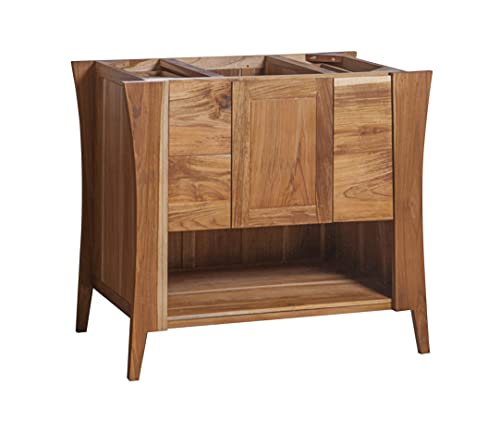
The EcoDecors Curvature is the strongest argument for choosing teak in a bathroom. It is built from 100 percent solid plantation-grown teak, with no veneers and no particleboard anywhere in the construction. Teak is one of the few woods that genuinely tolerates moisture: its natural oils resist water, and it has been used for boat decks and outdoor furniture for generations. That makes a solid teak vanity a very different proposition from a vanity that only looks like wood on the outside.
At 36 inches wide, this is a comfortable single-sink size for a main bathroom or a generous powder room. The signature detail is the curved front door, which softens the boxy look most vanities have and gives the piece a furniture-like quality. Soft-close drawers keep the storage quiet and prevent slamming, and the cabinet arrives pre-assembled, so there is no flat-pack build to wrestle with on installation day. An exposed back panel makes plumbing access easier, which your installer will appreciate.
This is a vanity base designed for a vessel or bowl sink, so the sink and faucet are separate purchases. That is actually an advantage if you want to choose your own vessel: the teak top acts as a warm counter for a ceramic, stone, or glass bowl. Just be sure to seal the wood around the sink area and wipe up standing water, as you should with any wood vanity.
Key specs:
- Material: 100 percent solid plantation-grown teak, no veneer or particleboard
- Dimensions: 36 inches wide x 21.25 inches deep x 32 inches high
- Weight: 90 pounds
- Model number: CT-BT-36-1
- Storage: Soft-close drawers with a decorative curved front door
- Assembly: Arrives pre-assembled
- Sink compatibility: Designed for vessel or bowl sinks
- Finish: Natural teak
- ASIN: B07GJPHBW6
Best for: Homeowners who want a genuine solid-wood vanity in a main bathroom and are willing to pair it with a vessel sink of their choosing.
Pros:
- True solid teak construction, not a wood-look wrap over composite board
- Teak’s natural oils give it real moisture resistance for a bathroom setting
- Pre-assembled, with an open back panel that simplifies plumbing hookups
- The curved door front adds character that plain slab-front vanities lack
- Soft-close drawers protect the cabinet from daily wear
Cons:
- Sold as a vanity base only, so a sink, faucet, and drain must be bought separately
- At 36 inches wide and 90 pounds, it needs a clear wall run and a solid floor
- The natural teak finish will change tone over time if it is not resealed occasionally
- A single size in this line, so it cannot stretch to a double-sink layout
2. EcoDecors Significado 24-Inch Solid Teak Bathroom Vanity
Small bathrooms punish bad material choices faster than large ones: steam concentrates, splashes land closer to the cabinet, and there is less air circulation to dry things out. The EcoDecors Significado in its 24-inch size is built for exactly that situation. Like its larger sibling above, it is made from 100 percent solid teak with no veneers or particleboard, so the moisture resistance is in the wood itself rather than in a coating that can peel.
The compact footprint is the point here. At 24 inches wide and 21.25 inches deep, it fits powder rooms, guest baths, and small ensuites where a standard 30- or 36-inch vanity would crowd the door swing or the toilet clearance. Inside, it still manages two drawers and two shelves behind soft-close doors, which is a respectable amount of storage for a cabinet this size. It arrives as a single pre-assembled piece with a stained natural teak finish that shows off the grain.
This is also a vanity base meant to be paired with a vessel sink. In a small bathroom that pairing works well: a compact bowl sink on a teak top reads as intentional and airy, where a bulky integrated top can make a tight room feel cramped. Keep the footprint in mind when choosing the vessel, though — an oversized bowl will overhang a 24-inch cabinet and steal counter space you do not have.
Key specs:
- Material: 100 percent solid teak wood, no veneer or particleboard
- Dimensions: 24 inches wide x 21.25 inches deep x 32 inches high
- Weight: 60 pounds
- Model number: ST-BT-24-1
- Storage: Two soft-close drawers and two shelves behind soft-close doors
- Assembly: Arrives pre-assembled
- Sink compatibility: Designed for vessel or bowl sinks
- Finish: Stained natural teak
- ASIN: B07CPYY9BP
Best for: Powder rooms, guest bathrooms, and small ensuites where a full-size vanity will not fit but solid wood is still the goal.
Pros:
- Genuine solid teak in a genuinely small footprint — a rare combination
- Soft-close doors and drawers throughout, even at this compact size
- Two drawers plus two shelves give a small bath real storage
- Lighter and easier to maneuver into a tight room than larger solid-wood pieces
- The stained natural finish highlights the teak grain
Cons:
- The 24-inch width limits counter space and rules out large vessel sinks
- Sink, faucet, and drain are not included
- Only one sink position, so it cannot serve a shared double-bathroom layout
- Teak needs occasional resealing to keep its color and water resistance at their best
Wood Bathroom Vanity Buying Guide
Solid wood versus veneer and engineered wood
The single most important decision is what the cabinet is actually made of. Solid wood means the panels, drawer boxes, and frames are cut from real lumber. Veneer means a thin layer of real wood glued over a core of MDF or particleboard, and engineered wood usually means the whole cabinet is composite board with a printed or laminated finish. In a bathroom, that distinction matters more than anywhere else in the house. If water gets past a veneer edge or into an unsealed composite core, the board swells, and the damage is permanent. Solid wood can absorb a splash, dry out, and recover. That does not make solid wood waterproof — no wood is — but it makes it far more forgiving. When a listing says “wood” without specifying, check the material details: look for the species name, whether drawer boxes are solid, and whether the words MDF or particleboard appear anywhere.
Which wood species hold up best
Teak is the standout for bathrooms because its natural oils repel water and resist rot, which is why it shows up in boatbuilding and outdoor furniture. Oak is strong, widely available, and takes stain well, but it needs a good seal on every surface, including the undersides and interiors that never get seen. Maple is hard and smooth with a clean, modern grain, though it can show water marks if the finish wears thin. Walnut brings rich color and a premium look but is softer than oak or maple and shows dings more easily. Pine and other softwoods are affordable and charming in a rustic or farmhouse bathroom, but they dent easily and demand diligent sealing. Whatever species you choose, the finish is half the product: a catalyzed varnish, marine-grade polyurethane, or a hardwax oil that is rated for wet areas will protect far better than a thin decorative lacquer.
Size and layout
Measure three things before you shop: the width of the wall run, the depth you can afford before the vanity blocks foot traffic or the door swing, and the height that works for the people using it. Standard vanity height is around 32 to 34 inches before the sink, and vessel sinks add several inches on top, so tall users may prefer a taller cabinet while a household with children may want something lower. Width is usually the binding constraint. A 24-inch vanity suits a powder room, 30 to 36 inches is the standard single-sink size, 48 inches gives a roomy single or a tight double, and 60 inches and up is true double-sink territory. Leave at least a few inches of clearance on each side for cleaning, and check that drawers can open fully without hitting the toilet or the door.
Sink and top compatibility
Wood vanities come in three basic configurations: a base only, a base with a top, or a complete set with sink and faucet included. A base-only vanity gives you the most freedom — you choose the vessel, undermount, or drop-in sink — but it also means more separate purchases and more coordination with your plumber. A vanity with an included top, usually stone or engineered quartz, simplifies installation and protects the wood beneath the sink, which is the wettest zone of all. If you go the vessel route, confirm the cabinet depth can support the bowl you want, and check whether the top is pre-drilled for your faucet or whether the faucet mounts to the wall or the vessel itself.
Storage that actually works in a bathroom
Open the product photos and look past the styling. Soft-close hinges and drawer slides are worth having in a room where doors get opened with wet hands dozens of times a day. Full-extension drawers let you reach the back without emptying the front. An open back panel or a U-shaped drawer around the drain trap keeps plumbing from eating your storage. And think about what you actually store: tall bottles need vertical clearance, while linens and spare rolls are better in a deep cabinet than in a shallow drawer.
Moisture protection and care
Even the best wood vanity needs a little routine care in a bathroom. Run the exhaust fan during and after showers so steam does not condense on the cabinet. Wipe up splashes and standing water rather than letting them sit, especially around the sink and along the bottom edge where water collects. Reseal or re-oil the top surface once a year, or sooner if water stops beading on it. Keep the cabinet off direct contact with a wet floor by checking that the feet or plinth are intact, and never store dripping items inside a closed drawer. None of this is onerous — it is the same care any good piece of wood furniture asks for — but it is what separates a vanity that looks great in year ten from one that swelled in year two.
Style: matching wood to the room
Wood vanities span nearly every bathroom style. Natural teak and light oak suit spa-like, Scandinavian, and coastal rooms. Dark walnut or espresso-stained oak anchors a traditional or moody bathroom. A whitewashed or weathered finish fits farmhouse and cottage styles, while a flat-panel slab-front vanity in rift-sawn oak reads as clean and contemporary. Let the wood tone set the palette: warm woods pair well with brass and matte black fixtures, while cooler, gray-washed woods sit comfortably with chrome and nickel. If the rest of the room is already busy with patterned tile, a quiet, straight-grained vanity will calm it down; if the room is plain, the vanity’s grain can carry the visual interest.
Frequently Asked Questions
Is solid wood a good choice for a bathroom vanity?
Yes, with the right species and finish. Solid wood tolerates the humidity and splashes of a bathroom far better than particleboard or MDF, which swell irreversibly when water reaches their core. Teak, oak, and maple are the most reliable choices. The key is a moisture-resistant finish on all surfaces, including hidden ones, plus basic habits like running the exhaust fan and wiping up standing water.
What is the difference between solid wood and wood veneer vanities?
A solid wood vanity is built from real lumber throughout the cabinet, including drawer boxes and frames. A veneer vanity has a thin layer of real wood over a composite core. Veneer can look identical from the front and costs less, but if water penetrates an edge or a seam, the core swells and the veneer can bubble or peel. Solid wood costs more up front and is more forgiving over a long, damp life.
Do wood bathroom vanities need a sink included?
Not necessarily. Many wood vanities are sold as a base only, designed to pair with a vessel, undermount, or drop-in sink that you choose separately. This gives you more control over the final look and lets you match the sink to the room. Vanities sold with a top and sink included are simpler to install and protect the wood under the wettest area, so they are a good choice if you want a single, coordinated purchase.
How do I protect a wood vanity from water damage?
Start with a vanity that has a proper moisture-resistant finish, then maintain it. Use the bathroom exhaust fan during and after showers, wipe up splashes promptly, and reseal or re-oil the top at least once a year. Check the finish where the sink meets the wood and along the bottom edges, since those are the places water reaches first. Avoid leaving wet items sitting on the wood for long periods.
What size wood vanity should I buy?
Match the vanity to the room, not to a catalog photo. A 24-inch vanity fits a powder room or very small bath. A 30- to 36-inch vanity is the standard single-sink size for most bathrooms. A 48-inch vanity gives a generous single sink with extra counter space, and 60 inches or more is needed for a comfortable double sink. Always measure the wall, the door swing, and the clearance to the toilet before ordering.
Can a wood vanity work with a vessel sink?
Yes, and it is one of the most popular pairings. A vessel sink sits on top of the wood, which turns the vanity top into a display surface and makes the wood grain part of the design. Make sure the cabinet is deep and wide enough for the bowl you choose, confirm the height is comfortable once the vessel is added, and keep the wood around the sink well sealed.
How long do wood bathroom vanities last?
A well-built solid wood vanity in a ventilated bathroom can last decades — often outliving the faucet and the sink it was paired with. Longevity depends on the species, the quality of the joinery and finish, and routine care. Composite vanities tend to fail first at the bottom edges and around plumbing penetrations, which is exactly where solid wood holds its advantage.
Conclusion
The best wood bathroom vanities earn their place by being honest about their material. Solid teak, like the two EcoDecors vanities in this guide, brings genuine moisture resistance to a room that punishes lesser materials, and it does so while looking like furniture rather than a fixture. The 36-inch Curvature is the pick for a main bathroom where presence and storage matter, while the 24-inch Significado proves that a small bathroom does not have to settle for composite board.
Whichever wood vanity you choose, let the material lead the decision: confirm it is solid wood rather than veneer over composite, pick a species and finish rated for wet areas, measure the space twice, and plan for the sink configuration before you order. Do that, and a wood vanity will be the warmest, longest-lasting piece in the room — and the one guests notice first.
More from Amazon
Programs that pair well with the guide above. Offers and eligibility are set by Amazon and may change.
Collect the home and kitchen items you want in one registry that guests can shop from.
Create a wedding registrySet up recurring deliveries of everyday items on eligible products. Terms and savings are set by Amazon.
Explore Subscribe & SaveFree shipping on eligible items, Prime Video and more. Eligible new members can start with a free trial.
Start a Prime free trialAudiobooks and podcasts to listen to on the go. Eligible new members can start with a free trial.
Try Audible freeAs an Amazon Associate we earn from qualifying purchases.