Key takeaways
- Find the best scope for long range shooting with a clear guide to magnification, focal plane, turrets and reticles, plus one verified non-Vortex pick.
As an Amazon Associate we earn from qualifying purchases.
Long range shooting asks more of a riflescope than almost any other kind of shooting. At a few hundred yards and beyond, small errors in magnification choice, turret tracking, reticle design and parallax control stop being minor annoyances and start deciding whether a shot lands where it was aimed. A scope that feels perfectly adequate on a short-range hunting rifle can hold a shooter back badly on a precision course, and a scope built for distance work brings features — a first focal plane reticle, exposed dialling turrets, generous elevation travel and side-focus parallax adjustment — that simply do not exist on simpler optics.
This guide is written for the brand-general question: what makes a scope genuinely good for long range shooting, regardless of badge? It walks through each decision in the order a buyer should make it, explains the trade-offs behind the headline specifications, and then profiles one verified long range scope in detail. The pick below is deliberately drawn from outside the single-brand coverage already published elsewhere, so readers comparing guides get a genuinely different product to consider rather than the same shortlist repeated. Every specification in the product section is taken from that product’s own Amazon US listing, and the listing link and ASIN are included so the details can be checked directly before buying.
A note on honesty about scope: long range means different things to different shooters. For some it starts where their hunting shots end; for others it means deliberate work at distances where wind reading matters as much as marksmanship. The guidance below is framed around the second group — target and precision shooting at extended distances — because that is the use case that drives the strictest requirements. Hunters who occasionally stretch a shot will still find the same framework useful, but they may reasonably trade some of the features discussed here for lighter weight and a simpler reticle.
Disclosure: This article contains affiliate links. If you buy through these links, we may earn a commission at no additional cost to you.
How to Choose a Scope for Long Range Shooting
Start with magnification range, not maximum power
The first number most buyers look at is the top magnification, and it is the wrong place to start. What matters is the whole range and how the scope behaves across it. Long range work rewards a wide zoom ratio: a low end low enough to find targets and manage mirage on hot days, and a high end high enough to resolve small targets and spot shot placement at distance. A 6-24x range, like the pick below, is a classic long range format precisely because it covers both ends of that problem. Very high maximum power is not automatically better — at extreme magnification, mirage, a narrow field of view and a dimmer image can make a scope harder to use, not easier. Choose a range that matches the distances and target sizes actually shot, and treat anything beyond that as weight and cost carried for no benefit.
First focal plane versus second focal plane
This is the defining choice in a long range scope. In a first focal plane (FFP) scope, the reticle grows and shrinks with magnification, so its measurement marks — the hash marks used to hold for elevation and wind — stay accurate at every power setting. In a second focal plane (SFP) scope, the reticle stays the same size and its marks are only accurate at one nominated magnification, usually the maximum. For deliberate long range shooting, where a shooter may dial or hold at whatever magnification suits the conditions, FFP is the safer and simpler system: the reticle can be trusted everywhere in the range. SFP still suits set-and-forget hunting, but for a dedicated long range scope, FFP should be the default assumption unless there is a specific reason to choose otherwise.
Turrets: exposed, repeatable and matched to the reticle
Long range shooters dial elevation constantly, so the turrets are not a detail — they are the mechanism the whole discipline runs on. Look for exposed turrets with clear, tactile and audible clicks, a zero stop that lets the shooter return to a confirmed zero quickly and without counting, and click values that match the reticle’s units. That last point matters more than it first appears: if the reticle is graduated in MIL, the turrets should adjust in MIL (commonly 0.1 MIL per click), and if the reticle is in MOA, the turrets should adjust in MOA. Mixed systems force mental conversion under pressure and invite errors. Total elevation travel matters too, because a scope mounted for distance work must have enough internal adjustment to reach the farthest intended target without running out of clicks; generous travel figures, stated in the listing, are a genuine long range credential rather than a marketing extra.
Reticle design for holding and dialling
A long range reticle needs more than a crosshair. Graduated hash marks below the centre give holdover references for shots taken without dialling, marks along the horizontal axis give wind holds, and a fine centre aiming point avoids covering small distant targets. Illumination is a genuine help in low light or against dark backstops, provided it can be turned low enough not to wash out the target. Etched-glass reticles, as used in the pick below, hold up under recoil and keep their markings crisp at high magnification. What to avoid is a reticle so fine it disappears in poor light, or so coarse that its centre obscures the very targets long range shooting is about.
Objective lens, tube diameter and glass quality
A larger objective lens — 50 mm is typical in this class — gathers more light and supports the high end of the magnification range with a brighter, more resolvable image. Tube diameter matters because a 30 mm tube, the standard for dedicated long range scopes, provides more internal room for elevation travel than a 1-inch tube and matches the wide availability of precision rings. Glass quality and coatings decide how much of the light gathered actually reaches the eye with contrast intact; fully multi-coated optics are the expected baseline here. None of these numbers replaces looking at how a scope resolves detail at distance, but together they separate purpose-built long range optics from general-purpose scopes stretched beyond their design.
Parallax adjustment and eye relief
At long range, parallax error — the apparent shift of the reticle against the target when the eye moves — can move a group without the shooter changing anything. A side-focus parallax control, adjustable from close range out to infinity, is therefore standard equipment on a serious long range scope; it also doubles as a rough focus control for the target image. Eye relief around the familiar three-inch-plus figure keeps the scope usable under recoil, and a consistent eye position behind the scope makes both parallax control and reticle holds more repeatable. When comparing listings, confirm that parallax adjustment is present and note its stated range; its absence is a sign the scope was designed for shorter work.
Weight, length and mounting reality
Long range scopes are not light, and pretending otherwise leads to bad builds. A scope in this class commonly weighs around two pounds and runs roughly fourteen inches long, which affects rifle balance, ring height and how the rifle carries. Check the listing’s stated weight and dimensions against the rifle it will live on, confirm the objective diameter will clear the barrel with the intended rings, and make sure the mounting system matches the tube diameter. None of this is glamorous, but a scope that cannot be mounted at the right height with a comfortable eye position will never shoot to its specification sheet.
The Verified Pick
Athlon Optics Argos BTR GEN2 6-24×50 Riflescope — APMR FFP IR MIL
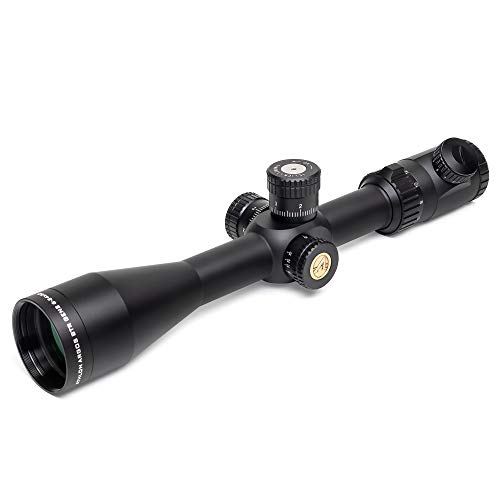
- Listing: https://www.amazon.com/dp/B082978NWJ
- Brand: Athlon Optics
- Model: 214063 (Argos BTR GEN2 6-24×50, Direct Dial, Side Focus, 30 mm, FFP, APMR IR — MIL)
The Athlon Argos BTR GEN2 6-24×50 is a purpose-built long range scope from a brand other than the one covered in single-brand roundups of this topic, which makes it a useful independent reference point for buyers comparing guides. Its specification reads like a checklist of the criteria set out above. The 6-24x magnification range covers the full span of long range work, from finding targets and managing mirage at the low end to resolving small targets at the high end. The 50 mm objective lens supports that top magnification with the light gathering a precision scope needs, and the scope is built on a 30 mm aluminium tube — the diameter that gives a dialling scope room for useful elevation travel and matches standard precision mounting hardware.
The reticle is the heart of this model. The listing states a first focal plane reticle of the APMR type, graduated in MIL and illuminated, which means its holdover and wind marks remain valid at every magnification setting in the 6-24x range — exactly the behaviour the how-to-choose section argues a long range scope should have. An FFP MIL reticle pairs naturally with MIL turret adjustments for dialling elevation, keeping the reticle and the turrets in one unit system so holds and dialled corrections agree with each other. The model name on the listing also confirms the supporting hardware a long range shooter expects: direct-dial turrets and a side-focus control for parallax correction, rather than a fixed-parallax design intended for shorter distances.
The physical specifications from the listing are honest long range numbers. The scope weighs 30.3 ounces and measures 14.1 x 2.2 x 1.8 inches, with a package weight of 1.5 kilograms — substantial, as a 6-24×50 FFP scope should be, and a figure to plan ring height and rifle balance around rather than a surprise on delivery. Construction is aluminium, the finish is black, the stated compatible device is a rifle, and the listing’s included components are the rifle scope itself, under part number 214063. Buyers should confirm on the live listing which mounting hardware, if any, is included, since rings are a separate decision matched to the rifle and the 30 mm tube.
Who should choose this scope? A shooter building or upgrading a dedicated long range or precision rifle who wants the defining features of the discipline — FFP reticle, MIL graduations, dialling turrets, side-focus parallax and a wide 6-24x range — in one coherent specification, and who wants a pick that does not simply repeat a single-brand shortlist. Who should look elsewhere? A hunter who wants the lightest possible carrying rifle and a simple duplex reticle for shots at ordinary distances will find this scope heavier and more specialised than that job requires, and a shooter committed to MOA units throughout should choose an MOA-graduated model instead of converting systems. Within its intended role, though, the Argos BTR GEN2’s listing states exactly the combination of features this guide recommends checking for, which is why it stands as the verified pick here.
Comparison Table
| Product | Magnification | Objective | Tube | Focal plane | Reticle | Weight | ASIN |
|---|---|---|---|---|---|---|---|
| Athlon Optics Argos BTR GEN2 6-24×50 | 6-24x | 50 mm | 30 mm | First focal plane | APMR IR MIL, illuminated | 30.3 oz | B082978NWJ |
Only one product is listed because only one non-Vortex long range scope could be fully verified against Amazon US product information at the standard this guide requires — an observed amazon.com/dp listing with the product’s own specification content and no unavailability notice. Rather than pad the table with unverified models, the table records the verified pick alone; its specification can be checked line by line against the buying criteria above and against the live listing before purchase.
Frequently Asked Questions
What magnification do I actually need for long range shooting?
Enough to resolve the target and see shot placement at the farthest distance regularly shot, and no more. A 6-24x range is a proven format because its low end stays usable for target finding and mirage, while its high end supports precision work at distance. Buying maximum power for its own sake adds weight, narrows the field of view and can make mirage worse.
Why does first focal plane matter so much?
Because the reticle’s measurement marks stay accurate at every magnification. In a first focal plane scope the reticle scales with the image, so a hold that reads correctly at one power reads correctly at all of them. In a second focal plane scope the marks are only true at one setting, which is an easy thing to forget at the worst moment.
Should the turrets and reticle use MIL or MOA?
Either system works; mixing them does not. Choose one unit and keep the reticle graduations and turret clicks in it, so a correction read off the reticle can be dialled directly without conversion. The verified pick above is a MIL scope — APMR MIL reticle on a 30 mm tube — so it suits a shooter standardising on MIL.
Is a 30 mm tube necessary for long range shooting?
It is the practical standard for this class of scope. A 30 mm tube gives more internal room for elevation travel than a 1-inch tube and matches the widest choice of precision rings. What ultimately matters is the scope’s stated total elevation travel and whether it reaches the farthest intended distance from a confirmed zero.
What does side-focus parallax adjustment do?
It lets the shooter focus the target image and remove parallax error — the apparent reticle shift that occurs when the eye is not perfectly centred — at the distance being shot. At long range that error is large enough to matter, so an adjustable side focus, typically running from close range to infinity, is standard equipment on a dedicated long range scope such as the pick above.
Can one scope cover both hunting and long range target work?
It can, with compromises understood. A 6-24×50 FFP scope like the verified pick weighs 30.3 ounces and carries features a walk-and-stalk hunter may never use. If the rifle’s main job is precision shooting at distance, that weight buys real capability; if the rifle is carried all day and shot at ordinary distances, a lighter, simpler scope is usually the better tool.
Conclusion
Choosing the best scope for long range shooting is mostly a matter of matching systems rather than chasing a single headline number: a magnification range that covers the distances actually shot, a first focal plane reticle whose marks can be trusted at any power, turrets that dial repeatably in the same units as that reticle, enough elevation travel to reach the far target, and side-focus parallax control to keep the reticle honest. The Athlon Optics Argos BTR GEN2 6-24×50 (ASIN B082978NWJ) states that combination on its own Amazon US listing — 6-24x magnification, 50 mm objective, 30 mm tube, FFP APMR IR MIL reticle, direct-dial turrets and side focus, at 30.3 ounces — and it does so as a genuinely different, non-single-brand option for buyers comparing long range guides. Check the live listing to confirm the specification and availability before buying, mount it in rings matched to its 30 mm tube, confirm zero, and the scope will be doing the job it was specified for.
More from Amazon
Programs that pair well with the guide above. Offers and eligibility are set by Amazon and may change.
Collect the home and kitchen items you want in one registry that guests can shop from.
Create a wedding registrySet up recurring deliveries of everyday items on eligible products. Terms and savings are set by Amazon.
Explore Subscribe & SaveFree shipping on eligible items, Prime Video and more. Eligible new members can start with a free trial.
Start a Prime free trialAudiobooks and podcasts to listen to on the go. Eligible new members can start with a free trial.
Try Audible freeAs an Amazon Associate we earn from qualifying purchases.