Key takeaways
- Lift capacity vs. loaded weight: Drawers add mass before you fill them. Check the rated capacity and mentally subtract the cabinet, then confirm the motor still has headroom for two monitors and a stack of files.
- Height floor and ceiling: A 27.9″ low end matters if you’re under 5’4″ or want a comfortable seated typing posture; a 46″+ top end matters if you’re over 6′. Ranges vary more than spec sheets suggest.
- Depth over width: Anything shallower than 24″ struggles with a monitor arm and a keyboard. A 30″ top gives you room to lean back and read a screen properly.
- Cable strategy: Look for a routing tray, grommets, and onboard AC/USB. Without them, a moving desk turns every cable into a tether you’ll be untangling weekly.
- Finish honesty: Rustic brown and walnut laminates hide fingerprints and scuffs; white and fluted fronts photograph beautifully but demand upkeep. Choose for your habits, not your mood board.
What's inside
The drawer is where most sit-stand setups quietly fall apart. A bare adjustable slab looks immaculate in a showroom, then real life arrives: chargers, notebooks, a label maker, three years of tax paperwork. The usual fix is a filing cabinet parked underneath, which immediately becomes the thing your desk collides with on the way down. Storage that travels with the desktop solves the problem at the root, and in 2026 there are finally enough well-built options to be picky about which one you bring home.
This guide looks at electric standing desks that integrate drawers into the moving frame, judged the way a designer would judge any piece of case goods: proportion, surface quality, hardware feel, and how gracefully the cabling disappears. I’ve flagged which models suit a small bedroom corner, which read as genuine executive furniture, and which earn their footprint in an L-shaped layout. Below are the current standouts.
As an Amazon Associate we earn from qualifying purchases.




How to Choose a Standing Desk With Drawers (2026)
- Lift capacity vs. loaded weight: Drawers add mass before you fill them. Check the rated capacity and mentally subtract the cabinet, then confirm the motor still has headroom for two monitors and a stack of files.
- Height floor and ceiling: A 27.9″ low end matters if you’re under 5’4″ or want a comfortable seated typing posture; a 46″+ top end matters if you’re over 6′. Ranges vary more than spec sheets suggest.
- Depth over width: Anything shallower than 24″ struggles with a monitor arm and a keyboard. A 30″ top gives you room to lean back and read a screen properly.
- Cable strategy: Look for a routing tray, grommets, and onboard AC/USB. Without them, a moving desk turns every cable into a tether you’ll be untangling weekly.
- Finish honesty: Rustic brown and walnut laminates hide fingerprints and scuffs; white and fluted fronts photograph beautifully but demand upkeep. Choose for your habits, not your mood board.
The Best Standing Desks With Drawers, Reviewed
AODK 55″ Standing Desk with Drawers & Keyboard Tray
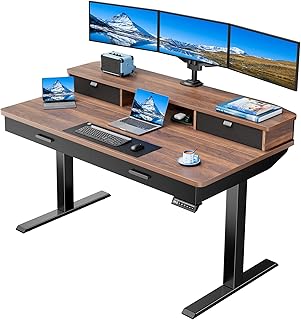
The most complete package at its size: drawers, a pull-out keyboard tray, monitor riser, integrated outlet, and LED accent lighting, all on a 29.9″–46.1″ frame with three memory presets. The rustic brown finish keeps the feature list from reading as gimmicky, and the keyboard tray genuinely improves seated ergonomics.
HUANUO 55 x 30″ Electric Standing Desk with 4 Drawers
My pick for anyone who actually works at their desk all day. The 30″ depth is the differentiator, giving you proper viewing distance and space for a monitor mount, while grommet routing and a cable tray keep the walnut top clean. A 27.9″–46.8″ range covers nearly every body type.
SEDETA 55.1″ Farmhouse Executive Standing Desk
The design-forward option: white farmhouse detailing, three drawers, a storage cabinet, and built-in outlets that let it sit in a living room without announcing itself as office equipment. Best suited to lighter setups and households willing to wipe down a pale finish.
59″ Electric Standing Desk with 8 Drawers
This is furniture, not a workstation accessory. Eight drawers plus a file cabinet, a keyboard tray, AC/USB, fluted panel detailing, and a privacy panel add up to a desk that can replace an entire wall of storage in a dedicated home office. Measure carefully and plan on help during assembly.
63″ L-Shaped Standing Desk with 4 Drawers
The smartest use of a corner on this list, with a reversible orientation so it works against either wall and four drawers plus outlets to keep the surface clear. Ideal for dual-monitor or creative setups where you need one zone for screens and another for physical work.
Frequently Asked Questions
Do drawers make a standing desk less stable?
Not inherently. A well-engineered dual-motor frame with a rigid cabinet often feels steadier than a bare single-column desk, because the cabinet resists lateral flex. Wobble usually traces back to under-tightened hardware or an uneven floor.
How much weight can I keep in the drawers?
Treat the stated lift capacity as your total budget, including the cabinet itself. Files and books are heavier than people expect, so keep dense items in the lowest drawer and avoid loading past roughly two-thirds of the rating.
Is a keyboard tray still worth having?
Yes, if you spend real time seated. It lets you drop your hands below desk height for a neutral wrist angle, which a fixed top can’t do without lowering your monitors uncomfortably.
How difficult is assembly?
Expect 60 to 120 minutes and a second pair of hands. Drawer units ship pre-assembled or semi-assembled, but the tops are heavy, and flipping a completed frame alone is where damage happens.
Final Thoughts
For most people, the HUANUO 55 x 30″ is the best balance of working depth, height range, and cable discipline. Choose the AODK 55″ if you want the widest feature set in a compact footprint, or the 59″ eight-drawer model if you’re furnishing a real office and want the desk to carry the storage load on its own.