Key takeaways
- Recline range and lock type: A stated 135° means little without an infinite lock. Multi-position or infinite-lock mechanisms let you settle at 110° for reading and 130° for a break; simple two-stage tilts tend to leave you between useful angles.
- Lumbar geometry: Look for lumbar support that moves vertically, not just in and out. Torso length varies far more than height does, and a fixed pad placed wrong is worse than none at all.
- Armrest clearance: Flip-up arms are the single most useful feature in a small room. They let the chair tuck fully under a desk, which visually returns floor space and keeps a work zone from dominating a living area.
- Seat width and material honesty: Wide seats invite cross-legged sitting but eat visual real estate. Mesh recedes and breathes; PU leather anchors a room and wipes clean but runs warm through summer.
- Weight rating as a proxy for build: A 400 lb rating signals a reinforced base, thicker gas lift, and heavier steel frame. Even for lighter users, that overhead translates directly into how the chair feels in year three.
What's inside
The reclining office chair sits in an awkward spot in most homes. Buyers want the ability to tip back and decompress between calls, but the category has split into two unappealing extremes: racing-inspired chairs upholstered in bright vinyl, and conventional task chairs whose tilt function amounts to a few degrees of wobble. Meanwhile the home office has quietly merged with the guest room, the dining nook, the corner of a living room. The chair no longer hides behind a closed door, so it has to hold its own visually while still doing the ergonomic work of a full recline.
This guide narrows the field to reclining chairs that actually recline, meaning locking mechanisms that hold an open angle under load rather than springing back the moment you shift. We looked at seat architecture, lumbar adjustability, armrest behavior in tight rooms, weight ratings, and how each chair reads as an object in a shared space. Below are the picks worth your attention in 2026, followed by the specifications that matter and the ones that are mostly marketing.
As an Amazon Associate we earn from qualifying purchases.


How to Choose a Reclining Office Chair (2026)
- Recline range and lock type: A stated 135° means little without an infinite lock. Multi-position or infinite-lock mechanisms let you settle at 110° for reading and 130° for a break; simple two-stage tilts tend to leave you between useful angles.
- Lumbar geometry: Look for lumbar support that moves vertically, not just in and out. Torso length varies far more than height does, and a fixed pad placed wrong is worse than none at all.
- Armrest clearance: Flip-up arms are the single most useful feature in a small room. They let the chair tuck fully under a desk, which visually returns floor space and keeps a work zone from dominating a living area.
- Seat width and material honesty: Wide seats invite cross-legged sitting but eat visual real estate. Mesh recedes and breathes; PU leather anchors a room and wipes clean but runs warm through summer.
- Weight rating as a proxy for build: A 400 lb rating signals a reinforced base, thicker gas lift, and heavier steel frame. Even for lighter users, that overhead translates directly into how the chair feels in year three.
The Best Reclining Office Chairs (2026) Reviewed
Executive Mesh Chair with Flip-Up Arms
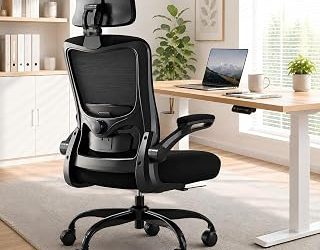
This is the quiet one, and that is the point: a breathable mesh back, adjustable lumbar block, and a 400 lb frame in a silhouette restrained enough to live beside a sofa. The flip-up arms let it disappear under a desk, making it the strongest choice for open-plan rooms where the chair is always in view.
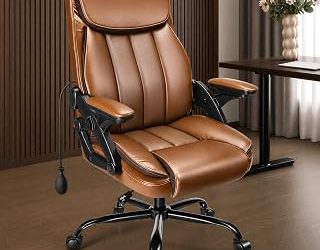
FelixKing PU Leather Office Chair
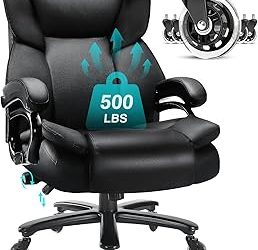
FelixKing delivers the traditional executive look without the bulk that usually comes with it, and the padded PU surfaces give a room a warmer, more furnished quality than mesh can. Best suited to cooler spaces or shorter sitting stretches, since leather-look upholstery holds heat over a long afternoon.
Ergonomic Chair with Footrest and 3D Massage Lumbar Support
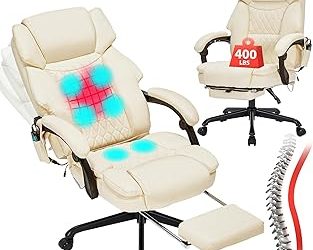
The most feature-dense pick here: adjustable seat depth, adjustable back height, 4D headrest and armrests, plus a retractable footrest and a massage lumbar unit. Genuine seat depth adjustment is rare at this price and matters enormously for taller sitters, though the sheer number of levers makes this a chair for people who enjoy dialing things in.
High Mesh Back Chair with Footrest and 135° Recline
A thickened seat cushion under a tall mesh back gives this one the best long-session balance in the group, with a 135° recline and footrest that make it a legitimate nap chair. The 400 lb rating and 4D armrests place it above most similarly priced mesh chairs on structure alone.
Big and Tall Crystal Velvet Reclining Chair
The velvet upholstery reads as furniture rather than office equipment, and the extra-wide seat genuinely accommodates cross-legged sitting. Flip-up arms also make it the most pet-tolerant chair here, which matters more in a home office than most spec sheets admit.
Frequently Asked Questions
Does reclining at a desk hurt your posture?
No. Research consistently finds that a slightly open hip angle, roughly 100° to 110°, reduces spinal disc pressure compared with sitting bolt upright. The real risk is holding any single position too long, which is why an adjustable lock matters more than the maximum angle.
Is a footrest worth having?
If you recline past about 120°, yes. Without leg support, your body braces to keep from sliding forward, which cancels out the recline. A retractable footrest keeps the chair from looking like a recliner when it is stowed.
Mesh or leather for a reclining chair?
Mesh handles heat better and visually lightens a room. PU leather looks more furnished and cleans easily, and pairs well with darker or more traditional interiors. For long daily hours, mesh usually wins.
Do high weight ratings matter if I am well under them?
Yes, indirectly. Higher ratings mean thicker steel, better gas cylinders, and stronger bases, all of which extend the useful life of a chair used daily.
Final Thoughts
For most home offices, the High Mesh Back Chair with Footrest strikes the best balance of recline quality, cushioning, and structural overbuild. If you want the widest range of adjustment, the chair with 3D massage lumbar and seat depth control earns its complexity, while the Executive Mesh Chair with Flip-Up Arms remains the most graceful option for rooms that do double duty.