Key takeaways
- Warm-only or hybrid: Dedicated warm mist units heat water to a near boil, which suppresses most mineral dust and suits cold-weather bedrooms. Hybrid models add a cool setting, making them the better year-round choice if you want one appliance rather than two.
- Tank size against real runtime: Warm mist consumes water faster than cool mist because of evaporation rate, so a 4.5L tank rated for 45 hours on low may only give you two nights on high. Match capacity to how often you genuinely want to refill.
- Cleaning access: Heating elements and reservoirs collect scale. Look for top-fill designs with a wide opening you can reach into with a cloth, and removable parts that do not require a specialty brush.
- Noise and light discipline: Anything under roughly 30dB disappears into a bedroom. Ambient RGB and night lights are useful for hallways and nurseries, but confirm they can be dimmed or switched off entirely.
- Placement and surface safety: These units emit heat and moisture, so give them a hard, water-tolerant surface at least a foot from walls and well away from solid wood, marquetry, or leather. A humidistat that holds a target level prevents over-saturating a small room.
What's inside
Dry indoor air announces itself before a hygrometer ever does. Oak floors start to creak in unfamiliar places, veneer seams lift at the edges, upholstery collects static, and that carefully chosen paint finish somehow looks flatter under winter light. Once the heating system runs steadily, relative humidity in most homes slides into the teens, and everything in the room, including the people, feels the difference. Cool mist units help, but they push chilled air across a space you have just paid to warm, and hard tap water often leaves a fine mineral film on nightstands and dark cabinetry.
Warm mist works differently. Water is heated inside the unit before it leaves as vapor, which means the output is gentler, quieter to the ear, and far less inclined to dust your furniture. This guide covers what actually matters when you shop in 2026, from tank capacity and runtime to cleaning access and how a unit reads visually in a bedroom, followed by focused reviews of the models worth your attention.
As an Amazon Associate we earn from qualifying purchases.


How to Choose a Warm Mist Humidifier (2026)
- Warm-only or hybrid: Dedicated warm mist units heat water to a near boil, which suppresses most mineral dust and suits cold-weather bedrooms. Hybrid models add a cool setting, making them the better year-round choice if you want one appliance rather than two.
- Tank size against real runtime: Warm mist consumes water faster than cool mist because of evaporation rate, so a 4.5L tank rated for 45 hours on low may only give you two nights on high. Match capacity to how often you genuinely want to refill.
- Cleaning access: Heating elements and reservoirs collect scale. Look for top-fill designs with a wide opening you can reach into with a cloth, and removable parts that do not require a specialty brush.
- Noise and light discipline: Anything under roughly 30dB disappears into a bedroom. Ambient RGB and night lights are useful for hallways and nurseries, but confirm they can be dimmed or switched off entirely.
- Placement and surface safety: These units emit heat and moisture, so give them a hard, water-tolerant surface at least a foot from walls and well away from solid wood, marquetry, or leather. A humidistat that holds a target level prevents over-saturating a small room.
The Best Warm Mist Humidifiers of 2026, Reviewed
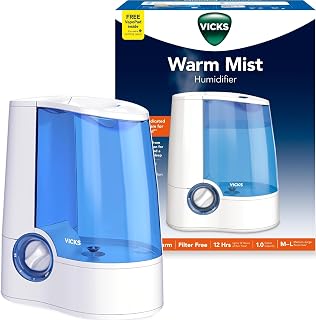
Vicks Warm Mist Humidifier
The most straightforward true warm mist unit here, with a 1-gallon tank, filter-free operation, and no app to configure. The VapoPad and VapoSteam compatibility makes it the obvious pick for cold and flu season, and the soft night light is diffuse enough not to compete with a bedside lamp.
Levoit OasisMist 4.5L
Levoit’s smart hybrid reads the room and adjusts output to hold a set humidity level, which is exactly what you want when a bedroom door stays closed all night. At 26dB it is the quietest option in this group, and the top-fill tank and 45-hour low-speed runtime keep maintenance to a weekly task.
DREO HM717S 8L
Built for open-plan spaces up to 600 square feet, with an 80-hour runtime that genuinely reduces refill trips. Precise humidity control plus Alexa and app support make it the most capable unit here, and the RGB lighting can be tuned to a single restrained tone or turned off completely.
Everlasting Comfort 6L
High mist output and a 60-hour runtime at a lower price point, with a simple top-fill design that is easy to wipe down. It skips the smart features, but for a nursery or a guest room where you want volume and simplicity, that is a reasonable trade.
GloryAir 6L
A well-rounded hybrid with smart humidity control, a remote, and a seven-color light ring that suits a plant corner or a child’s room. The essential oil tray is separate from the main tank, which keeps oils out of the heating path and simplifies cleaning.
Frequently Asked Questions
Is warm mist better than cool mist for congestion?
Many people find warm mist more soothing in dry winter air, and it does not lower room temperature. Either type raises humidity effectively; the difference is comfort and how much mineral residue ends up on your furniture.
Do warm mist humidifiers use much more electricity?
Yes, because heating water requires energy. Expect noticeably higher draw than a cool mist unit, though still modest compared with a space heater.
Should I use distilled water?
Warm mist units handle tap water better than ultrasonic models, but distilled water slows scale buildup on the heating element and extends the time between deep cleans.
How often should I clean it?
Rinse and refill daily, and descale weekly with white vinegar or the manufacturer’s recommended solution. Standing water in a warm reservoir is the main reason humidifiers develop odor.
Final Thoughts
For a true warm mist unit that simply works, the Vicks remains the benchmark. If you want set-and-forget humidity control in a quiet bedroom, the Levoit OasisMist is the more refined choice, and the DREO HM717S is the one to specify for larger open rooms where runtime and coverage matter most.