Key takeaways
- Head count vs. rail length: Match the two, or you’ll get hot spots. Roughly one head per 18–24 inches of rail works for general room light; cluster them tighter for task zones like a galley kitchen or a workbench.
- Integrated LED or GU10 socket: Integrated heads are slimmer and dimmer-ready out of the box. GU10 kits let you swap color temperature, beam angle, and wattage later — the better call if you’re still deciding how the room will be used.
- Color temperature and CRI: 2700K–3000K for living and bedrooms, 4000K–5000K where you prep food or work. If art, textiles, or cooking are involved, look for CRI 90+; anything lower flattens color.
- Track format: Fixed linear kits mount as one piece and suit a single run. Standard H-track systems let you cut, extend, and add heads down the line — worth it for open-plan ceilings or long hallways.
- Mounting and dimming: Confirm the kit works with your junction box, and check whether wall mounting is supported if you’re lighting a stairwell or gallery wall. Verify dimmer compatibility before you buy the dimmer.
What's inside
Ceiling light is the one design decision most homes get handed rather than choose. A builder-grade dome in the center of the room, a fixed grid of recessed cans, or a single pendant over a counter that misses the counter — none of it adapts when you move the sofa, hang new art, or finally turn the spare room into a studio. The result is a space that reads flat in photos and feels dim in exactly the spots you actually use.
Track lighting is the fix, and the 2026 crop is genuinely worth a second look: slimmer housings, matte and brushed finishes that don’t scream office park, and heads that pivot far enough to wash a wall or pin a single shelf. Below are six kits we’d specify for real rooms, plus the specs that separate a fixture you’ll keep from one you’ll quietly replace in eighteen months.
As an Amazon Associate we earn from qualifying purchases.



How to Choose Track Lighting in 2026
- Head count vs. rail length: Match the two, or you’ll get hot spots. Roughly one head per 18–24 inches of rail works for general room light; cluster them tighter for task zones like a galley kitchen or a workbench.
- Integrated LED or GU10 socket: Integrated heads are slimmer and dimmer-ready out of the box. GU10 kits let you swap color temperature, beam angle, and wattage later — the better call if you’re still deciding how the room will be used.
- Color temperature and CRI: 2700K–3000K for living and bedrooms, 4000K–5000K where you prep food or work. If art, textiles, or cooking are involved, look for CRI 90+; anything lower flattens color.
- Track format: Fixed linear kits mount as one piece and suit a single run. Standard H-track systems let you cut, extend, and add heads down the line — worth it for open-plan ceilings or long hallways.
- Mounting and dimming: Confirm the kit works with your junction box, and check whether wall mounting is supported if you’re lighting a stairwell or gallery wall. Verify dimmer compatibility before you buy the dimmer.
The Best Track Lighting Kits (2026) Reviewed
AUQUEE 8-Light Matte Black Track Lighting
Eight rotatable heads on one matte black run is unusually generous, which makes this the most flexible pick for a long kitchen ceiling or a hallway that’s never had enough light. Bulbs aren’t included, so budget for eight GU10s — an advantage if you want to dial in your own color temperature from day one.
VANoopee 12-Light Kit with 13 ft H-Track
The most serious system here: a full 13-foot H-track, twelve dimmable 10W heads at 3000K, and CRI 90+ with a tight 24-degree beam. That narrow spread and high color accuracy make it our choice for galleries, open-plan great rooms, and anywhere you’re lighting objects rather than just filling space.
Bojim 6-Light Gold Track Lighting
The acrylic ring detail and warm gold finish give this one an actual point of view, which is rare in a category that defaults to black or white. Six GU10 heads pivot freely for closets, studios, and basements — spaces that need directional light but shouldn’t look like storage.
4-Light 24.8″ Black Kit with Bulbs Included
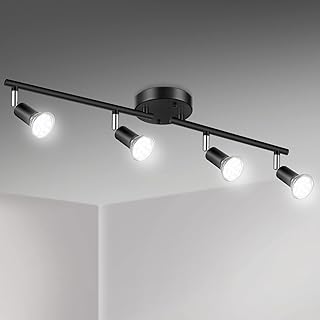
The easiest install on this list: a compact 24.8-inch bar with four 5000K daylight bulbs already in the box, so it’s operational the moment the wire nuts are on. Best over a small kitchen run, a laundry area, or any room where crisp white light beats atmosphere.
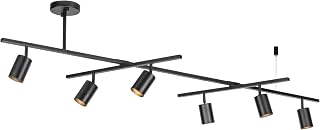
4-Light Dual-Output Black Spotlight Kit
The 50W plus 20W dual configuration means you get both a bright task layer and a softer ambient one from a single fixture, controlled independently. Ceiling or wall mounting plus four included GU10 bulbs makes it a strong value for living rooms doing double duty.
Frequently Asked Questions
Can I install track lighting myself?
If you’re replacing an existing ceiling fixture on the same junction box, it’s a manageable DIY swap with the breaker off. New wiring, added circuits, or anything you’re unsure about should go to a licensed electrician.
How many heads do I actually need?
For general room lighting, plan on one head per 18–24 inches of track. For task lighting over a counter or desk, space them closer and aim each one deliberately rather than adding more.
Warm or cool white for a kitchen?
4000K reads clean and accurate for food prep without the clinical edge of 5000K. If your kitchen opens onto a living area, 3000K keeps the two spaces visually consistent.
Does track lighting look dated?
The bulky 1990s versions do. Current fixtures use slim cylindrical heads, low-profile rails, and finishes like matte black and brushed gold that sit comfortably in contemporary interiors.
Final Thoughts
For most homes, the AUQUEE 8-Light matte black kit hits the best balance of coverage, price, and restraint. Step up to the VANoopee 12-Light system if you’re lighting a large open plan or want CRI 90+ accuracy for artwork, and choose the Bojim 6-Light gold kit when the fixture itself needs to be part of the design.