Key takeaways
- Lowest seat height, not the range: Ignore the marketing span and find the minimum number. You want your feet flat with thighs roughly parallel to the floor, which usually means a floor-to-seat measurement of 16 to 17.5 inches. Anything starting at 18 inches will leave most petite users dangling.
- Seat depth under 19 inches: A pan that’s too deep is the most common culprit behind knee pressure and slouching. Leave two to three fingers of clearance between the seat edge and the back of your knee, and favor a waterfall front edge that relieves pressure rather than a hard, squared lip.
- Adjustable or low-set lumbar support: Fixed lumbar padding designed for a taller torso lands too high and pushes your mid-back forward. Look for height-adjustable lumbar pads, or a backrest with a shallow curve that meets your natural lower-spine position without forcing it.
- Armrests that drop low or move aside: Shorter torsos need armrests closer to the seat. Height-adjustable arms are ideal; flip-up arms are the practical alternative, letting you fold them out of the way and tuck the chair fully under a desk.
- Scale and finish for the room: A compact footprint keeps a home office from feeling crowded, and a five-star base under 26 inches wide navigates tight corners. Mesh reads lighter and cooler; PU leather in grey or brown warms up a space and hides the office-supply look entirely.
What's inside
Most desk chairs are built around a mythical average body: roughly 5’9″, long femurs, a torso that meets the lumbar curve exactly where the manufacturer decided it should. If you’re 5’3″ or under, you already know how that plays out. Your feet hover an inch above the floor, the seat pan presses into the back of your knees, the lumbar bulge lands somewhere between your shoulder blades, and the armrests sit high enough that your shoulders creep toward your ears by mid-afternoon. The chair isn’t uncomfortable because it’s cheap. It’s uncomfortable because it was never dimensioned for you.
This guide approaches the problem the way I’d approach any piece of furniture in a small, well-considered room: by measurement first, aesthetics second. Below you’ll find chairs whose lowest seat height, seat depth, and backrest geometry genuinely work for petite frames, spanning mesh task chairs, softly upholstered PU options, and a couple of compact designs that read more like a study chair than office equipment. Each pick is assessed on fit, adjustability, and how it behaves in a real home where the desk chair is also visible from the sofa.
As an Amazon Associate we earn from qualifying purchases.



How to Choose an Ergonomic Office Chair For Short People (2026)
- Lowest seat height, not the range: Ignore the marketing span and find the minimum number. You want your feet flat with thighs roughly parallel to the floor, which usually means a floor-to-seat measurement of 16 to 17.5 inches. Anything starting at 18 inches will leave most petite users dangling.
- Seat depth under 19 inches: A pan that’s too deep is the most common culprit behind knee pressure and slouching. Leave two to three fingers of clearance between the seat edge and the back of your knee, and favor a waterfall front edge that relieves pressure rather than a hard, squared lip.
- Adjustable or low-set lumbar support: Fixed lumbar padding designed for a taller torso lands too high and pushes your mid-back forward. Look for height-adjustable lumbar pads, or a backrest with a shallow curve that meets your natural lower-spine position without forcing it.
- Armrests that drop low or move aside: Shorter torsos need armrests closer to the seat. Height-adjustable arms are ideal; flip-up arms are the practical alternative, letting you fold them out of the way and tuck the chair fully under a desk.
- Scale and finish for the room: A compact footprint keeps a home office from feeling crowded, and a five-star base under 26 inches wide navigates tight corners. Mesh reads lighter and cooler; PU leather in grey or brown warms up a space and hides the office-supply look entirely.
The Best Ergonomic Office Chairs For Short People (2026) Reviewed
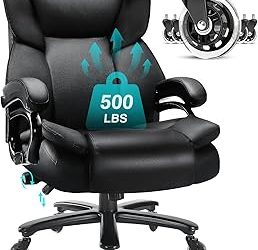
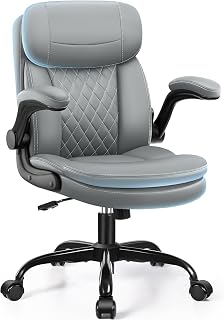
Upgraded PU Leather Office Chair with Double-Layer Cushion, Grey
This is my first recommendation for anyone under 5’4″, because the whole chair is drawn to a smaller scale rather than shrunk down from a full-size model. The double-layer cushion keeps the seat supportive without adding sitting height, and the grey PU finish is soft enough visually to live in a bedroom corner or a shared living space.
PU Leather Office Chair with Ergonomic Back Support
A pared-back sibling to the grey model, this one trades the neckrest for a cleaner silhouette and a lower overall profile, which is exactly what you want under a floating desk or in a room where sightlines matter. Adjustable armrests and a genuinely low starting seat height make it a strong pick for petite users who don’t want a gaming-chair aesthetic.
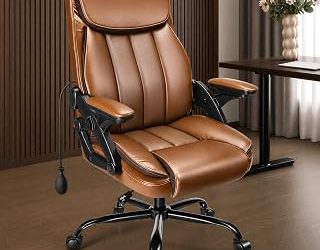
Brown PU Leather Executive Chair with Lumbar Support
The most traditional-looking option here, and the one I’d put in a study with wood tones or a warmer palette. Padded arms and a supportive lumbar curve give it executive presence at a compact size, though the seat is firmer than the double-cushion models, so try it if you prefer structure over softness.
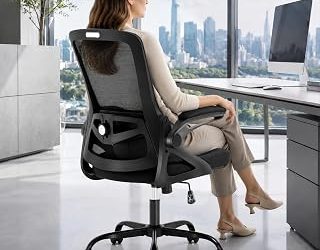
High-Back Mesh Office Chair with Flip-Up Armrests
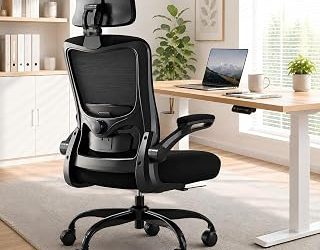
The best choice if you run warm or work long stretches, with breathable mesh, a 330-pound capacity, and adjustable lumbar support you can slide down to meet a shorter torso. The flip-up arms are the real advantage for petite users, letting the chair slide completely under the desk instead of colliding with the apron.
TRALT Ergonomic Office Chair with Headrest
Similar mesh construction with a headrest included, which only helps if it sits low enough to catch your head rather than your shoulders, so check the adjustment range against your seated height. For those it fits, it’s the most complete support package in this group and a tidy, unfussy black that disappears into most interiors.
Frequently Asked Questions
What seat height should I look for if I’m 5’2″?
Aim for a chair that drops to about 16.5 inches or lower. A quick check: measure from the floor to the crease behind your knee while wearing your usual shoes, then look for a chair whose minimum seat height sits at or just below that number.
Is a footrest a real solution?
It’s a useful correction, not a substitute. A footrest fixes leg support but does nothing about excessive seat depth or a lumbar pad sitting too high, so treat it as a supplement to a properly dimensioned chair rather than a workaround for the wrong one.
Mesh or PU leather for a petite frame?
Mesh keeps you cooler and generally offers more adjustability at this price point. PU leather typically has a lower profile and reads better as furniture in a multi-use room, which matters if your desk lives in the living room or bedroom.
Do I need a headrest?
Only if it adjusts low enough to reach your head. On many chairs the headrest is fixed for taller users and ends up pressing the shoulders forward, which is worse than no headrest at all.
Final Thoughts
For most petite users, the Upgraded PU Leather Office Chair in grey is the safest fit straight out of the box, with a genuinely low seat and cushioning that doesn’t cost you height. If you want maximum adjustability and airflow, the High-Back Mesh Office Chair with flip-up armrests is the better long-day companion, and the Brown PU Executive Chair remains the pick for anyone who wants the support without the office-equipment look.