Key takeaways
- Length and layout: Aim to cover roughly two-thirds of each cabinet’s width, then link fixtures end to end. Measure the clear space under the box, not the cabinet face, and buy 12″, 18″, 24″, and 36″ bars in combination rather than forcing one size to fit every run.
- Color temperature and CRI: Selectable CCT is now standard and worth using: 2700K-3000K flatters wood and warm brass, 3500K-4000K keeps white and gray kitchens crisp. For food prep and finish matching, look for CRI above 90 with a strong R9 value, which is what makes reds and skin tones read correctly.
- Dimming and control: Confirm the driver works with your existing TRIAC or ELV dimmer before you close up the wall. Some fixtures add a hi/low switch on the housing, useful as a nightlight setting without rewiring.
- Profile and lens: Under an inch tall is the target. A frosted or diffused lens matters more than raw lumens, since a bare-diode strip reflects hot spots off polished quartz and stainless.
- Wiring and certification: Look for ETL or UL listing, an accessible junction compartment, and knockouts on both ends. A plug-in option gives you a bailout if one run has no accessible power.
What's inside
Countertops are where a kitchen actually gets used, and they’re also where overhead lighting fails most predictably. A ceiling fixture sits behind you while you work, so your own body casts a shadow across the exact eight inches of granite you’re trying to see. Buyers usually notice the problem only after the remodel is done, then reach for stick-on battery pucks that die in six weeks, glare into their eyes at seated height, or throw a color of white that fights the paint and the backsplash. Hardwired under cabinet lighting solves the shadow and the clutter at once: no cords draped behind the toaster, no wall wart hogging an outlet, no dimming that only works from a phone app.
This guide looks at hardwired LED bars worth specifying in 2026, chosen the way a designer spec-sheets them rather than the way a shelf tag describes them. We weighted three things heavily: color rendering and tunable color temperature, because undercabinet light is what your food and finishes are seen under; low-profile housings that hide behind a face frame or light rail; and honest dimming compatibility with the wall switch you already own. Linkability, ETL listing, and the availability of a plug-in fallback also factored in, since not every run gets a junction box.
As an Amazon Associate we earn from qualifying purchases.


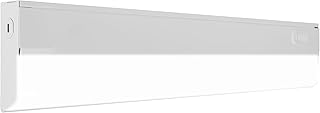
How to Choose a Led Under Cabinet Lighting Hardwired (2026)
- Length and layout: Aim to cover roughly two-thirds of each cabinet’s width, then link fixtures end to end. Measure the clear space under the box, not the cabinet face, and buy 12″, 18″, 24″, and 36″ bars in combination rather than forcing one size to fit every run.
- Color temperature and CRI: Selectable CCT is now standard and worth using: 2700K-3000K flatters wood and warm brass, 3500K-4000K keeps white and gray kitchens crisp. For food prep and finish matching, look for CRI above 90 with a strong R9 value, which is what makes reds and skin tones read correctly.
- Dimming and control: Confirm the driver works with your existing TRIAC or ELV dimmer before you close up the wall. Some fixtures add a hi/low switch on the housing, useful as a nightlight setting without rewiring.
- Profile and lens: Under an inch tall is the target. A frosted or diffused lens matters more than raw lumens, since a bare-diode strip reflects hot spots off polished quartz and stainless.
- Wiring and certification: Look for ETL or UL listing, an accessible junction compartment, and knockouts on both ends. A plug-in option gives you a bailout if one run has no accessible power.
The Best Led Under Cabinet Lighting Hardwired (2026)s Reviewed
36in 22W Hardwired Under Cabinet Light, CRI>92
The strongest color performance in this group, with CRI above 92 and R9 above 90, meaning tomatoes and cutting boards look like themselves rather than washed out. At 1426 lumens across 36 inches it’s the right call for a long uninterrupted run over a prep zone or a deep pantry closet.
24 Inch 12W Hardwired or Plug-In, 5 Color Options
The most flexible pick for mixed installations: five color temperatures, dimming, linkable ends, and a diffused eye-care lens that stays comfortable at bar-stool height. Choosing hardwired or plug-in at install time makes it a safe default when you don’t yet know which cabinets have power.
UltraPro 24 Inch Hardwired Under Cabinet Light
A clean, no-drama fixture at 908 lumens with three color temperatures and reliable dimming from a standard wall control. UltraPro’s build quality and ETL listing make this the one to hand a contractor when you want consistent results across six identical bars.
12 Inch Hardwired Under Cabinet Light, 3CCT
Purpose-built for the awkward gaps: narrow cabinets, a sink flanked by two short boxes, or a floating shelf over a coffee station. The hi/low brightness control and low-profile housing let it double as ambient light after dinner.
NICOR 18″ UCB Series Direct Wire Under Cabinet Light
NICOR builds to a spec-grade standard, and the UCB Series shows it in the wiring compartment and selectable 2700K-5000K output. At 9W and roughly 630 lumens it’s the balanced middle length most kitchens need two or three of.
Frequently Asked Questions
Do I need an electrician to install hardwired under cabinet lighting?
If you’re tapping an existing circuit or adding a junction box, yes, and in most jurisdictions permits apply. Fixtures with a plug-in option can be installed by a confident DIYer.
How many fixtures can I link together?
Most manufacturers cap a single run by total wattage rather than fixture count, commonly in the 100-200W range. Check the spec sheet and keep runs on one switch leg for even dimming.
Which color temperature should I choose?
Match your other kitchen fixtures. Warm 2700K-3000K suits wood, warm whites, and traditional cabinetry; 3500K-4000K reads cleaner against cool grays, marble, and stainless.
Why does my light flicker when dimmed?
Almost always a dimmer mismatch. Swap to a dimmer listed as compatible with LED drivers, and avoid loading the circuit below the dimmer’s minimum wattage.
Final Thoughts
For most kitchens, the 24 Inch 12W hardwired-or-plug-in bar is the sensible default thanks to its five color options and installation flexibility. Cooks who care about how food and finishes look should spend up for the 36in 22W CRI>92 fixture, while the NICOR 18″ UCB Series is the dependable spec-grade choice for filling out a full set of runs.