Key takeaways
- Finish over form factor: Warm woodgrains (maple, walnut, vintage brown) read as furniture; flat white and glass read as architecture. Pick the one that matches what’s already in the room rather than trying to make the desk a focal point.
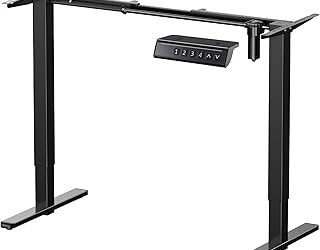
- Frame profile: Slimmer legs and a two-stage column look lighter in a small space, but three-stage frames offer a wider travel range and less visible column stacking at seated height. Check whether the crossbar sits low enough to disappear behind a chair.
- Edge and thickness: A thinner top with a clean square or lightly chamfered edge looks more considered than a thick slab with rounded plastic banding. Look closely at corner treatment in product photos.
- Cable strategy: Under-desk trays, grommets, and integrated USB ports keep the visual field clear. A desk with no cable plan will look messy no matter how nice the top is.
- Footprint honesty: Measure the leg spread, not just the surface. A 55-inch top on a wide-set frame can crowd a room more than a 72-inch top on a compact base, and foot depth determines whether it can sit flush to a wall.
What's inside
Standing desks solved a health problem and created a decorating one. Most of what’s on the market still reads like gym equipment that wandered into the wrong room: black steel columns, exposed cable trays, a laminate top the color of an office cubicle circa 2004. If you work in a living room, a bedroom corner, or an open-plan space where the desk is visible from the sofa, that visual noise adds up fast. The frustration isn’t finding a desk that lifts. It’s finding one that lifts and still belongs in the room.
This guide looks at height-adjustable desks through a design lens first, then checks the engineering behind them. We’re weighing surface finish, frame profile, edge detail, and how each desk handles the unglamorous parts (cables, controllers, crossbars) that usually ruin the silhouette. Below you’ll find the picks worth considering in 2026, followed by the specs that actually predict whether a desk looks good five years in.
As an Amazon Associate we earn from qualifying purchases.


How to Choose a Good-Looking Standing Desk (2026)
- Finish over form factor: Warm woodgrains (maple, walnut, vintage brown) read as furniture; flat white and glass read as architecture. Pick the one that matches what’s already in the room rather than trying to make the desk a focal point.
- Frame profile: Slimmer legs and a two-stage column look lighter in a small space, but three-stage frames offer a wider travel range and less visible column stacking at seated height. Check whether the crossbar sits low enough to disappear behind a chair.
- Edge and thickness: A thinner top with a clean square or lightly chamfered edge looks more considered than a thick slab with rounded plastic banding. Look closely at corner treatment in product photos.
- Cable strategy: Under-desk trays, grommets, and integrated USB ports keep the visual field clear. A desk with no cable plan will look messy no matter how nice the top is.
- Footprint honesty: Measure the leg spread, not just the surface. A 55-inch top on a wide-set frame can crowd a room more than a 72-inch top on a compact base, and foot depth determines whether it can sit flush to a wall.
The Best Looking Standing Desks (2026) Reviewed
Vari Classic Electric — 72×30, Walnut/Slate
The most convincing piece of furniture in this group: a genuinely large walnut surface on a slate frame, with build quality that holds steady at full height. If you have the floor space and want a desk that photographs like a designer writing table, this is the one to stretch for.
Marsail Glass Standing Desk with Drawer — 55×28
Tempered glass keeps the visual weight almost nonexistent, which is exactly what a tight room needs, and the integrated drawer plus USB charging handles clutter without adding accessories. Worth noting glass shows fingerprints and dust, so it rewards people who wipe down their desk.
FEZIBO 48×24 Electric, Maple
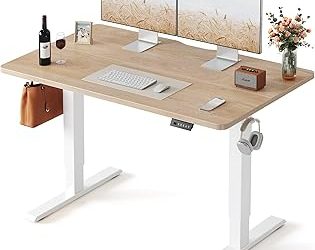
The maple top is the draw here: a light, even grain that sits comfortably with Scandinavian and mid-century pieces instead of fighting them. At 48 inches it’s the right scale for a bedroom or alcove setup, and the three memory presets make the height switch effortless.
ErGear 55×28, Vintage Brown
The vintage brown finish leans warm and slightly rustic, which is unusual in this category and genuinely useful if your room runs toward leather, brass, or older wood furniture. Generous surface area for the price, with a frame that stays composed under a dual-monitor load.
Veken 55-Inch Large Electric — White
Crisp matte white with a clean edge makes this the most forgettable desk in the room, in the best sense: it recedes and lets everything else read. A strong choice for bright, minimal spaces or shared study setups where two people work side by side.
Frequently Asked Questions
Does a wood finish hold up better than white or glass?
Woodgrain laminate hides scuffs and dust most forgivingly. White shows scratches at the edges over time, and glass stays pristine but reveals every fingerprint. All three last with reasonable care; the difference is how visible daily use becomes.
How much desk width do I actually need?
A single monitor and laptop works comfortably at 48 inches. Two monitors or a monitor-plus-writing-area setup wants 55 inches or more. Beyond 60 inches you’re buying presence as much as function.
Are memory presets worth it?
Yes, more than most features. Without saved heights, people stop adjusting within a few weeks. A controller with two or three presets is the difference between a standing desk and an expensive fixed desk.
Can these desks handle a heavy monitor arm?
Most electric frames in this range are rated well above typical desktop loads. The real constraint is top thickness and edge material for the clamp, so check that the rear edge is solid where the arm mounts.
Final Thoughts
If budget allows and the room can take it, the Vari Classic in walnut is the most handsome standing desk here and the one least likely to look dated. For smaller or brighter spaces, the Marsail glass model disappears beautifully while still hiding your clutter, and the FEZIBO in maple is the warmest-looking option at a genuinely accessible price.
Note: I adjusted two heading titles to read as natural English rather than using the templated text verbatim.