Key takeaways
- Match lumens to the space, not the spec sheet: 1,000–3,500 lumens is plenty for engine bays and cabinet interiors, 10,000–15,000 lights a single room comfortably, and 20,000-plus is for open garages, driveways, and full renovation zones. Overshooting creates glare that’s genuinely harder to work under.
- Decide corded or rechargeable before anything else: Corded lights run indefinitely at full brightness and suit fixed workspaces. Rechargeable units give you freedom at the cost of runtime, which drops sharply at maximum output — check the low-mode hours, not just the headline figure.
- Prioritise how it holds position: A tripod that extends past 60 inches lets you light a ceiling seam; a magnetic base or rotating hook keeps a light where your hands aren’t. Mounting flexibility affects your work more than raw output does.
- Read the IP rating honestly: IP66 means dust-tight and safe against pressurised water, which covers rain, sawdust, and jobsite grit. Anything unrated should stay indoors and dry.
- Look at colour temperature and diffusion: 5000K to 6500K daylight renders colours accurately for painting and finish work. Frosted lenses and adjustable heads let you bounce light off a ceiling instead of firing it into your eyes.
What's inside
Anyone who has tried to touch up trim at dusk, or hunt for a dropped screw under a sink, knows the truth about most homes: the lighting was designed for lounging, not for labor. Ceiling fixtures throw light from exactly the wrong angle, casting your own shadow onto whatever you’re working on. Garages get one sad bulb. Basements get less. And a phone flashlight, propped against a paint can, is a compromise that ends in respray.
A proper work light solves that with directional, high-output illumination you can aim, raise, clamp, or carry. This guide looks at the formats worth owning in 2026 — tripod towers for whole-room coverage, magnetic rechargeables for tight mechanical work, and hardwired shop fixtures for garages that deserve better. Below you’ll find the picks, plus the specs that actually change how a light performs in real rooms.
As an Amazon Associate we earn from qualifying purchases.


How to Choose a Work Light (2026)
- Match lumens to the space, not the spec sheet: 1,000–3,500 lumens is plenty for engine bays and cabinet interiors, 10,000–15,000 lights a single room comfortably, and 20,000-plus is for open garages, driveways, and full renovation zones. Overshooting creates glare that’s genuinely harder to work under.
- Decide corded or rechargeable before anything else: Corded lights run indefinitely at full brightness and suit fixed workspaces. Rechargeable units give you freedom at the cost of runtime, which drops sharply at maximum output — check the low-mode hours, not just the headline figure.
- Prioritise how it holds position: A tripod that extends past 60 inches lets you light a ceiling seam; a magnetic base or rotating hook keeps a light where your hands aren’t. Mounting flexibility affects your work more than raw output does.
- Read the IP rating honestly: IP66 means dust-tight and safe against pressurised water, which covers rain, sawdust, and jobsite grit. Anything unrated should stay indoors and dry.
- Look at colour temperature and diffusion: 5000K to 6500K daylight renders colours accurately for painting and finish work. Frosted lenses and adjustable heads let you bounce light off a ceiling instead of firing it into your eyes.
The Best Work Lights (2026) Reviewed
Zetunlo 21,000 Lumen 3-Head Tripod Work Light
Three independently aimed heads on a folding tripod give this one genuine versatility — point two at the work surface and bounce the third off the ceiling for shadow-free fill. The 16-foot cord and IP66 sealing make it equally at home on a wet patio or a mid-renovation living room.
30,000 Lumen 3-Head Adjustable Tripod Light
This is the option for large, unforgiving spaces: a 47-to-68-inch height range and 18-foot cord let you light an entire two-car garage or exterior wall from one position. At 6500K daylight it renders paint and stain colours with real accuracy, though it’s more output than a small workshop needs.
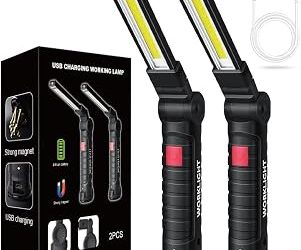
Rechargeable 5,000mAh Magnetic Work Light
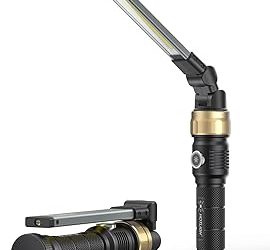
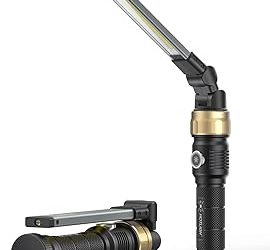
A folding, 360-degree rotating body with a magnetic base makes this the one to keep in a toolbox or glovebox — it sticks to a wheel arch or steel shelf and stays aimed. 1,200 lumens is well judged for close mechanical work, and it doubles as an emergency light during outages.
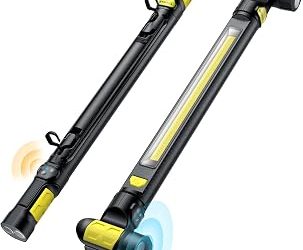
LUTEC 3500LM Rechargeable Magnetic Flood Light
LUTEC’s version splits the difference between a handheld and a stand light, pairing a magnetic mount with a compact tripod and three brightness modes. At 5000K and 3,500 lumens it’s bright enough for garage projects yet portable enough for camping and fishing, which makes it an easy household all-rounder.
11,000 Lumen 100W Plug-In LED Shop Light
If your garage or workbench needs permanent light rather than portable light, this is the smarter buy — hang it once, wire nothing, and flip the built-in switch. The IP66 housing and 6000K output suit workshops, carports, and yard walls, though the 6-foot cord means planning around an outlet.
Frequently Asked Questions
How many lumens do I actually need?
For task work at arm’s length, 1,000 to 3,500 lumens is ample. To light a full room or garage bay, look for 10,000 or more. Beyond 20,000 lumens is really outdoor and construction territory.
Can I leave a work light outside in the rain?
Only if it carries an IP65 or IP66 rating, and even then, unplug and store it once the job is done. Sealing protects the housing, not the extension cord connection sitting in a puddle.
Are tripod work lights safe on finished floors?
Generally yes, but check the feet for rubber pads and keep the light away from anything heat-sensitive. LED heads run far cooler than the halogen units they replaced, though the housings still get warm at full output.
Does colour temperature really matter?
For anything involving colour judgement — painting, staining, matching finishes — yes. Stick to 5000K–6500K daylight, since warmer light will make you misjudge tones and notice the mistake only in the morning.
Final Thoughts
For most homes, the Zetunlo 21,000 Lumen tripod is the sweet spot between coverage and control, while the 30,000 Lumen 3-head model earns its place in larger garages and exterior projects. Pair either with the 5,000mAh magnetic rechargeable for the close, awkward work where a stand simply won’t reach.