Key takeaways
- Depth before height: Depth is what steals your walkway. A 10 to 12 inch shelf holds standard hardcovers and paperbacks comfortably; anything deeper is storing air behind your books. Measure the clearance you can lose without pinching a doorway or traffic path, then shop to that number.
- Footprint geometry: Tree and spiral designs stagger shelves around a central column, so the base occupies a fraction of the visual mass above it. These slot into corners and beside sofas where a rectangular unit would jut awkwardly into the room.
- Structural honesty: A tall, narrow bookcase is a tipping risk by definition. Look for a steel frame, a full or partial backboard for lateral rigidity, adjustable feet for uneven floors, and an included anti-tip anchor — then actually use it.
- Closed storage ratio: Open shelves display; cabinets hide. In a small room where everything is visible at once, one closed compartment for cables, chargers, and paperwork does more for perceived calm than two extra open tiers.
- Visual weight: Raised legs, open sides, and lighter wood tones let sightlines pass underneath and around the piece, which keeps the floor reading as continuous. Solid plinth bases and dark finishes anchor a room but consume it faster.
What's inside
Square footage rarely negotiates. In a 600-square-foot apartment, a studio carved out of a converted attic, or a bedroom that doubles as a workspace, the bookcase is usually the last piece to find a home — and the first one to feel like it’s in the way. Standard shelving units assume 30 to 36 inches of clear wall, generous walkways, and no radiator, no baseboard heating, no door swing. Meanwhile the books keep arriving. So do the plants, the ceramics, the router that needs somewhere dignified to live.
The fix isn’t fewer books. It’s shelving that reads vertically instead of horizontally, tucks into corners other furniture ignores, and stays visually light enough that the room doesn’t shrink around it. This guide gathers the narrow, tiered, and corner-friendly bookcases worth considering in 2026 — from spine-width towers under 11 inches deep to mid-century cube units that work as much as a side table as a shelf — plus the measurements and structural details that separate a smart small-space buy from a wobbly regret.
As an Amazon Associate we earn from qualifying purchases.




How to Choose a Bookcase For Small Spaces (2026)
- Depth before height: Depth is what steals your walkway. A 10 to 12 inch shelf holds standard hardcovers and paperbacks comfortably; anything deeper is storing air behind your books. Measure the clearance you can lose without pinching a doorway or traffic path, then shop to that number.
- Footprint geometry: Tree and spiral designs stagger shelves around a central column, so the base occupies a fraction of the visual mass above it. These slot into corners and beside sofas where a rectangular unit would jut awkwardly into the room.
- Structural honesty: A tall, narrow bookcase is a tipping risk by definition. Look for a steel frame, a full or partial backboard for lateral rigidity, adjustable feet for uneven floors, and an included anti-tip anchor — then actually use it.
- Closed storage ratio: Open shelves display; cabinets hide. In a small room where everything is visible at once, one closed compartment for cables, chargers, and paperwork does more for perceived calm than two extra open tiers.
- Visual weight: Raised legs, open sides, and lighter wood tones let sightlines pass underneath and around the piece, which keeps the floor reading as continuous. Solid plinth bases and dark finishes anchor a room but consume it faster.
The Best Bookcase For Small Spaces (2026)s Reviewed
TUTOTAK 8-Tier Narrow Spine Bookshelf
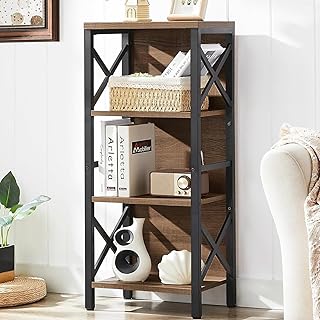
At 10.4 inches wide and just over 13 inches deep, this is the most literal answer to a wall you thought was unusable — eight tiers of vertical storage in the footprint of a floor lamp. Best suited to paperbacks and mid-size hardcovers rather than oversized art books, and it earns its place in an entryway or the dead space beside a desk.
SUNMORY 6-Tier Tree Bookshelf with Cabinet
The staggered tree layout gives you six display surfaces with a base that barely registers, and the lower cabinet handles the clutter you’d rather not see. The rustic brown finish keeps it warm enough for a bedroom corner without reading as farmhouse pastiche.
MNEETRUNG 3-Tier Industrial Bookshelf
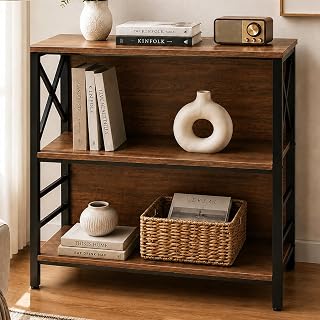
At 29.5 inches tall, this short bookcase clears most windowsills and reads as a console rather than a tower — useful under sloped ceilings or behind a sofa. The metal frame plus backboard combination makes it noticeably more rigid than particleboard units at a similar price.
LEYAOYAO Mid-Century Cube Bookshelf
Three tiers on splayed legs, with the open, airy proportions that make mid-century pieces work so well in tight rooms. It functions as a nightstand, entry catch-all, or record shelf as readily as a bookcase, which is exactly the flexibility a small floor plan needs.
Casaottima 6-Tier Tree Bookshelf with LED Lights
The integrated LED strips turn a narrow corner shelf into a light source, which is a real advantage in rooms with only one window or a single overhead fixture. Steel and wood construction with a closed cabinet at the base rounds it out as the most complete small-space unit here.
Frequently Asked Questions
What shelf depth actually fits standard books?
Around 9 to 10 inches handles nearly all paperbacks and standard hardcovers. Between 11 and 13 inches covers most trade editions and cookbooks. Oversized art and photography books need 14 inches or more, so plan for those separately rather than oversizing every shelf.
Are tall narrow bookcases safe with children or pets?
Only when anchored. Any unit above roughly 40 inches with a footprint under a foot deep should be secured to a stud with the included bracket, and heavy items belong on the bottom two tiers. Load the base first and the top shelf last.
Do tree-style bookshelves hold as much as rectangular ones?
Less per tier, but often more per square foot of floor. Staggered shelves cap you at roughly six to ten books each, which suits displaying a curated selection alongside objects rather than storing a full library.
How much assembly should I expect?
Most units in this category ship flat with pre-drilled panels and take 30 to 60 minutes. Metal-frame models generally go faster and hold tolerances better; leave every bolt slightly loose until the frame is fully squared, then tighten in sequence.
Final Thoughts
If depth is your hard constraint, the TUTOTAK 8-tier narrow spine bookshelf makes a genuinely unusable wall productive. For a corner that needs storage and atmosphere at once, the Casaottima LED tree bookshelf does double duty better than anything else on this list, while the LEYAOYAO cube bookshelf remains the most versatile pick — the one that still earns its footprint if you rearrange the whole room next spring.