Key takeaways
- Blade span versus room scale: A 42 inch fan suits bedrooms, offices, and nooks up to roughly 150 square feet. Push past 250 square feet and you want 52 inches, otherwise the fan works harder for less perceived breeze.
- Motor type: DC motors draw less power, run noticeably quieter, and typically offer six speeds instead of three. If the fan lives above a bed or a desk, this is the single upgrade worth paying for.
- Light quality, not just brightness: Look for 3CCT switching so you can move between 3000K warm white for evenings and 5000K daylight for task work, plus true dimming rather than fixed output.
- Control method: Remotes and app control add scheduling and timers, but a pull chain never needs pairing, batteries, or a firmware update. Match the interface to how patient you feel about technology.
- Location rating and finish: Covered porches need at least a damp rating and ETL listing. Indoors, treat the finish as a design decision: matte black for contrast, brushed nickel to recede, wood tones to warm up cool palettes.
What's inside
Low ceilings are the quiet design constraint nobody warns you about. You finally settle on a sofa, a rug, a paint color that behaves in afternoon light, and then you look up at eight feet of flat drywall and realize a standard downrod fan would hang somewhere between decorative and hazardous. Hugger fans, also called flush mount or low profile fans, solve that by mounting the motor housing directly to the ceiling. The trade-off used to be real: less airflow, buzzier motors, and a light kit that felt like an afterthought bolted to the bottom.
That has changed. The current crop pairs brushless DC motors with integrated LED panels, selectable color temperature, and app or remote control, so a fan can disappear into a ceiling instead of dominating it. Below, we look at six flush mount fans worth specifying in 2026, from a wood-blade model that reads more furniture than fixture to a pull-chain Hunter that quietly outlasts trends. We cover what actually matters when you shop, then review the standouts.
As an Amazon Associate we earn from qualifying purchases.


How to Choose a Hugger Ceiling Fans With Light (2026)
- Blade span versus room scale: A 42 inch fan suits bedrooms, offices, and nooks up to roughly 150 square feet. Push past 250 square feet and you want 52 inches, otherwise the fan works harder for less perceived breeze.
- Motor type: DC motors draw less power, run noticeably quieter, and typically offer six speeds instead of three. If the fan lives above a bed or a desk, this is the single upgrade worth paying for.
- Light quality, not just brightness: Look for 3CCT switching so you can move between 3000K warm white for evenings and 5000K daylight for task work, plus true dimming rather than fixed output.
- Control method: Remotes and app control add scheduling and timers, but a pull chain never needs pairing, batteries, or a firmware update. Match the interface to how patient you feel about technology.
- Location rating and finish: Covered porches need at least a damp rating and ETL listing. Indoors, treat the finish as a design decision: matte black for contrast, brushed nickel to recede, wood tones to warm up cool palettes.
The Best Hugger Ceiling Fans With Light (2026)s Reviewed
42 Inch Flush Mount Fan with 3CCT Dimmable Light, Black
This is the versatile pick, combining a noiseless reversible DC motor, six speeds, and three color temperatures in a slim black housing that suits both a guest room and a covered patio thanks to its ETL indoor/outdoor listing. The reversible winter mode is genuinely useful in low-ceiling rooms where warm air pools overhead.
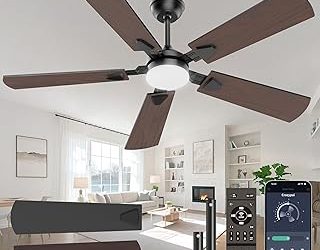
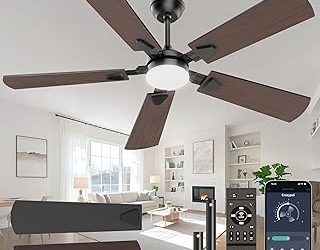
52″ Black Flush Mount Fan with App and Remote Control
The larger span moves real air across open living areas and primary bedrooms, and the app control adds scheduling that a basic remote cannot match. The quiet DC motor and dimmable 3CCT panel make it easy to run at low speed overnight without light bleed or motor hum.
42-Inch Wood Blade Hugger Fan with Remote
Our design-forward choice: the wood blades give a flush mount fan the warmth of a furniture piece rather than a hardware-store fixture, which matters when the ceiling is close enough to notice. Power-off memory means it returns to your last speed and light setting after an outage.
Hunter Builder 42 Inch Low Profile Fan, New Bronze
No remote, no app, no pairing, just a well-balanced five-blade fan from a brand with a long track record and a WhisperWind-class motor. The pull chain and integrated LED make this the sensible specification for rentals, hallways, and anyone replacing a fan they would rather not think about again.
Prominence Home Alvina 42 Inch Flush Mount Fan
The dual-finish reversible blades let one fixture work in two different rooms or palettes, which is quietly practical when you are furnishing an entire floor. Brushed nickel and a traditional light kit make it a safe fit for transitional interiors.
Frequently Asked Questions
How low can my ceiling be for a hugger fan?
Most building codes require at least seven feet of clearance from floor to blade. A flush mount fan typically drops eight to eleven inches, so an eight-foot ceiling works comfortably.
Do flush mount fans move less air than downrod fans?
Slightly, because the housing sits close to the ceiling and restricts intake. A DC motor with six speeds and a well-pitched blade largely closes the gap in normal-sized rooms.
Can I install one on a sloped ceiling?
Generally no. Hugger fans mount flat and most are not rated for slopes beyond a few degrees, so an angled ceiling needs a downrod with a sloped-ceiling adapter.
Is a remote or an app better?
Apps win on scheduling and multi-fan control; remotes are simpler and keep working without Wi-Fi. Several models include both, which is the safest option.
Final Thoughts
For most rooms, the 42 inch 3CCT flush mount fan is the best balance of quiet DC performance, lighting flexibility, and indoor/outdoor versatility, while the 52″ app-controlled model is the one to specify for open living spaces. If you want the fan to read as part of the room rather than a fixture, the wood-blade 42 inch hugger is the most design-considered choice on this list.