Key takeaways
- Lumens in context: Headline numbers are usually peak output on high, sustainable for only a few minutes. For close-up repair work, 300–800 lumens is plenty and far kinder on your eyes; save four-figure output for lighting a whole garage bay or driveway.
- Battery capacity and charge port: Look for 4,000mAh or more if you want a full evening of runtime, and insist on USB-C. Micro-USB in 2026 means one more orphaned cable in the drawer.
- Mounting options: A strong magnet base, a fold-out hook, and a pivoting head are what separate a work light from a flashlight. The goal is hands-free positioning, so count the ways it can hold itself in place.
- Housing material and ingress rating: Aluminium bodies shed heat better and survive drops onto concrete; IP65 or higher means rain and hose spray are non-events. Both matter more than an extra brightness mode.
- Colour temperature and beam shape: Neutral white around 4000–5000K renders surfaces accurately without the blue glare of very cool LEDs. A diffused flood panel is better for inspection; a focused spot is better for reaching into a cavity.
What's inside
Most of us don’t think about work lighting until we’re lying under a sink at 9pm, holding a phone in our teeth while the flashlight beam points everywhere except the fitting we’re trying to loosen. Overhead fixtures throw shadows exactly where you need detail, corded lamps tether you to the nearest outlet, and the cheap plastic torch in the junk drawer has been dead since last winter. For anyone who maintains a home — not just a workshop — a genuinely good rechargeable work light is one of those quiet upgrades that pays for itself in a single afternoon.
This guide looks at rechargeable work lights the way we’d look at any other fixture: build quality, materials, how the light actually behaves in a space, and whether it earns its keep in a drawer or on a pegboard. Below you’ll find our current picks across the range — compact pen-style lights for tight cavities, wide-flood panels for garages and outages, and a pro-grade tool-battery option — plus the specs that matter in 2026 and the ones that are just marketing.
As an Amazon Associate we earn from qualifying purchases.


How to Choose a Rechargeable Work Light (2026)
- Lumens in context: Headline numbers are usually peak output on high, sustainable for only a few minutes. For close-up repair work, 300–800 lumens is plenty and far kinder on your eyes; save four-figure output for lighting a whole garage bay or driveway.
- Battery capacity and charge port: Look for 4,000mAh or more if you want a full evening of runtime, and insist on USB-C. Micro-USB in 2026 means one more orphaned cable in the drawer.
- Mounting options: A strong magnet base, a fold-out hook, and a pivoting head are what separate a work light from a flashlight. The goal is hands-free positioning, so count the ways it can hold itself in place.
- Housing material and ingress rating: Aluminium bodies shed heat better and survive drops onto concrete; IP65 or higher means rain and hose spray are non-events. Both matter more than an extra brightness mode.
- Colour temperature and beam shape: Neutral white around 4000–5000K renders surfaces accurately without the blue glare of very cool LEDs. A diffused flood panel is better for inspection; a focused spot is better for reaching into a cavity.
The Best Rechargeable Work Lights of 2026, Reviewed
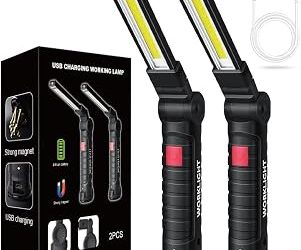
5000mAh Magnetic Foldable Work Light, 1200 Lumens
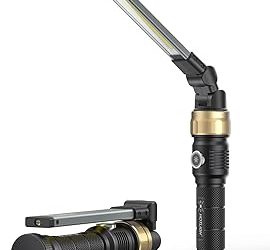
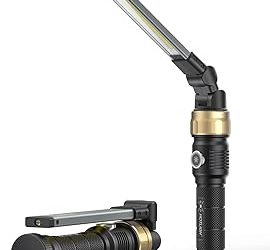
The 360° rotating head and folding body make this the most adaptable single light here — it stands, clips, hangs, and sticks to steel with equal confidence. At 1,200 lumens with a 5000mAh cell it hits the sweet spot for car repairs and household troubleshooting, and it’s a genuinely thoughtful gift for anyone who fixes things.
DEWALT 20V MAX LED Work Light (DCL050)
If you already own DEWALT 20V batteries, this bare-tool pivoting light is the most sensible money in the category: no separate charger, no internal cell to degrade, and runtime limited only by how many packs you own. The trade-off is bulk and the assumption you’re inside the ecosystem already.
innofox 40W Magnetic Work Light, 2-Pack (Orange)
A wide 1,500-lumen flood with four modes and a hanging hook, sold in pairs so you can light a space from two angles instead of fighting one harsh shadow. The high-visibility orange housing is easy to find in a cluttered boot or storm-prep bin.
10,000-Lumen Rechargeable Magnetic Work Light, 13000mAh
This is the one to buy if you want a light that doubles as area lighting during a power cut — the 13000mAh battery delivers real endurance on lower modes, and IP65 sealing means it works outdoors without babying. Treat the 10,000-lumen figure as a short burst rather than a setting you’ll live in.
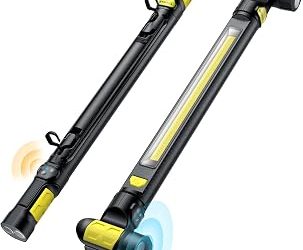
2-Pack Aluminium Magnetic Work Light with Digital Display
All-aluminium construction, 1,500 lumens, seven modes, and a battery percentage readout that removes the guesswork about whether you’ll make it through the job. Buying two means one lives in the car and one stays on the workbench.
Frequently Asked Questions
How many lumens do I actually need?
For detail work at arm’s length, 300–800 lumens is ideal. Choose 1,500 or more only when you’re lighting a full garage bay, a driveway, or a room during an outage.
Are magnetic bases strong enough to trust?
On clean steel, yes — good neodymium bases hold securely at awkward angles. They won’t help on aluminium, stainless trim, or painted timber, which is why a hook or clip matters just as much.
Can I keep one plugged in permanently?
Most modern lights have protection circuitry, but lithium cells last longest stored around half charge in a cool spot. Top up before a job rather than trickling year-round.
Is one light enough?
Rarely. Two modest lights placed opposite each other eliminate shadows far better than one very bright light, which is why multi-packs are such good value.
Final Thoughts
For most homes, the 5000mAh magnetic foldable light is the easiest recommendation — versatile, well-sized, and bright enough for real work. Step up to the 13000mAh 10,000-lumen model if outage-proofing matters to you, or the DEWALT DCL050 if your battery platform is already sorted.