Key takeaways
- Match capacity to the room, not the headline: Look for SACC or the stated coverage in square feet rather than the peak BTU figure. A 7,000–8,000 BTU unit suits a single bedroom or home office up to around 350 sq ft; open-plan living spaces and knock-through kitchens want 12,000 BTU or more.
- Plan the window before you buy: Most kits are designed for sliding windows, so UK sash and side-hung casements often need a bespoke panel, a hose seal, or a fabric window shroud. Measure the opening and check the hose length reaches your intended corner.
- Treat noise as a spec, not a footnote: Anything under 45dB is genuinely liveable overnight. Inverter compressors modulate instead of cycling hard on and off, which is why they read quieter and feel less intrusive in small rooms.
- Understand the water: UK summers are humid, so condensate builds fast. Auto-evaporation and drainage-free designs spare you the bucket routine; if a model needs manual emptying, make sure the tank is accessible without moving furniture.
- Weigh running costs and control: Dual-hose units are meaningfully more efficient because they don’t pull conditioned air from the room to cool the compressor. Pair that with app or voice control and a 24-hour timer so you’re only cooling when someone’s home.
What's inside
British homes were built to hold heat, not shed it. Thick masonry, small windows, loft conversions with south-facing roofs — the same construction that keeps a January evening tolerable turns a July bedroom into something closer to a greenhouse. And because fitted air conditioning is rare in UK housing stock and often awkward to get past a freeholder or a conservation officer, most people reach for a portable unit instead. The trouble is that the market is crowded with near-identical white boxes quoting BTU numbers that mean very little on their own.
This guide cuts through that. We’ve focused on the details that actually decide whether a portable AC earns its floor space in a UK room: honest cooling capacity for the square footage, how the exhaust hose behaves with sash and casement windows, noise levels you can sleep through in a terrace, and how each unit handles the sticky, humid air that defines a British heatwave. Below are the models worth shortlisting in 2026, followed by a buying framework and answers to the questions that come up most.
As an Amazon Associate we earn from qualifying purchases.


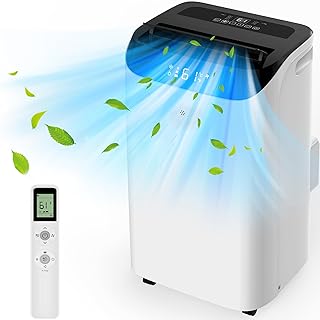
How to Choose a Portable Air Conditioner In Uk (2026)
- Match capacity to the room, not the headline: Look for SACC or the stated coverage in square feet rather than the peak BTU figure. A 7,000–8,000 BTU unit suits a single bedroom or home office up to around 350 sq ft; open-plan living spaces and knock-through kitchens want 12,000 BTU or more.
- Plan the window before you buy: Most kits are designed for sliding windows, so UK sash and side-hung casements often need a bespoke panel, a hose seal, or a fabric window shroud. Measure the opening and check the hose length reaches your intended corner.
- Treat noise as a spec, not a footnote: Anything under 45dB is genuinely liveable overnight. Inverter compressors modulate instead of cycling hard on and off, which is why they read quieter and feel less intrusive in small rooms.
- Understand the water: UK summers are humid, so condensate builds fast. Auto-evaporation and drainage-free designs spare you the bucket routine; if a model needs manual emptying, make sure the tank is accessible without moving furniture.
- Weigh running costs and control: Dual-hose units are meaningfully more efficient because they don’t pull conditioned air from the room to cool the compressor. Pair that with app or voice control and a 24-hour timer so you’re only cooling when someone’s home.
The Best Portable Air Conditioner In Uk (2026)s Reviewed
ZAFRO Smart Inverter 16,000 BTU Dual Hose (38dB Upgraded)
The upgraded ZAFRO is the most complete package here: inverter cooling, a dual-hose layout that avoids drawing warm replacement air into the room, and a measured 38dB low setting that genuinely disappears behind ambient street noise. Drainage-free operation and app control make it the closest thing to a fitted system you can wheel out of a cupboard.
ZAFRO Smart Inverter 16,000 BTU Dual Hose (42dB)
Mechanically the same intelligent platform with a slightly higher noise floor, which is a non-issue in a living room or garden office. If it’s the better buy on the day, the energy-saving inverter and dual-hose efficiency are still the headline reasons to choose it.
Garvee 14,000 BTU 3-in-1
Rated for rooms up to 750 sq ft, this is the pick for open-plan ground floors and large loft rooms where smaller units simply run flat out without ever catching up. The dehumidifier mode is the underrated feature — plenty of muggy British days need moisture removed more than temperature dropped.
14,000 BTU Smart WiFi Portable Air Conditioner
Auto-evaporation plus voice and app control makes this the low-maintenance choice: schedule it to pre-cool a bedroom before bedtime and there’s no tank to empty afterwards. The clean white cabinet is restrained enough to sit beside pale furniture without dominating the room.
8,000 BTU 4-in-1 Portable Air Conditioner
A neatly judged unit for bedrooms, studies and basements up to 350 sq ft, with cool, fan, dehumidify and sleep modes covering the full British summer range. Its compact footprint and quiet operation matter more in a small room than raw capacity ever will.
Frequently Asked Questions
Does a portable air conditioner have to be vented outside?
Yes. Any unit that actively cools produces hot exhaust air that must leave the room through a window, door or wall vent. Products sold without a hose are evaporative coolers, which behave quite differently and struggle in humid conditions.
What size do I need for a typical UK bedroom?
Most UK double bedrooms fall comfortably within the range of a 7,000–8,000 BTU model. Step up to 12,000–14,000 BTU for open-plan spaces, west-facing rooms, or loft conversions with significant roof gain.
Are they expensive to run?
Running cost tracks compressor power and how long the unit runs, so efficiency and correct sizing matter more than the BTU figure. Inverter and dual-hose designs reach target temperature faster and then throttle back, which keeps consumption lower over a full evening.
Single hose or dual hose?
Dual hose is the better engineering: it draws outside air to cool the condenser rather than pulling air from your room, avoiding the slight negative pressure that lets warm air seep in elsewhere. Single-hose units are simpler to set up and fine for smaller, well-sealed rooms.
Final Thoughts
For most UK homes the ZAFRO Smart Inverter 16,000 BTU in its 38dB form is the standout — quiet, efficient and genuinely hands-off thanks to drainage-free operation. If you’re cooling a large open-plan space, the Garvee 14,000 BTU has the capacity to keep up, while the compact 8,000 BTU 4-in-1 remains the sensible, unobtrusive choice for a single bedroom or home office.