Key takeaways
- Measure from floor to counter underside: Leave 10 to 12 inches of thigh clearance. Standard 36-inch kitchen counters call for a 24 to 26 inch seat, while true 42-inch bars need 29 to 31 inches. Several stools below ship in multiple heights, so confirm the variant on the listing rather than assuming.
- Decide on arms and backs early: A full back and arms turn a stool into a lingering chair — ideal for open-plan kitchens that double as dining. Armless models tuck fully beneath the overhang, which matters in tight galley layouts.
- Weigh the swivel: A 360-degree seat makes getting in and out effortless and reduces scraping on hardwood. Look for a metal swivel plate rather than plastic, and expect a small amount of settling play over time.
- Match upholstery to your traffic: Faux and bonded leather wipe clean in seconds and suit households with kids or frequent cooking. Linen-look fabric reads softer and warmer but wants a stain-resistant finish or a removable cover.
- Check the weight rating and footrest: A 300-pound minimum is reasonable; 450 pounds signals a genuinely reinforced frame. A metal footrest is not decorative — it stabilizes the base and makes taller seats comfortable for shorter guests.
What's inside
Seating at a raised counter is one of those design decisions that looks simple until you’re standing in front of a hundred listings with a tape measure in your hand. The stool that photographs beautifully often turns out to be two inches too tall, or too shallow to sit in through a whole dinner, or upholstered in a fabric that surrenders to the first spilled espresso. And because stools live in the busiest square footage of the house — the spot where homework, wine, and Tuesday takeout all happen — the wrong choice announces itself daily.
This guide takes the curator’s approach rather than the catalog one: we look at proportion first, then materials, then the mechanics that determine whether a stool still feels solid in year three. Below you’ll find the models worth shortlisting in 2026, spanning barrel-back upholstery, swivel bases, bonded leather, and four-packs for larger islands, plus a straightforward framework for matching seat height to your counter before you commit.
As an Amazon Associate we earn from qualifying purchases.




🛒 Best Price Today on Amazon
Prime members get fast, free shipping on everything above, plus member-only deals. New members get a 30-day free trial — cancel anytime.
How to Choose a/an Bar Height Stools (2026)
- Measure from floor to counter underside: Leave 10 to 12 inches of thigh clearance. Standard 36-inch kitchen counters call for a 24 to 26 inch seat, while true 42-inch bars need 29 to 31 inches. Several stools below ship in multiple heights, so confirm the variant on the listing rather than assuming.
- Decide on arms and backs early: A full back and arms turn a stool into a lingering chair — ideal for open-plan kitchens that double as dining. Armless models tuck fully beneath the overhang, which matters in tight galley layouts.
- Weigh the swivel: A 360-degree seat makes getting in and out effortless and reduces scraping on hardwood. Look for a metal swivel plate rather than plastic, and expect a small amount of settling play over time.
- Match upholstery to your traffic: Faux and bonded leather wipe clean in seconds and suit households with kids or frequent cooking. Linen-look fabric reads softer and warmer but wants a stain-resistant finish or a removable cover.
- Check the weight rating and footrest: A 300-pound minimum is reasonable; 450 pounds signals a genuinely reinforced frame. A metal footrest is not decorative — it stabilizes the base and makes taller seats comfortable for shorter guests.
The Best Bar Height Stools (2026)s Reviewed
26″ Barrel Counter Stools with Backrest and Arms (Beige)
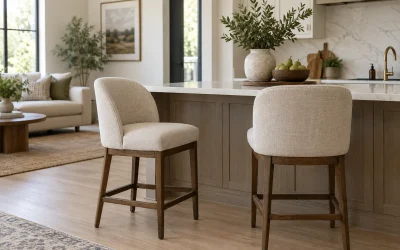
The barrel silhouette does real work here, wrapping the sitter in a continuous curve that reads more like a lounge chair than a kitchen stool. With a 450-pound rating and linen upholstery in a warm neutral beige, it’s the pick for islands that function as the household’s actual dining table.
Swivel Counter Stools with Full Linen Back, Grey 24″
A full padded back plus a swivel base is a rare combination at this price, and the 24-inch seat is correctly sized for standard 36-inch counters. The grey linen keeps the profile quiet in transitional kitchens where the cabinetry is meant to be the focal point.
Raynesys Bonded Leather Curved Counter Stools
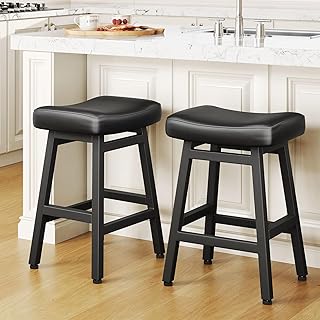
The curved bonded leather seat is the detail that elevates these beyond basic — it cradles more than a flat pad and cleans with a damp cloth. All-black hardware and heavy-duty metal legs make them a natural fit for industrial, loft, and moody-kitchen schemes.
DUMOS Faux Leather Counter Stools, Set of 4
Four matching stools in one box is the practical answer for a long island or peninsula, and the armless upholstered design tucks away cleanly when not in use. The brown faux leather is forgiving in high-traffic homes and warms up cooler cabinet palettes.
Nalupatio Adjustable Swivel Bar Stools
Height adjustability is the standout feature, letting one pair serve a counter now and a taller bar later — genuinely useful in rentals or renovation-in-progress kitchens. The black faux leather and swivel action lean contemporary without tipping into office-chair territory.
Frequently Asked Questions
What is the difference between counter height and bar height?
Counter height stools measure roughly 24 to 27 inches at the seat and pair with 35 to 36 inch counters. Bar height stools measure 29 to 31 inches and suit 41 to 43 inch bars. Most kitchen islands are counter height.
How much space should I leave between stools?
Allow 6 to 10 inches between stools, measured seat edge to seat edge. As a shortcut, budget 24 inches of counter width per stool for armless models and 28 to 30 inches for stools with arms.
Are swivel stools worth it?
For daily-use kitchens, yes. Swivels reduce dragging on floors and make it easier for guests to turn toward conversation. If you prefer an absolutely fixed, furniture-like feel, a static base is the quieter choice.
How do I keep upholstered stools clean?
Vacuum fabric seats weekly and treat spills immediately with a fabric-safe cleaner. Bonded and faux leather need only a damp cloth, plus an occasional conditioner to prevent surface cracking.
Final Thoughts
If comfort is the priority, the 26″ barrel stools with arms are the most inviting seat in this group, while the Raynesys bonded leather pair delivers the sharpest visual edge for modern and industrial kitchens. For larger islands or households that seat four regularly, the DUMOS set of four remains the most sensible value. Measure your counter first, then choose the silhouette you actually want to look at every morning.