Key takeaways
- Shopping for kitchen island seating seems straightforward until you try tucking a new seat under your overhang, only to realize your knees are jammed against the apron—or worse, your elbows are hanging awkwardly low while you try to eat breakfast.…
What's inside
Shopping for kitchen island seating seems straightforward until you try tucking a new seat under your overhang, only to realize your knees are jammed against the apron—or worse, your elbows are hanging awkwardly low while you try to eat breakfast. The debate between counter height bar stools vs bar height bar stools boils down to an industry-standard difference of roughly six inches. However, that half-foot dramatically alters room sightlines, seating ergonomics, accessibility, and architectural flow.
As open-concept layouts and oversized kitchen islands dominate home architecture in 2026, choosing the wrong stool height remains one of the most frequent interior styling mistakes. Standard counters and elevated breakfast ledges require precise measurements to maintain a comfortable 9 to 12 inches of thigh clearance. Understanding the precise differences in dimensions, stability, visual weight, and daily functionality ensures you select seating that fits both your cabinetry and your lifestyle.
Quick Verdict
Choose counter height bar stools (seat height: 24 to 26 inches) if your seating surface measures 35 to 37 inches from the floor, which is standard for modern kitchen islands and perimeter countertops. They offer a grounded, stable seat that is safe for children, easy for aging adults to navigate, and low-profile enough to preserve an uninterrupted line of sight across open-plan living areas.
Choose bar height bar stools (seat height: 28 to 30 inches) if your surface stands between 41 and 43 inches tall, typical of raised breakfast bars, pub tables, and dedicated wet bars. These taller seats excel at creating defined entertainment zones, hiding kitchen prep mess behind elevated ledges, and allowing seated guests to maintain effortless eye-level contact with hosts who are standing nearby.
As an Amazon Associate we earn from qualifying purchases at no extra cost to you. Product prices and availability are accurate as of the date shown and are subject to change.
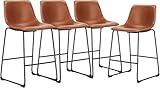

Side by Side
| Feature | Counter Height Bar Stools | Bar Height Bar Stools |
|---|---|---|
| Matching Surface Height | 35 to 37 inches (36″ standard) | 41 to 43 inches (42″ standard) |
| Stool Seat Height | 24 to 26 inches | 28 to 30 inches |
| Target Thigh Clearance | 9 to 12 inches | 9 to 12 inches |
| Spacing (Center-to-Center) | 24 to 28 inches per stool | 26 to 30 inches per stool |
| Visual Impact | Subtle, low-profile, open sightlines | Dramatic, vertical emphasis, zone-defining |
| Accessibility | High; easy for kids and seniors | Moderate; requires stepping up onto a footrest |
| Tip Risk & Stability | Lower center of gravity; extremely stable | Higher center of gravity; needs wider base for stability |
| Average Price Range | $35 to $250 per seat | $45 to $300 per seat |
| Resale & Market Demand | Very High (matches 85%+ modern kitchen islands) | Moderate (specialized for raised bars and pub tables) |
| Best For | Main kitchen islands, everyday dining, task seating | Raised breakfast ledges, basement bars, game rooms |
Where Counter Height Bar Stools Wins
Counter height bar stools reign supreme in modern residential kitchens because builder-standard kitchen countertops sit at precisely 36 inches off the finished floor. Pairing a 36-inch counter with a stool that has a 24- to 26-inch seat height yields the ideal 10-inch clearance for comfortable leg movement without scraping knees on counter support brackets.
From an ergonomic perspective, counter height seating is noticeably easier to mount and dismount. Children can slide onto a 24-inch seat independently without pulling the chair over, and adults do not need to push off from high footrests. The lower center of gravity makes counter height furniture inherently more stable against tipping, which is crucial in busy family environments.
Visually, counter height options maintain an airy, expansive feel across open floor plans. Because the backs of the stools barely peek above the main countertop line, they do not block natural light or interrupt viewlines into adjoining dining and living rooms. Budget-conscious homeowners furnishing standard islands frequently select fixed sets like the DUMOS Counter Height Bar Stools Set of 4, Faux Leather Metal Bar Chairs ($149.99), which deliver slim steel profiles and easy-clean upholstery tailored specifically for 36-inch counter heights.
Where Bar Height Bar Stools Wins
Bar height bar stools are engineered for elevated surfaces measuring 41 to 43 inches. These higher setups are traditional in older home designs with two-tiered kitchen islands, as well as dedicated basement wet bars, game rooms, and outdoor patio pub tables. The primary architectural benefit of a raised bar top is concealment: a 42-inch tier effectively hides dirty dishes, cutting boards, and prep clutter from guests seated in adjacent living spaces.
Socially, bar height seating changes how people interact in an entertainment setting. When guests sit on a 30-inch bar stool, their eye level sits around 56 to 60 inches—nearly identical to a host who is standing and mixing drinks or plating food behind the bar. This eliminates the dynamic where a standing host towers over seated guests.
Design-wise, taller stools introduce a dramatic vertical accent that can help anchor large, high-ceiling rooms or break up massive open floor plans into distinct functional zones. They also pair exceptionally well with outdoor railing counters and tall patio ledges where sweeping views over deck railings are desired.
Cost Over 5 Years
When calculating the true cost of ownership over a five-year period, frame construction and height-adjustment mechanics play a much larger role than the initial retail price tag. Entry-level bar seating generally costs between $40 and $90 per chair, while mid-range commercial-grade steel or solid hardwood options range from $120 to $250 per seat.
Pneumatic swivel models offer great flexibility across different counters. For example, adjustable height options such as the Nalupatio Modern Bar Stools Set of 2, Adjustable Faux Leather Upholstered Swivel Bar Stools, Counter Height Bar Chairs with Back for Kitchen Island, Black ($79.99) allow users to smoothly transition between counter and bar height. However, hydraulic gas-lift cylinders endure continuous mechanical wear; in heavy-use households, gas pistons may require replacement or service after 3 to 5 years. By contrast, static welded steel frames or solid oak four-legged stools have zero moving parts, routinely lasting 10 years or more with minimal maintenance beyond wiping down the seats.
Upholstery material also affects long-term value. Water-resistant polyurethane (faux leather) cleans up easily against spills and grease, costing virtually nothing to maintain over 5 years. Fabric or genuine aniline leather requires specialized cleaners and scotch-guarding treatments every 12 to 18 months, adding approximately $15 to $30 annually in maintenance supplies per stool.
Which One for Your Home
Small Apartment
For compact spaces or studio apartments, counter height bar stools are almost always the better choice. Standard 36-inch kitchen counters often double as prep space, workspace, and primary dining tables in smaller layouts. Low-profile, backless, or low-back counter height stools slide completely under the counter overhang when not in use, freeing up critical walkthrough clearance in narrow kitchen corridors.
Family with Kids and Pets
If you have toddlers, young children, or energetic dogs, counter height is far safer. A 24-inch seat height allows kids to climb up with far less risk of tipping the stool backward. Furthermore, the lower frame height means falling from a counter stool carries significantly less impact energy than falling from a 30-inch bar stool. Sturdy metal frames with wipeable faux leather upholstery offer maximum longevity against food spills and accidental knocks.
Rental Property
Renters face changing counter heights from one lease to the next. In this scenario, purchasing height-adjustable swivel stools featuring gas-lift pedestals yields the maximum versatility. These hybrid units adjust from 22 inches up to 31 inches, ensuring you can use the exact same furniture whether your next apartment features a standard 36-inch kitchen island or a 42-inch raised bar ledge.
Long-Term Single-Family Home
If you own a permanent residence with a modern, single-level continuous kitchen island, invest in fixed-height counter height stools constructed from solid wood or heavy-gauge steel. Matching the exact scale of your built-in cabinetry provides a cohesive, custom-built look that withstands daily meals, homework sessions, and entertaining for years without wobble or mechanical wear.
FAQ
How do I measure my counter to select the right stool height?
Measure directly from the finished floor to the underside of your counter or bar top (not the top surface). Subtract 10 inches from that total clearance measurement. The resulting number represents your ideal seat height. For example, a 36-inch underside measurement minus 10 inches equals a 26-inch stool seat height.
Can I use bar height stools on a standard 36-inch kitchen island?
No. A standard 30-inch bar height stool paired with a 36-inch counter leaves only 6 inches of space between the seat cushion and the bottom of the counter. This makes it almost impossible for an adult to fit their thighs underneath, leading to pinched legs and poor posture.
How much horizontal space should I leave between bar stools?
Allow 24 to 28 inches of width per seat measured from the center of one stool to the center of the next. For stools that swivel or have wider armrests, expand that spacing to 28 or 30 inches center-to-center to prevent elbows and chairs from bumping into each other when guests turn around.
Are swivel or fixed-frame stools better for counter seating?
Swivel stools make entering and exiting tight counter spaces easier because you do not have to slide the chair legs across the floor. However, fixed four-legged frames offer superior long-term durability, fewer moving parts to loosen over time, and better safety for small children who might spin unsupervised.