Our Short List of 3

- Capacity: 256 watt-hours
- Battery type: Lithium iron phosphate
- AC output: 300 watts, 600 watts surge
- Outlets: 2 AC outlets, 12 volt car port, USB-C port, 2 USB-A ports
- Capacity: 100 amp-hours, 1,200 watt-hours
- Voltage: 12.8 volts
- Battery type: Lithium iron phosphate
- Continuous discharge: 100 amps

- Capacity: 100 amp-hours, 1,280 watt-hours
- Voltage: 12.8 volts
- Battery type: Lithium iron phosphate
- Weight: 19.1 pounds
All 5 Picks at a Glance
| Product | Specs | Action |
|---|---|---|
| 1. EcoFlow River 2 Portable Power Station |
| Check price on Amazon |
| 2. Renogy Core Mini 12.8V 100Ah Lithium Iron Phosphate Battery |
| Check price on Amazon |
| 3. LiTime 12V 100Ah Xtra-Mini Bluetooth Lithium Iron Phosphate Battery |
| Check price on Amazon |
 4. LiTime 12V 100Ah Lithium Iron Phosphate Battery Group 31 |
| Check price on Amazon |
 5. Renogy Pro 12V 100Ah Smart Lithium Iron Phosphate Battery with Bluetooth and Self-Heating |
| Check price on Amazon |
Key takeaways
- Find the best battery to run a car fridge, from power stations to 12 volt lithium batteries, with runtimes, charging options, and cold-weather notes.
A car fridge is only as useful as the battery behind it. Plug a compressor fridge into your starter battery and you risk a dead battery by morning, because the fridge keeps drawing power long after the engine stops. A dedicated battery solves that problem: it powers the fridge through the night or across a weekend off grid, and it leaves your starter battery alone. The right choice depends on how long you need the fridge to run, how much space and weight you can spare, and whether you want household outlets as well as a 12 volt output.
This guide covers both shapes of the answer. Portable power stations are self-contained boxes with built-in outlets, so you can set one beside the fridge and plug in. Bare 12 volt lithium iron phosphate batteries hold far more energy for the size and wire straight into the fridge’s 12 volt plug, the most efficient way to run it. All five picks use lithium iron phosphate cells, the standard for this job because they tolerate deep discharge and last for thousands of cycles.
As an Amazon Associate, we earn from qualifying purchases.
Quick Answer
For most car fridge owners, a 12 volt 100 amp-hour lithium iron phosphate battery is the best choice, because it runs a typical compressor fridge for a full day or more, recharges from the car or solar, and weighs far less than lead-acid. If you would rather have a grab-and-go box with household outlets, the EcoFlow River 2 is the simplest pick.
Table of Contents
- Our Top Picks
- How to Choose
- Who Should Skip
- Frequently Asked Questions
- Final Verdict
- Product and ASIN Reference
Our Top Picks
The five picks below cover the two ways to power a car fridge: a portable power station for simple plug-and-go use, and four 12 volt lithium iron phosphate batteries for longer runtimes and direct wiring. Budget picks keep the cost lean, mid-range picks add monitoring or lighter cases, and the premium pick adds cold-weather self-heating and the strongest sealing.
1. EcoFlow River 2 Portable Power Station
- Capacity: 256 watt-hours
- Battery type: Lithium iron phosphate
- AC output: 300 watts, 600 watts surge
- Outlets: 2 AC outlets, 12 volt car port, USB-C port, 2 USB-A ports
The EcoFlow River 2 is the simplest way to run a car fridge without wiring anything. It is a compact power station with a 256 watt-hour lithium iron phosphate battery, two household AC outlets, a 12 volt car port, and USB ports, so the fridge can plug into the car port for the most efficient connection while phones and lights use the other outlets. At 7.7 pounds it is light enough to carry from the car to a campsite table with one hand, and it fits in a footwell or beside a fridge slide without taking over the cargo area.
Its main strength for fridge duty is speed of turnaround. The station recharges from a wall outlet in about one hour, and it also accepts solar input and charging from a car socket, so a day of driving can refill it for the next night. The lithium iron phosphate battery is rated for more than 3,000 cycles before capacity falls to four fifths of its original level, which means years of weekend trips before any noticeable loss of runtime.
The trade-off is capacity. With 256 watt-hours on board, this is a one-night solution for a typical compressor fridge rather than a multi-day one. It suits short trips and day parking, but buyers who camp for several days without driving should look at the 100 amp-hour batteries below.
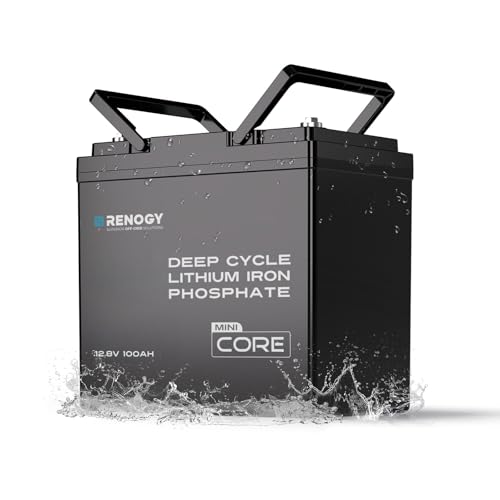
2. Renogy Core Mini 12.8V 100Ah Lithium Iron Phosphate Battery
- Capacity: 100 amp-hours, 1,200 watt-hours
- Voltage: 12.8 volts
- Battery type: Lithium iron phosphate
- Continuous discharge: 100 amps
The Renogy Core Mini is the value pick for a dedicated fridge battery. It stores 100 amp-hours at 12.8 volts, about 1,200 watt-hours, in a compact Group 22NF case that weighs 21.8 pounds. That is roughly five times the energy of the portable power station above, so a typical compressor fridge can run for a full day or more on a single charge, with room to spare for lights or a phone charger wired into the same circuit.
Its small case is the reason it fits where full-size batteries do not. The housing measures about 9.0 x 5.4 x 8.4 inches, so it slides into tight battery boxes, under seats, and into the small compartments common in teardrop trailers and vans. A built-in 100 amp battery management system guards against overcharge, over-discharge, short circuits, and temperature extremes, the IP65 rated housing resists dust and splashes, and it can be wired in series or parallel if a second battery is needed later.
The limit to know before buying is cold charging: Renogy states this battery will not charge below 32 degrees Fahrenheit, so it needs a warm spot or a heated model in freezing weather. For three-season camping and warm-climate travel, though, it is the most energy per dollar in this guide and the easiest fit in a small rig.
3. LiTime 12V 100Ah Xtra-Mini Bluetooth Lithium Iron Phosphate Battery
- Capacity: 100 amp-hours, 1,280 watt-hours
- Voltage: 12.8 volts
- Battery type: Lithium iron phosphate
- Weight: 19.1 pounds
The LiTime Xtra-Mini is the lightest 100 amp-hour battery in this guide at 19.1 pounds, and it adds Bluetooth monitoring that the budget pick lacks. From the phone app you can check the state of charge, voltage, and current draw without opening the battery box, which is handy when the battery lives under a seat or behind a fridge slide. It stores 1,280 watt-hours in a Group 22NF case, so it matches the Renogy Core Mini on energy while saving a couple of pounds.
The built-in battery management system includes low-temperature charging cut-off protection, so the battery protects itself if you try to charge it while the cells are too cold. The listing does not publish the exact cut-off temperature, so buyers who camp in freezing weather should check the manual or choose a self-heating model instead. Like the other bare batteries here, it wires straight to the fridge’s 12 volt plug for maximum efficiency, and it can be mounted in several orientations to fit awkward compartments.
This is the pick for small vans and car campers who count every pound and want to watch their battery from the driver’s seat, and the weight saving and app monitoring justify the step up where the battery is hard to reach.
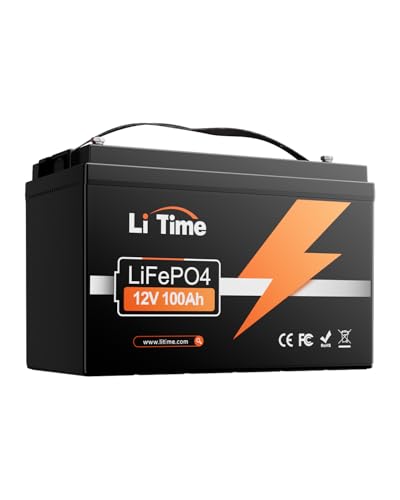
4. LiTime 12V 100Ah Lithium Iron Phosphate Battery Group 31
- Capacity: 100 amp-hours, 1,280 watt-hours
- Voltage: 12.8 volts
- Battery type: Lithium iron phosphate
- Weight: 24.3 pounds
The LiTime Group 31 is the plain, no-extras version of the 100 amp-hour battery: same 1,280 watt-hours and 12.8 volts as the Xtra-Mini, in a standard Group 31 case that drops into the battery trays and boxes built for traditional deep-cycle batteries. At 24.3 pounds it is heavier than the mini-size models, but the Group 31 footprint is the easiest swap for anyone replacing an old lead-acid house battery, with no new tray or hold-down to buy.
There is no Bluetooth and no self-heating here, which keeps the design simple and the cost down. The built-in 100 amp battery management system handles overcharge, over-discharge, short circuit, and temperature protection, the IP65 rated housing resists dust and splashes, and the battery can be expanded in series or parallel up to four in each direction for larger banks.
Choose this one for a straightforward drop-in replacement without app monitoring or cold-weather heating: wire it to the fridge, charge it with a lithium-compatible charger, and it does its job without any setup.
5. Renogy Pro 12V 100Ah Smart Lithium Iron Phosphate Battery with Bluetooth and Self-Heating
- Capacity: 100 amp-hours
- Voltage: 12.8 volts
- Battery type: Lithium iron phosphate
- Weight: 26.9 pounds
The Renogy Pro is the premium pick, built for cold weather and for owners who want full visibility into their battery. It pairs a 100 amp-hour lithium iron phosphate battery with Bluetooth monitoring and a self-heating function: when a charger above 4 amps is connected in the cold, the battery warms its own cells before it starts charging, and Renogy lists a charge range from minus 4 to 131 degrees Fahrenheit. That makes it the only pick here that can be charged confidently on a freezing morning.
The housing is sealed to IP67, a step above the IP65 rating on the budget picks. The battery management system covers overcharge, over-discharge, short circuit, and temperature faults, and the maker backs it with a 7-year warranty, the longest in this guide. At 26.9 pounds it is the heaviest pick, and it can only be connected in parallel, not in series, so it suits 12 volt banks rather than 24 volt builds.
For winter campers and anyone whose fridge battery lives in an unheated cargo area, the self-heating alone is worth the premium. For warm-weather use, the cheaper picks deliver the same runtime, so buy this one for the cold, not for the capacity.
How to Choose
Start with capacity, because it decides how long the fridge runs. A 12 volt compressor fridge typically draws about 35 to 45 watts on average once it is cold, cycling on and off as the thermostat demands. Divide the battery’s watt-hours by that draw for a rough runtime: a 256 watt-hour power station gives about six hours at a 40 watt average draw, while a 100 amp-hour 12 volt battery holding about 1,280 watt-hours gives about thirty hours under the same draw. Real runtimes are shorter, because no battery delivers every watt-hour it stores and hot weather makes the compressor work harder, so treat the math as an upper bound.
Next, decide between a direct 12 volt connection and household AC power. A car fridge with a 12 volt plug runs most efficiently straight from a 12 volt battery, because no energy is lost converting the power to household current and back. The bare batteries in this guide are built for that connection. A portable power station is the better choice if you also want to run household devices, because it has AC outlets built in, but running the fridge from its AC outlet instead of its 12 volt car port wastes energy in the inverter, so use the car port whenever the fridge offers a 12 volt plug.
Chemistry matters more than brand. Lithium iron phosphate can be discharged deeply without damage, holds its voltage steady as it drains, and lasts for thousands of cycles. A lead-acid battery of the same amp-hour rating delivers far less usable energy, because draining it past half its capacity shortens its life sharply, and it weighs roughly twice as much.
Cold weather deserves its own check. Lithium iron phosphate batteries must not be charged while their cells are below freezing, and most battery management systems simply refuse the charge in that state. If you camp in winter, keep the battery in a heated space or buy a self-heating model such as the Renogy Pro. Discharging in the cold is far less restricted, so a cold battery can still run the fridge overnight; the problem is only the morning recharge.
Recharging is the other half of the system. A bare 12 volt battery needs a lithium-compatible charger, and the fastest refill on the road comes from the car itself, through a DC to DC charger while driving or a solar panel while parked. A charger built for lead-acid batteries can overcharge or undercharge the cells. A portable power station is simpler here, since the charger is built in and it accepts wall, car, and solar input.
Finally, measure the space before you order. Group 22NF cases are compact and light, while Group 31 cases match the standard deep-cycle footprint. Weigh the battery against what you can lift in and out of the car, and leave room around it for cables and airflow.
Who Should Skip
Skip a dedicated fridge battery if the fridge only runs while you drive and never needs to stay cold overnight. In that case the car’s own electrical system and a short stop are enough, and a separate battery adds weight and cost for no benefit. Skip the big 100 amp-hour batteries if your trips are single overnights in mild weather: the compact power station covers that job with less bulk and no wiring.
Skip the premium self-heating model if you camp only in warm weather, since you would pay for a feature you never use. Skip any battery that lacks a built-in management system, and skip lead-acid batteries for this job, because their usable capacity and weight count against them on every trip. If your fridge is a thermoelectric cooler rather than a compressor fridge, pause before buying: thermoelectric coolers draw far more power around the clock, so even a 100 amp-hour battery drains in hours, and a larger bank or a compressor fridge is the real fix.
Frequently Asked Questions
How long will a 100Ah battery run a car fridge?
A 100 amp-hour 12 volt battery holds about 1,280 watt-hours, and a typical compressor fridge draws about 35 to 45 watts on average, so expect roughly a full day to a day and a half in mild weather. Hot weather, a warm fridge at startup, and frequent door opening shorten that figure, while pre-cooling the fridge at home and keeping it full stretch it.
Can I run a car fridge from a portable power station?
Yes, and it is the simplest setup for short trips. Plug the fridge into the station’s 12 volt car port rather than its AC outlet, because the direct connection avoids inverter losses and runs the fridge longer. A 256 watt-hour station covers about one night for a typical compressor fridge.
Do I need a special charger for a lithium iron phosphate battery?
Yes. Use a charger with a lithium iron phosphate profile, which charges to the correct voltage and stops cleanly when the battery is full. A charger built only for lead-acid batteries can overcharge the cells or leave the battery partly charged. Portable power stations have the right charger built in, while bare batteries need a separate lithium-compatible charger.
Can I charge the battery while the fridge is running?
Yes, as long as the charging source can cover the fridge’s draw plus add charge to the battery. Driving with a DC to DC charger or parking in sun with a solar panel both work, and the fridge keeps running while the charger tops the battery up. Charging is blocked below freezing on most lithium iron phosphate batteries unless the battery has self-heating.
Final Verdict
The best battery to run a car fridge for most owners is the Renogy Core Mini 12.8V 100Ah, because it packs a full day or more of runtime into a compact, light case at a budget tier and wires straight to the fridge for maximum efficiency. If you want the simplest setup with no wiring, the EcoFlow River 2 is the pick: it carries the fridge for a night, charges in about an hour, and doubles as a charger for phones and laptops. Cold-weather campers should step up to the Renogy Pro for its self-heating and sealed housing, while the LiTime Xtra-Mini suits small builds where every pound counts and the LiTime Group 31 suits a straight drop-in replacement. Size the battery for a full day longer than your longest stop, and your fridge will stay cold without ever touching the starter battery.
Product and ASIN Reference
| Product | ASIN |
|---|---|
| EcoFlow River 2 Portable Power Station | B0B8MXPRDB |
| Renogy Core Mini 12.8V 100Ah Lithium Iron Phosphate Battery | B0DJP772YP |
| LiTime 12V 100Ah Xtra-Mini Bluetooth Lithium Iron Phosphate Battery | B0F3XP375R |
| LiTime 12V 100Ah Lithium Iron Phosphate Battery Group 31 | B084DB36KW |
| Renogy Pro 12V 100Ah Smart Lithium Iron Phosphate Battery with Bluetooth and Self-Heating | B0CRR491ZN |
More from Amazon
Programs that pair well with the guide above. Offers and eligibility are set by Amazon and may change.
Collect the home and kitchen items you want in one registry that guests can shop from.
Create a wedding registrySet up recurring deliveries of everyday items on eligible products. Terms and savings are set by Amazon.
Explore Subscribe & SaveFree shipping on eligible items, Prime Video and more. Eligible new members can start with a free trial.
Start a Prime free trialAudiobooks and podcasts to listen to on the go. Eligible new members can start with a free trial.
Try Audible freeAs an Amazon Associate we earn from qualifying purchases.