Key takeaways
- Base and shape: Nearly every chandelier uses an E12 candelabra base, but the bulb profile changes the look entirely. Flame-tip CA10 reads traditional and hides the diode array; straight-sided B10 and B11 read cleaner and suit modern or transitional fixtures. Measure your shade clearance before committing.
- Color temperature: Stay at 2700K for dining and entry chandeliers. It flatters wood, brass, and skin tones without going amber. Anything at 3000K or above starts to feel commercial in a residential fixture, and mixing temperatures across arms is the single most common styling mistake.
- Dimming compatibility: Confirm the bulb is explicitly dimmable and check it against your dimmer type. LED filament bulbs draw very little current, so older triac dimmers sometimes need a minimum-load correction or a LED-rated replacement to avoid flicker at the low end.
- Color rendering (CRI): For rooms where food, art, or textiles are on display, look for 90+ CRI. The difference between 80 and 90 CRI shows up immediately in reds and warm neutrals — a dining table looks appetizing under one and slightly gray under the other.
- Pack size and spares: Buy for the whole fixture plus extras from the same batch. Manufacturing runs drift slightly in tint, and a single replacement bought two years later rarely matches. A 12-pack for a six-arm chandelier is smart planning, not overbuying.
What's inside
A chandelier is usually the most expensive decision in a dining room, and the cheapest part of it — the bulbs — is what people actually see. Swap in the wrong ones and a fixture that looked luminous in the showroom turns cold and clinical, or worse, flickers and buzzes every time someone touches the dimmer. The frustration is real: mismatched color temperatures across a six-arm fixture, filaments that glare instead of glow, bulbs whose shape fights the socket instead of finishing the silhouette.
This guide approaches bulb selection the way a stylist approaches a room — as a finish, not a component. Below you’ll find the candelabra bulbs worth specifying in 2026, sorted by the situations they actually solve: exposed-filament fixtures where the bulb is the ornament, shaded fixtures where output matters more than looks, and high-fidelity spaces where color rendering carries the whole scheme. We cover base and shape compatibility, dimming behavior, CRI, and how to buy enough bulbs to keep a fixture visually consistent for years.
As an Amazon Associate we earn from qualifying purchases.



How to Choose a Bulbs For Chandelier (2026)
- Base and shape: Nearly every chandelier uses an E12 candelabra base, but the bulb profile changes the look entirely. Flame-tip CA10 reads traditional and hides the diode array; straight-sided B10 and B11 read cleaner and suit modern or transitional fixtures. Measure your shade clearance before committing.
- Color temperature: Stay at 2700K for dining and entry chandeliers. It flatters wood, brass, and skin tones without going amber. Anything at 3000K or above starts to feel commercial in a residential fixture, and mixing temperatures across arms is the single most common styling mistake.
- Dimming compatibility: Confirm the bulb is explicitly dimmable and check it against your dimmer type. LED filament bulbs draw very little current, so older triac dimmers sometimes need a minimum-load correction or a LED-rated replacement to avoid flicker at the low end.
- Color rendering (CRI): For rooms where food, art, or textiles are on display, look for 90+ CRI. The difference between 80 and 90 CRI shows up immediately in reds and warm neutrals — a dining table looks appetizing under one and slightly gray under the other.
- Pack size and spares: Buy for the whole fixture plus extras from the same batch. Manufacturing runs drift slightly in tint, and a single replacement bought two years later rarely matches. A 12-pack for a six-arm chandelier is smart planning, not overbuying.
The Best Bulbs For Chandelier (2026)s Reviewed
Hizashi 90+ CRI LED Candelabra Bulb, 12-Pack
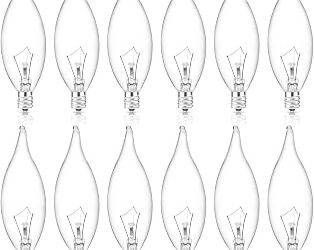
The 90+ CRI rating is what separates these from the field — warm materials and food read accurately rather than washed out, which makes them the default choice above a dining table. The flame-tip CA10 profile and 450 lumens at 4W give traditional fixtures a convincing candlelit quality, and the UL listing is reassuring in a bulb you’ll install a dozen at a time.
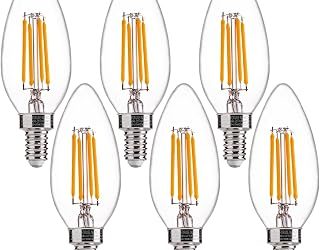
60W Equivalent Clear B11 LED Filament Candelabra Bulbs, 6-Pack
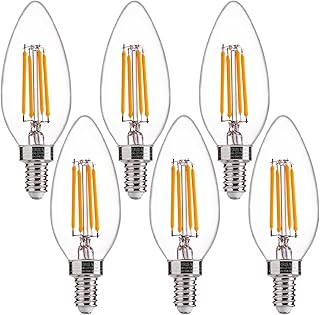
If your chandelier leaves the bulbs exposed, this is the one to specify: clear glass, visible filament, and enough brightness to carry a room on its own at 60W equivalent. The 2700K tone stays warm without tipping orange, and the six-pack sizing suits most small to mid-size fixtures exactly.
Dimmable E12 LED Filament Candelabra Bulbs, 12-Pack
A well-judged balance of vintage look and modern efficiency — 450 lumens from 4W in a clear-glass B11 body that suits ceiling fans and sconces as readily as chandeliers. The generous 12-pack makes it the practical pick when you’re relamping several fixtures at once and want them all to match.
E12 Candelabra LED Flame Tip Bulbs, 12-Pack
These lean into softness rather than sparkle, with a frosted flame-tip shape that diffuses evenly and keeps glare down in shaded or crystal fixtures. At 4W and 460 lumens they’re a straightforward 40W replacement, and the smooth dimming curve is better than the price suggests.
60W E12 B10 Clear Incandescent Candelabra Bulbs, 12-Pack
For purists and for dimmers that refuse to cooperate with LEDs, genuine incandescent remains unbeatable — 600 lumens of continuous-spectrum light that dims to a deep, flicker-free glow. Expect shorter life and more heat, but the warmth as it dims is something no LED fully replicates.
Frequently Asked Questions
How many lumens do I need per bulb?
For a six-arm chandelier in a standard dining room, 400 to 500 lumens per bulb is typically right — roughly 40W equivalent. Larger rooms or fixtures with heavy shades benefit from 60W equivalents around 600 lumens.
Why do my LED bulbs flicker on a dimmer?
Usually a mismatch between low LED load and an older incandescent dimmer. Replacing the dimmer with a LED-compatible model resolves it in most cases; using all identical bulbs on the circuit also helps.
Should I choose clear or frosted glass?
Clear for exposed bulbs where the filament is part of the design, frosted for shaded fixtures or any position at eye level where glare becomes an issue.
Can I mix LED and incandescent in one fixture?
It’s technically fine but visually poor — the two dim at different rates and rarely match in tint. Commit to one type per fixture.
Final Thoughts
For most chandeliers, the Hizashi 90+ CRI candelabra bulbs are the safest specification — accurate color, warm tone, and enough of them to relamp a whole fixture consistently. If your bulbs are on display, the clear B11 LED filament six-pack delivers the most convincing vintage look, while the 60W B10 incandescent set remains the right call for anyone chasing true dim-to-warm behavior on legacy dimmers.