Key takeaways
- Match span to square footage: A 42-inch fan suits rooms under 150 sq ft, 52 inches covers most bedrooms and living rooms up to about 350 sq ft, and 60 inches earns its keep in great rooms, open-plan kitchens, and covered patios where air has to travel.
- Insist on a DC motor for quiet spaces: DC motors draw roughly 60–70% less power than comparable AC units and typically run in the low 20-decibel range at mid speed. In a bedroom or home office, that difference is the whole ballgame.
- Check your ceiling geometry first: Flush or low-profile mounts are required under 8-foot ceilings, while sloped ceilings need a canopy rated for the pitch. Confirm the maximum degree of slope before you buy, not after the box arrives.
- Verify the location rating: Damp-rated fans handle covered porches and screened patios; only wet-rated units belong anywhere exposed to direct rain. Indoor-only motors will corrode outdoors regardless of how sheltered the spot looks.
- Decide how you want to control it: Pull chains are utterly reliable and cost nothing to maintain. Remotes and app control add reverse-season switching and speed presets from bed, but they introduce a receiver in the canopy and a battery to replace.
What's inside
Anyone who has ever installed a ceiling fan under a low ceiling, or tried to layer lighting in a room that already has recessed cans, knows the frustration: almost every fan on the shelf arrives welded to a glowing glass bowl you never asked for. Integrated light kits force a fixed color temperature into your room, add visual bulk to the downrod, and compete with the pendants or sconces you actually chose. For designers and homeowners building a considered lighting plan, the light-free fan is the cleaner move — it lets the fan behave like architecture instead of a fixture.
This guide focuses on fans that either ship with no light at all or let you switch the light off permanently without a stub cap ruining the silhouette. We look at blade span versus room size, DC versus AC motors, sloped-ceiling compatibility, indoor/outdoor ratings, and how quiet a fan really needs to be in a bedroom. Below are the models worth your attention in 2026, followed by a short buying framework and answers to the questions that come up most.
As an Amazon Associate we earn from qualifying purchases.




How to Choose a Ceiling Fan No Light (2026)
- Match span to square footage: A 42-inch fan suits rooms under 150 sq ft, 52 inches covers most bedrooms and living rooms up to about 350 sq ft, and 60 inches earns its keep in great rooms, open-plan kitchens, and covered patios where air has to travel.
- Insist on a DC motor for quiet spaces: DC motors draw roughly 60–70% less power than comparable AC units and typically run in the low 20-decibel range at mid speed. In a bedroom or home office, that difference is the whole ballgame.
- Check your ceiling geometry first: Flush or low-profile mounts are required under 8-foot ceilings, while sloped ceilings need a canopy rated for the pitch. Confirm the maximum degree of slope before you buy, not after the box arrives.
- Verify the location rating: Damp-rated fans handle covered porches and screened patios; only wet-rated units belong anywhere exposed to direct rain. Indoor-only motors will corrode outdoors regardless of how sheltered the spot looks.
- Decide how you want to control it: Pull chains are utterly reliable and cost nothing to maintain. Remotes and app control add reverse-season switching and speed presets from bed, but they introduce a receiver in the canopy and a battery to replace.
The Best Ceiling Fan No Light (2026)s Reviewed
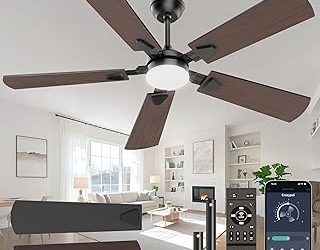
Sofucor 52-Inch Wood Ceiling Fan, No Light
Three wide wood-tone blades on a quiet reversible DC motor make this the most design-forward pick here — it reads more like a sculptural object than an appliance, and the six-speed remote covers everything from a whisper to real summer airflow. Rated for covered outdoor use, it’s an easy specification for a farmhouse porch or a bedroom where you want warmth without a light kit.
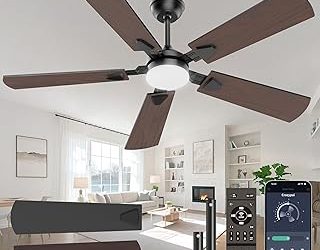
60-Inch Wood Ceiling Fan Without Light (Walnut)
When the room is genuinely large, span beats motor tricks, and this walnut 60-inch is the value play for great rooms, long living spaces, and deep covered patios. Its flat-and-sloped ceiling compatibility is the real differentiator, since oversized fans are often where slope adapters become an expensive afterthought.
Hunter Builder Elite 52-Inch, No Light (Snow White)
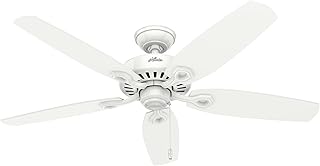
This is the fan to install and forget: a five-blade Hunter on a standard mount with a pull chain, no receiver to fail and no remote to lose. Snow white disappears into a painted ceiling completely, which is exactly what you want when the lighting design lives elsewhere in the room.
TCL 52-Inch Low Profile Flush Mount
For 8-foot ceilings where headroom is tight, TCL’s flush-mount 52-inch pairs a quiet six-speed DC motor with a dimmable LED you can simply leave off — a practical compromise when you want minimal drop but might sell the house to someone who wants light. Blade span and airflow are competitive with fans twice the profile height.
DREO 42-Inch Low Profile Indoor/Outdoor
At 22 dB and 42 inches, this is the small-room specialist: nurseries, offices, guest rooms, and compact covered balconies. The quick-install bracket genuinely shortens a solo installation, and the five-CCT light can stay dark indefinitely if you’re running the fan as a pure air-mover.
Frequently Asked Questions
Are fans without lights actually better for air circulation?
Not inherently, but removing the light kit lets manufacturers shorten the housing and lower the blade plane, which often improves how air moves near the ceiling. The bigger factors remain blade span, pitch, and motor output.
Can I add a light kit later?
Sometimes. Models sold as “no light” frequently have no wiring provision or mounting boss for a kit, so treat the absence of light as permanent unless the manufacturer lists a compatible accessory.
Do I still need a wall switch if the fan has a remote?
Yes — keep a switched hot leg for power. Remote receivers should not be the only means of cutting current for maintenance or a stuck motor.
Which direction should the blades turn?
Counterclockwise in summer to push a cooling downdraft, clockwise on low in winter to pull warm air off the ceiling and mix it back down without a draft.
Final Thoughts
For most rooms, the Sofucor 52-inch wood fan is the strongest overall choice: quiet DC motor, genuinely handsome blades, and a covered-outdoor rating that widens where you can use it. Choose the Hunter Builder Elite if you want the simplest, most serviceable no-light fan available, and step up to the 60-inch walnut model when the room is large enough that span, not features, is the deciding factor.