Key takeaways
- Size to the room, not the ceiling: Rooms up to 12 feet across do well with a 44 to 52 inch span; anything larger, or an open-plan great room and covered patio, benefits from 60 to 65 inches. Undersized fans compensate by running fast and loud.
- Prioritize DC motors: A brushless DC or BLDC motor draws roughly 60 to 70 percent less power than an AC equivalent, runs closer to 35 dB, and unlocks six-speed control with a reverse setting for winter circulation. It’s the single biggest quality jump available.
- Read the CFM figure: Airflow is the honest spec. Bedrooms feel comfortable around 3,000 to 4,000 CFM; exposed patios and garages want 5,500 or more to overcome open air and heat.
- Match the rating to the location: Damp-rated fans handle covered porches and screened rooms. Wet-rated units tolerate direct rain. Indoor-only fans in humid air will warp, rust, and fail early.
- Confirm the mount before you buy: Sloped ceilings, low 8-foot ceilings, and flush installs each need specific hardware. Check the included canopy range, and decide whether you want remote, app, or a simple pull chain — some walls are better off untouched.
What's inside
Ceiling fans have spent decades apologizing for themselves with a frosted glass bowl bolted to the bottom. That made sense when a bedroom had one junction box and one chance at illumination. It makes far less sense now, when most renovated spaces layer recessed cans, sconces, and a lamp or two — leaving the fan’s built-in fixture as a dim, yellowish afterthought nobody switches on. Strip it away and the fan finally reads as what it should be: a piece of ceiling hardware with a silhouette, a finish, and a job.
This guide covers six light-free fans worth specifying in 2026, from natural-wood three-blade profiles built for quiet bedrooms to 60-inch industrial units that push serious air across a covered porch. We looked at airflow in CFM rather than blade count alone, motor type and noise floor, damp and wet ratings for outdoor use, mounting flexibility on sloped ceilings, and whether the control scheme feels considered or tacked on.
As an Amazon Associate we earn from qualifying purchases.


How to Choose a Ceiling Fan Without Light (2026)
- Size to the room, not the ceiling: Rooms up to 12 feet across do well with a 44 to 52 inch span; anything larger, or an open-plan great room and covered patio, benefits from 60 to 65 inches. Undersized fans compensate by running fast and loud.
- Prioritize DC motors: A brushless DC or BLDC motor draws roughly 60 to 70 percent less power than an AC equivalent, runs closer to 35 dB, and unlocks six-speed control with a reverse setting for winter circulation. It’s the single biggest quality jump available.
- Read the CFM figure: Airflow is the honest spec. Bedrooms feel comfortable around 3,000 to 4,000 CFM; exposed patios and garages want 5,500 or more to overcome open air and heat.
- Match the rating to the location: Damp-rated fans handle covered porches and screened rooms. Wet-rated units tolerate direct rain. Indoor-only fans in humid air will warp, rust, and fail early.
- Confirm the mount before you buy: Sloped ceilings, low 8-foot ceilings, and flush installs each need specific hardware. Check the included canopy range, and decide whether you want remote, app, or a simple pull chain — some walls are better off untouched.
The Best Ceiling Fans Without Light, Reviewed
52″ Solid Wood 3-Blade Ceiling Fan, Remote Control
Natural wood blades and a slim housing give this one a warm, almost furniture-like presence, which is exactly what a bedroom or dining room wants overhead. Six speeds and a genuinely quiet motor make it easy to leave running through the night, and it accommodates both flat and sloped ceilings.
Ohniyou 60″ Industrial Ceiling Fan, Black
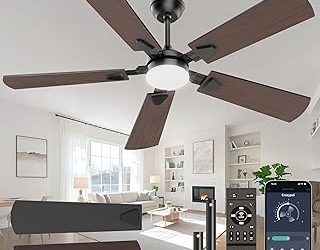
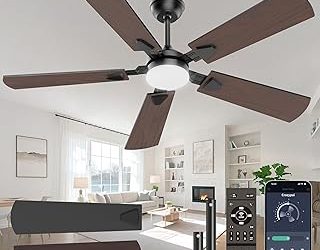
At 6,800 CFM from five aluminum blades, this is the airflow answer for a wide porch, sunroom, or workshop where lesser fans just stir the heat around. The DC motor keeps it near 35 dB despite the output, and remote plus app control means you’re not running a new switch leg to the ceiling.
52″ Outdoor Solid Wood Fan, Dark Walnut
A rustic three-blade propeller in dark walnut, damp rated and driven by a high-CFM BLDC motor — the rare outdoor fan that doesn’t look like equipment. It works equally well indoors, so it’s a smart choice when a covered patio needs to visually match the room it opens onto.
ZMISHIBO 65″ Ceiling Fan with Remote
Sixty-five inches and 6,116 CFM put this in great-room and garage territory, where sheer sweep does more than motor speed ever will. The reversible DC motor stays quiet at the low end, and the matte black finish disappears against a dark ceiling.
Hunter Builder Elite 52″, New Bronze
Pull chain, five blades, standard mount, no electronics to fail — Hunter’s Builder Elite is the dependable spec for a rental unit, guest room, or kitchen where simplicity is the feature. The New Bronze finish holds up better than budget painted housings.
Frequently Asked Questions
Can I add a light to these later?
Sometimes. Some models accept a manufacturer light kit at the switch housing, but many light-free fans are sealed by design. Assume no unless the listing specifies a compatible kit.
Do fans without lights move more air?
Not inherently, though removing the fixture lets designers lower the blade profile and use a cleaner motor housing. The real airflow drivers are blade span, pitch, and motor type.
Is a DC motor worth the premium?
For any fan you run daily, yes. Lower draw, quieter operation, more speed steps, and reverse mode compound over years of use.
Can an indoor fan work on a covered porch?
It shouldn’t. Humidity corrodes bearings and swells non-treated blades. Choose damp rated for covered areas, wet rated for anything exposed.
Final Thoughts
For most bedrooms and dining rooms, the 52-inch solid wood three-blade fan delivers the quietest, most architectural result. Outdoors or in a large open room, the Ohniyou 60-inch industrial fan has the airflow headroom to actually change how a space feels, while the Hunter Builder Elite remains the sensible, no-drama pick when budget and reliability matter more than styling.