Key takeaways
- Blade span to room size: Measure the longest wall. Under 12 feet, a 42–52 inch fan is right; 13 to 18 feet calls for 52–60 inches; great rooms and covered patios past 18 feet want 60–65 inches or a second fan.
- DC motor over AC: DC motors draw roughly 60–70% less power, run appreciably quieter, and unlock six or more speeds plus reverse for winter downdraft. AC motors are cheaper and pull-chain simple, which still suits a guest room or garage.
- Mount type, measured honestly: Flush and low-profile mounts belong on ceilings under 9 feet, keeping blades safely above head height. Anything taller needs a downrod, and sloped ceilings require confirming the canopy’s maximum degree rating before you buy.
- CFM, not blade count: Airflow is a function of pitch, motor torque, and span. A well-pitched three-blade fan often outperforms a flat five-blade. Look for 4,000+ CFM in living spaces and treat published numbers as comparative, not absolute.
- Damp or wet rating: Covered porches need a damp-rated fan at minimum. Open pergolas and anywhere rain reaches require wet-rated housing and ABS or treated blades that won’t warp through a humid season.
What's inside
Ceiling fans spent two decades trying to be light fixtures, and the results were rarely flattering. Frosted glass bowls, five-bulb candelabras, integrated LED panels that glow like a dental exam — all of it competing with the pendant or sconce you actually chose. The light-free ceiling fan solves this by staying in its lane. It moves air, reads as architecture rather than hardware, and leaves your lighting plan intact. The catch is that stripping the light out doesn’t automatically make a fan good. Plenty of no-light models are the same builder-grade motors with the fitter capped off, humming through three speeds and calling it a day.
This guide looks at the fans worth mounting in a room you care about. We weighted airflow against noise, since CFM ratings mean little if the fan buzzes at speed four, and paid attention to profile: flush-mount options for low ceilings, downrod-and-sloped-ceiling compatibility for vaulted spaces, and blade spans scaled to real square footage. Finishes matter too, so wood-toned and matte black bodies get their due alongside traditional bronze. Below are six current picks, followed by the specs that separate a fan you forget about from one you notice every evening.
As an Amazon Associate we earn from qualifying purchases.


How to Choose a Ceiling Fan Without a Light (2026)
- Blade span to room size: Measure the longest wall. Under 12 feet, a 42–52 inch fan is right; 13 to 18 feet calls for 52–60 inches; great rooms and covered patios past 18 feet want 60–65 inches or a second fan.
- DC motor over AC: DC motors draw roughly 60–70% less power, run appreciably quieter, and unlock six or more speeds plus reverse for winter downdraft. AC motors are cheaper and pull-chain simple, which still suits a guest room or garage.
- Mount type, measured honestly: Flush and low-profile mounts belong on ceilings under 9 feet, keeping blades safely above head height. Anything taller needs a downrod, and sloped ceilings require confirming the canopy’s maximum degree rating before you buy.
- CFM, not blade count: Airflow is a function of pitch, motor torque, and span. A well-pitched three-blade fan often outperforms a flat five-blade. Look for 4,000+ CFM in living spaces and treat published numbers as comparative, not absolute.
- Damp or wet rating: Covered porches need a damp-rated fan at minimum. Open pergolas and anywhere rain reaches require wet-rated housing and ABS or treated blades that won’t warp through a humid season.
The Best Ceiling Fans Without Lights, Reviewed
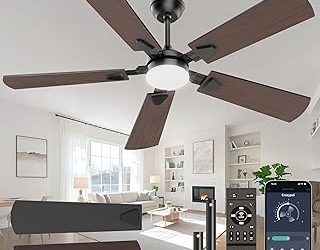
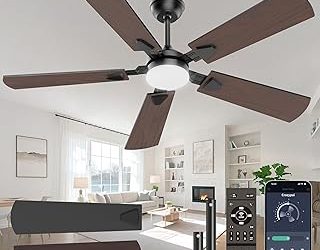
ZMISHIBO 52 Inch Ceiling Fan, Black
At 3,713 CFM from a 52 inch span, this is the airflow-per-inch benchmark in the category, and the reversible DC motor stays genuinely quiet through all six speeds. The matte black body and remote-plus-timer controls make it the default choice for a modern living room or a home office that needs air without visual noise.
ZMISHIBO 65 Inch Ceiling Fan with Remote
6,116 CFM across a 65 inch sweep is serious displacement, enough for open-plan great rooms, deep covered patios, and workshops where stagnant air is the problem. It keeps the same six-speed DC motor and remote as its smaller sibling, so the scale-up costs you nothing in refinement.
Sofucor 52 Inch Wood Ceiling Fan, Flush Mount
A flush-mount fan with a wood-grain finish is a rare combination, and this one handles both well: low enough for eight-foot ceilings, warm enough to sit alongside oak floors and rattan without reading as an appliance. Six speeds, a timer, and reverse come standard through the remote.
60 Inch Wood Ceiling Fan, Walnut
The walnut finish and generous 60 inch span give this fan real presence over a dining table or a screened porch, and flat-plus-sloped ceiling compatibility means it works in vaulted rooms where most budget fans can’t hang plumb. Best treated as a design element you also happen to run.
Hunter Builder Elite, 52 Inch, New Bronze
Pull chain, five blades, no app and no pairing — Hunter’s Builder Elite is the reliable traditionalist here, and the New Bronze finish suits transitional and craftsman interiors that matte black fights. Choose it when you want a fan that simply works for fifteen years in a bedroom or kitchen.
Frequently Asked Questions
Can I add a light to a no-light ceiling fan later?
Sometimes, but don’t count on it. Many modern DC fans have no light kit adapter at all, and the ones that do list a specific compatible kit. If lighting flexibility matters, buy a fan with an available add-on rather than assuming.
Do fans without lights move more air?
Not inherently, though they often measure better. Removing the fitter lowers the blade assembly’s obstruction and lets manufacturers optimize hub design and pitch, which is part of why compact no-light fans post competitive CFM figures.
What direction should the blades turn in winter?
Clockwise on low speed. That pulls cool air up and pushes trapped warm air down the walls without creating a draft, which can meaningfully cut heating load in rooms with high ceilings.
Is a remote-only fan a problem on a wall switch?
Most DC fans need constant power, so a switched circuit works only if the switch stays on. Existing dimmer switches must be replaced with a standard switch, since dimmers will damage the receiver.
Final Thoughts
For most rooms, the ZMISHIBO 52 Inch is the balanced pick: strong airflow, quiet DC motor, and a profile that disappears into a contemporary ceiling. Scale up to the ZMISHIBO 65 Inch for open-plan spaces and large patios, or choose the Sofucor 52 Inch flush mount if your ceilings sit low and you want warmth rather than matte black. Any of the three will outperform the fixture-fan hybrid it replaces.