Key takeaways
- Match the seat range to your desk: Measure from floor to desktop, then subtract 10 to 12 inches for your ideal seat height. Most drafting chairs cover roughly 22 to 32 inches, so confirm your number falls in the middle of the range rather than at the very top of it.
- Insist on an adjustable footrest ring: A fixed ring only works for one leg length. Rings that slide or lift several inches let you set a true 90-degree knee angle, which is what keeps the chair comfortable past the one-hour mark.
- Choose your back support honestly: Mesh breathes and suits warm rooms and long sessions. Bonded leather reads more polished in a shared living space but traps heat. Either way, look for a contoured lumbar curve rather than a flat panel.
- Flip-up arms are a space feature, not a luxury: Raised desks leave less clearance underneath. Arms that fold vertically let the chair tuck fully away, which matters enormously in an alcove office or a bedroom corner.
- Check the base diameter and casters: Tall chairs need a wide five-star base for stability. If you’re on hardwood or tile, budget for felt-lined or PU casters, and prefer nylon bases over plastic for anything approaching daily use.
What's inside
Height-adjustable desks changed the way we work, but most of us never updated the seat. A standard task chair tops out around 21 inches, while a counter-height or raised sit-stand surface sits closer to 40. The result is the posture nobody plans for: shoulders shrugged toward the keyboard, wrists angled up, feet dangling with nothing to brace against. It’s the reason so many people abandon the “sit” half of sit-stand entirely and end up standing until their knees complain.
A drafting chair fixes the geometry. It’s essentially a task chair on a longer gas cylinder, paired with a footrest ring so your legs have a landing spot at elevation. Below we’ve gathered six of the most credible options for 2026, from breathable mesh builds to leather-look executive seats and a slim armless stool for tight studios. We look at seat-height range, footrest quality, back support, and how each one behaves in a room you actually live in.
As an Amazon Associate we earn from qualifying purchases.




How to Choose a Chair Standing Desk (2026)
- Match the seat range to your desk: Measure from floor to desktop, then subtract 10 to 12 inches for your ideal seat height. Most drafting chairs cover roughly 22 to 32 inches, so confirm your number falls in the middle of the range rather than at the very top of it.
- Insist on an adjustable footrest ring: A fixed ring only works for one leg length. Rings that slide or lift several inches let you set a true 90-degree knee angle, which is what keeps the chair comfortable past the one-hour mark.
- Choose your back support honestly: Mesh breathes and suits warm rooms and long sessions. Bonded leather reads more polished in a shared living space but traps heat. Either way, look for a contoured lumbar curve rather than a flat panel.
- Flip-up arms are a space feature, not a luxury: Raised desks leave less clearance underneath. Arms that fold vertically let the chair tuck fully away, which matters enormously in an alcove office or a bedroom corner.
- Check the base diameter and casters: Tall chairs need a wide five-star base for stability. If you’re on hardwood or tile, budget for felt-lined or PU casters, and prefer nylon bases over plastic for anything approaching daily use.
The Best Chair Standing Desks (2026) Reviewed
Drafting Chair with Flip-up Armrests and Adjustable Footrest Ring
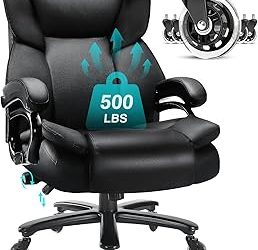
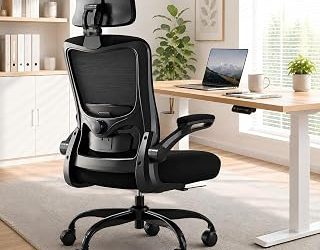
This is the well-rounded starting point: executive-style padding, sculpted lumbar support, and a footrest ring that adjusts independently of seat height, so tall and shorter users both get proper leg support. The flip-up armrests make it easy to slide under a raised desk when you switch to standing.
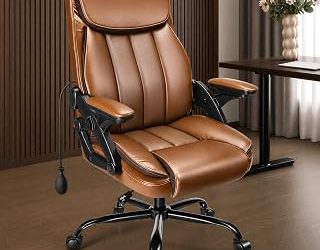
High-Back Leather Drafting Chair for Counter-Height Desks
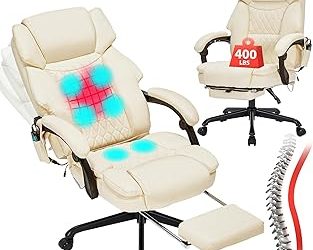
The most design-forward option here, with a tall upholstered back that reads like a conventional office chair rather than a workshop stool. It’s the one to pick if the desk lives in a visible part of the home, though the leather-look surface runs warmer than mesh over a full workday.
Sweetcrispy Tall Drafting Chair with Footrest
Sweetcrispy has built a following on value, and this model earns it with a genuinely supportive lumbar curve, flip-up arm, and smooth 360-degree rotation. A sensible pick for a secondary workstation, craft table, or a teen’s study setup.
Drafting Chair with 22″–30″ Seat Height and 7″ Lift Footrest
The specification sheet does the talking: an eight-inch seat range plus a seven-inch footrest lift covers nearly every desk height and body type in one chair. Mesh backing and flip-up arms round out a strong option for artists working at easels or drafting tables.
Ergonomic Mesh Tall Drafting Chair with Flip-Up Arms
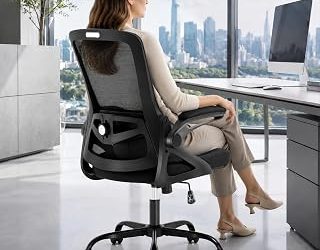
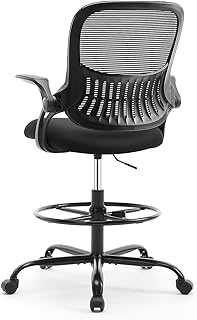
Our choice for warm rooms and long stretches of focused work, thanks to a fully breathable backrest that doesn’t compromise on lumbar shaping. The adjustable footrest ring and folding arms make it flexible enough to move between a standing desk and a kitchen island.
Frequently Asked Questions
Do I need a drafting chair if my desk already adjusts?
Yes, if you want to sit at the raised position. Lowering the desk each time you sit works, but it discourages switching. A tall chair lets you keep the desk high and alternate freely, which is the entire point of sit-stand.
What seat height should I order?
Subtract 10 to 12 inches from your desktop height. A 40-inch desk pairs well with a seat around 28 to 30 inches. Buy for the middle of a chair’s range so you have room to fine-tune in both directions.
Is an armless drafting chair worth considering?
For tight spaces and detail work, absolutely. Armless models like the high-back rolling stool tuck in closer and give your elbows unrestricted movement, though you lose the option to rest your arms between tasks.
Are these chairs stable at full height?
Reputable models use a wide five-star base to counteract the raised center of gravity. Avoid leaning back hard at maximum extension, keep the footrest ring engaged, and check the stated weight capacity before buying.
Final Thoughts
For most homes, the Drafting Chair with Flip-up Armrests and Adjustable Footrest Ring hits the right balance of comfort, adjustability, and price. Choose the Ergonomic Mesh Tall Drafting Chair if breathability matters more than plush padding, or the High-Back Leather Drafting Chair when the workstation sits in full view of the rest of the room.