Key takeaways
- Backrest height, not just chair height: Look for a backrest reaching 28 inches or more from the seat, so the headrest supports your skull rather than your shoulders. A tall chair with a short back is still a short chair.
- Seat depth and width: Longer femurs need 19 to 21 inches of usable depth, with a waterfall front edge to keep pressure off the back of your knees. Sliding seat pans are a genuine advantage here.
- Cylinder range: Check the maximum seat height, not the minimum. You want your feet flat and your knees at or slightly below hip level, which usually means 20 inches or higher at the top of the range.
- Weight capacity as a proxy for build: A 350 to 750 lb rating signals a reinforced steel base, thicker foam, and a sturdier mechanism, all of which resist the twisting forces a longer torso applies over an eight-hour day.
- Adjustable lumbar in two axes: Tall spines put the lumbar curve higher than standard chairs assume. Support that moves up and down as well as in and out is essential, not a luxury.
What's inside
Most desk chairs are engineered around a statistical average that taller bodies simply fall outside of. If you’re over six feet, you know the symptoms: a backrest that stops at your ribs, a headrest that lands squarely between your shoulder blades, a seat pan too shallow to support your thighs, and a gas cylinder that maxes out just as your knees start rising above your hips. The result isn’t only discomfort. It’s a slow collapse into a forward-head posture that no amount of stretching at 4 p.m. will undo.
This guide looks at chairs through the lens of proportion rather than marketing spec sheets. We’ve prioritized tall-specific geometry, high backrests, generous seat depth, wide weight ratings, and cylinders with real vertical range, alongside the finish and silhouette that matter when a chair lives in a visible corner of your home rather than a cubicle. Below are the models worth your attention in 2026, followed by the buying criteria we used to sort them.
As an Amazon Associate we earn from qualifying purchases.


How to Choose an Ergonomic Office Chair For Tall Person (2026)
- Backrest height, not just chair height: Look for a backrest reaching 28 inches or more from the seat, so the headrest supports your skull rather than your shoulders. A tall chair with a short back is still a short chair.
- Seat depth and width: Longer femurs need 19 to 21 inches of usable depth, with a waterfall front edge to keep pressure off the back of your knees. Sliding seat pans are a genuine advantage here.
- Cylinder range: Check the maximum seat height, not the minimum. You want your feet flat and your knees at or slightly below hip level, which usually means 20 inches or higher at the top of the range.
- Weight capacity as a proxy for build: A 350 to 750 lb rating signals a reinforced steel base, thicker foam, and a sturdier mechanism, all of which resist the twisting forces a longer torso applies over an eight-hour day.
- Adjustable lumbar in two axes: Tall spines put the lumbar curve higher than standard chairs assume. Support that moves up and down as well as in and out is essential, not a luxury.
The Best Ergonomic Office Chairs For Tall People (2026) Reviewed
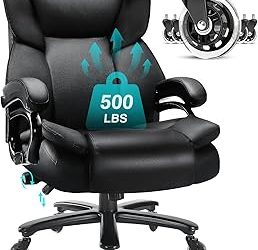
750lbs Big and Tall Mesh Office Chair
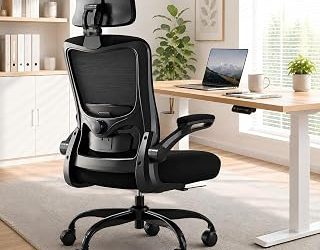
The most structurally serious option here, with a wide, thickly padded seat cushion and a frame rated for exceptionally heavy use, making it the safest pick for anyone tall and broad. The 4D armrests and adjustable lumbar module let you dial in support precisely, and it’s clearly built for genuine full-day sitting.
X100 Ergonomic Mesh Chair with Footrest
A strong balance of tall-friendly geometry and modern visual restraint, pairing a high mesh back and 3D lumbar adjustment with 5D flip-up arms that tuck away under a desk. The retractable footrest makes it a natural fit for rooms where your desk chair doubles as your reading chair; the First Light colorway is the softer, lighter-toned version of the same design.
Mimoglad High Back Ergonomic Desk Chair
Our value recommendation for taller users who mostly need height and headrest coverage rather than maximum load capacity. The flip-up armrests are genuinely useful for guitarists and anyone who works close to their desk, and the five-year warranty is unusually confident at this price.
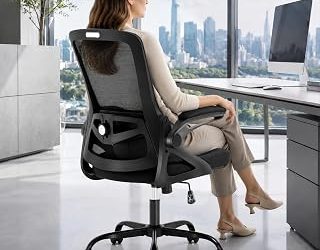
330LBS High Back Mesh Computer Chair
A clean, breathable everyday chair with adjustable lumbar support and flip-up arms, best suited to leaner tall frames or secondary workspaces. Treat the 330 lb rating as a real limit rather than a rounding error.
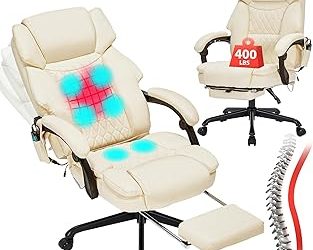
6-Point Massage Executive Chair with Heat
The executive choice, wrapping a reclining frame and retractable footrest in off-white leather that reads more furniture than office equipment. Massage and heat are pleasant extras rather than ergonomic features, so buy it for the recline and the presence.
Frequently Asked Questions
What seat height do I need if I’m 6’4″?
Roughly 20 to 22 inches, measured from the floor to the top of the compressed cushion. Sit down and check that your thighs run parallel to the floor or angle very slightly downward.
Is mesh or leather better for tall users?
Mesh usually wins for long workdays because it flexes to a longer spine and stays cooler. Leather suits reclining, lower-intensity use and rooms where the chair needs to look like furniture.
Do I really need a headrest?
Only if it reaches your head. A headrest positioned too low acts as a fulcrum that pushes your upper back forward, so verify the adjustment range before buying.
Are footrests worth it?
For tall users they’re less about foot support and more about enabling a proper recline break. Useful, but never a substitute for correct seat height.
Final Thoughts
For most tall buyers, the 750lbs Big and Tall mesh chair is the safest long-term investment, with the X100 with footrest close behind for anyone who wants tall-friendly ergonomics in a quieter, more design-conscious package. If budget is the constraint, the Mimoglad high back delivers most of the height and support that matters for noticeably less.