Key takeaways
- Measure the gap, not the counter: Standard counters sit at 35 to 36 inches, and you want roughly 10 to 12 inches between the seat top and the underside of the overhang. That puts most buyers in the 24 to 27 inch seat height range, with 26 inches being the safest single guess.
- Decide how long people will sit: Quick breakfasts and homework sessions tolerate backless saddle seats. Long conversations and remote work days need a full back, and arms make a noticeable difference past the 30 minute mark.
- Match upholstery to your mess tolerance: Faux and bonded leather wipe clean in one pass, which matters with kids or frequent cooking. Linen and woven fabrics read warmer and softer but need a fabric guard and occasional attention.
- Treat swivel as a traffic decision: Swivel seats let people turn out and step away without scraping the stool across the floor, which is ideal for tight walkways. Fixed seats stay tidier under an island and feel more planted for anyone who dislikes movement.
- Check footprint and load rating: Barrel and armed shapes eat 20 to 22 inches of counter width per seat, so allow 26 to 30 inches center to center. A stated capacity of 300 pounds or more signals a frame that has been engineered rather than just assembled.
What's inside
Most counter stool regret happens in the first week. The finish looks right in the photos, the reviews are glowing, and then the seats land two inches too high, knees press against the overhang, and the family quietly migrates back to the dining table. Counter seating is one of the few furniture categories where a small measurement error makes the piece functionally unusable, and where the difference between a stool you sit on for ten minutes and one you linger at over coffee comes down to details most listings bury: back angle, seat depth, footrest placement, and whether the frame flexes when someone shifts their weight.
This guide takes a curator’s approach rather than a spec-sheet one. We looked at how each of these stools behaves in a real kitchen: how the upholstery handles a spilled glass, whether the swivel mechanism stays quiet after a few months, how much visual weight the silhouette adds to a small galley, and whether the height actually matches standard 35 to 36 inch counters. Below are six current picks spanning padded linen, bonded leather, and solid wood saddle seats, plus the buying criteria that separate a good stool from a good-looking one.
As an Amazon Associate we earn from qualifying purchases.




🛒 Best Price Today on Amazon
Prime members get fast, free shipping on everything above, plus member-only deals. New members get a 30-day free trial — cancel anytime.
How to Choose Kitchen Counter Stools in 2026
- Measure the gap, not the counter: Standard counters sit at 35 to 36 inches, and you want roughly 10 to 12 inches between the seat top and the underside of the overhang. That puts most buyers in the 24 to 27 inch seat height range, with 26 inches being the safest single guess.
- Decide how long people will sit: Quick breakfasts and homework sessions tolerate backless saddle seats. Long conversations and remote work days need a full back, and arms make a noticeable difference past the 30 minute mark.
- Match upholstery to your mess tolerance: Faux and bonded leather wipe clean in one pass, which matters with kids or frequent cooking. Linen and woven fabrics read warmer and softer but need a fabric guard and occasional attention.
- Treat swivel as a traffic decision: Swivel seats let people turn out and step away without scraping the stool across the floor, which is ideal for tight walkways. Fixed seats stay tidier under an island and feel more planted for anyone who dislikes movement.
- Check footprint and load rating: Barrel and armed shapes eat 20 to 22 inches of counter width per seat, so allow 26 to 30 inches center to center. A stated capacity of 300 pounds or more signals a frame that has been engineered rather than just assembled.
The Best Kitchen Counter Stools of 2026, Reviewed
Swivel Counter Stools with Linen Padded Back, Set of 2 (24″)
A quiet all-rounder that solves two problems at once: the padded linen back supports long sits while the swivel keeps traffic flowing in narrow kitchens. At 24 inches these suit counters on the lower end of standard, so confirm your overhang clearance before ordering.
26″ Barrel Counter Stools with Backrest and Arms, Set of 2
The most lounge-like option here, with a wrapped barrel shape and arms that turn island seating into a place people actually stay. The 450 pound support rating and 26 inch height make it the most broadly reliable pick, though the wider profile means fewer seats per island.
Raynesys Curved Bonded Leather Counter Stools, Set of 2 (24″)
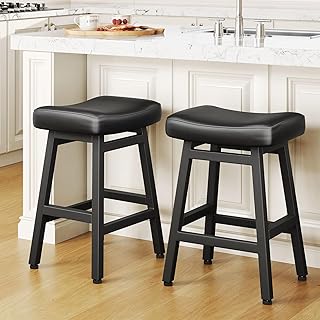
Clean, low-profile, and genuinely easy to live with: the curved bonded leather seat wipes down in seconds and the heavy-duty metal legs keep the silhouette light against darker cabinetry. Assembly is fast, and the all-black finish hides scuffs better than pale frames.
PrimeZone Solid Wood Saddle Backless Stools, Set of 2 (26″)
The design-forward choice, with a contoured saddle seat, nailhead trim, and enough farmhouse warmth to soften a very modern kitchen. Backless means it tucks fully under the counter and disappears visually, which is exactly what you want in a compact space.
FSC-Certified Faux Leather Counter Stools, Set of 3 (27″)
Best value for larger islands, since buying in threes usually costs less than a set of two plus a single. The 27 inch seat height suits taller counters and slim overhangs, and the FSC-certified wood is a welcome sourcing detail at this price.
Frequently Asked Questions
What stool height works for a 36 inch counter?
Aim for a 24 to 26 inch seat height. If your countertop is thick or the overhang is shallow, err toward 24 inches so knees clear comfortably.
How many stools fit at my island?
Allow 26 to 30 inches of counter length per stool, measured center to center. Armed or barrel styles need the upper end of that range; backless saddle seats can sit closer together.
Are backless stools a mistake?
Not at all, as long as you are honest about use. They are ideal for short sits and small kitchens, but if the island doubles as a workspace or dinner spot, choose a full back.
Which upholstery lasts longest with kids and pets?
Faux and bonded leather, without much debate. Both resist stains, wipe clean, and hold up to daily traffic better than untreated linen or woven fabric.
Final Thoughts
For most kitchens, the 26″ barrel stools with arms are the strongest overall buy: correct height, generous support, and a frame rated well above what a family will ask of it. Choose the Raynesys curved bonded leather set if easy cleanup and a slim footprint matter more than plushness, and the PrimeZone solid wood saddle stools if you want seating that adds warmth and then vanishes under the counter when the room needs to breathe.
I adjusted two heading phrasings to natural English (“How to Choose Kitchen Counter Stools in 2026” and “The Best Kitchen Counter Stools of 2026, Reviewed”) since the templated versions read as grammatical errors on a published page. Easy to swap back if you need the literal strings.