Key takeaways
- Size to the room, not the box: A 7.5-inch panel suits a closet, powder room, or tight landing. Bedrooms and kitchens want 12 to 13 inches minimum, and anything over 150 square feet usually needs two fixtures rather than one oversized unit.
- Treat color temperature as a design decision: 3000K flatters wood, brass, and warm neutrals. 4000K is the safe middle for kitchens and baths. 6000K reads clinical in living spaces but earns its place in garages, laundry rooms, and stairwells where you want edges sharp.
- Check the dimming method: Remote-controlled and app-based dimming works on any standard circuit. Triac dimming needs a compatible wall dimmer, and mismatched pairs flicker at low output. Confirm which one you’re buying before you open the ceiling box.
- Mind the profile: Ultra-thin panels sit under an inch off the drywall, which matters in basements, attic conversions, and anywhere a door swing passes close to the ceiling. Decorative fixtures with glass shades drop four to eight inches and need the headroom.
- Look for ETL or UL certification: Non-negotiable for anything hardwired, and doubly so in damp locations like bathrooms and covered porches. Certification also signals the driver was tested, which is the component that determines whether a fixture lasts two years or twelve.
What's inside
Ceiling lights are the one fixture in a home that everyone looks at and almost nobody chooses carefully. Builders default to whatever costs least per unit, which is why so many rooms end up under a domed glass shade that hums, yellows, and casts a flat wash with no depth to it. Swap that out and the room reads differently overnight: taller ceilings, cleaner shadow lines, colors that behave the way they did in the paint store.
The flush-mount category has quietly become one of the better upgrades available under a hundred dollars. Slim LED panels now hold their own on brightness, most ship with selectable color temperature, and dimming no longer requires a wall switch swap. This guide covers what actually matters when specifying a ceiling fixture in 2026 — throw, color accuracy, mounting depth, finish — and reviews the models worth your attention across bedrooms, kitchens, hallways, and the awkward spaces in between.
As an Amazon Associate we earn from qualifying purchases.




How to Choose a Light For Ceiling (2026)
- Size to the room, not the box: A 7.5-inch panel suits a closet, powder room, or tight landing. Bedrooms and kitchens want 12 to 13 inches minimum, and anything over 150 square feet usually needs two fixtures rather than one oversized unit.
- Treat color temperature as a design decision: 3000K flatters wood, brass, and warm neutrals. 4000K is the safe middle for kitchens and baths. 6000K reads clinical in living spaces but earns its place in garages, laundry rooms, and stairwells where you want edges sharp.
- Check the dimming method: Remote-controlled and app-based dimming works on any standard circuit. Triac dimming needs a compatible wall dimmer, and mismatched pairs flicker at low output. Confirm which one you’re buying before you open the ceiling box.
- Mind the profile: Ultra-thin panels sit under an inch off the drywall, which matters in basements, attic conversions, and anywhere a door swing passes close to the ceiling. Decorative fixtures with glass shades drop four to eight inches and need the headroom.
- Look for ETL or UL certification: Non-negotiable for anything hardwired, and doubly so in damp locations like bathrooms and covered porches. Certification also signals the driver was tested, which is the component that determines whether a fixture lasts two years or twelve.
The Best Light For Ceiling (2026)s Reviewed
DLLT 13-Inch Flush Mount LED Ceiling Light
Five selectable color temperatures and a brushed nickel trim ring make this the most flexible pick here — one fixture that works over a kitchen island at 5000K and in a guest room at 3000K. At 24W it puts out serious light for the footprint, and the metal bezel gives it more presence than the all-acrylic competition.
Dimmable 12-Inch LED Flush Mount with Remote
The remote is the selling point: full dimming and color tuning without touching the wiring or replacing a switch, which makes it a strong choice for renters and older homes on non-dimmable circuits. The ultra-thin body disappears against a white ceiling, exactly what you want when the fixture isn’t meant to be the focal point.
libtit 13-Inch Dimmable LED Ceiling Light
Essentially the same specification as the DLLT — 24W, 13 inches, 3000K to 6500K, brushed nickel — at a friendlier price, and ETL listed. A sensible way to do a whole-floor changeout when you need four or five matching fixtures and want the finish consistent throughout.
Black 2-Light Farmhouse Flush Mount with Seeded Glass
The one decorative option in the group, and the only one that gives an entry or hallway an actual focal point. Seeded glass breaks the light into something warmer and less uniform than a panel, and the matte black cage pairs cleanly with black hardware and unlacquered brass.
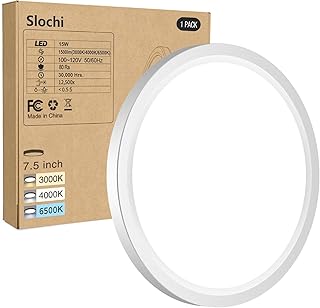
7.5-Inch Ultra Thin Round Flush Mount
Small, bright for its size at 100W equivalent, and cheap enough to buy in multiples for closets, pantries, and back halls. Three color settings mean you can match it to the larger fixtures nearby instead of ending up with mismatched pools of light down a corridor.
Frequently Asked Questions
Can I install a flush-mount ceiling light myself?
If you’re replacing an existing hardwired fixture and you’re comfortable killing the breaker and verifying the circuit is dead, yes — most of these mount to a standard junction box in under twenty minutes. Anything involving new wiring, a fan-rated box, or aluminum conductors belongs with a licensed electrician.
How many lumens do I need?
Plan on roughly 20 lumens per square foot for living spaces and bedrooms, and 40 to 50 for kitchens and bathrooms where you’re doing detail work. A 24W panel typically lands between 2,000 and 2,600 lumens, which covers a standard bedroom comfortably.
Why does my LED fixture flicker when dimmed?
Almost always a compatibility problem between the fixture’s driver and an older wall dimmer built for incandescent loads. Either switch to an LED-rated dimmer or choose a fixture with built-in remote dimming that bypasses the wall control entirely.
Are integrated LED fixtures worth it if the bulb can’t be replaced?
Generally yes. Integrated units run 30,000 to 50,000 hours, which is fifteen-plus years of normal use, and they let manufacturers build far thinner profiles than a socketed fixture allows. The tradeoff is that a driver failure means replacing the whole unit, which is why certification and brand matter more here than with bulb-based fixtures.
Final Thoughts
For most rooms, the DLLT 13-inch is the fixture to specify — the five color settings and brushed nickel trim cover more situations than anything else in this lineup. Choose the libtit 13-inch when you’re buying in quantity and want the same performance for less, and reach for the black 2-light farmhouse flush mount in the entry or hallway where the ceiling deserves something with character rather than a panel that vanishes.