Key takeaways
- Minimum seat height: Aim for a chair that drops to 16 inches or lower. Your feet should rest flat with knees at roughly 90 degrees — if the lowest setting still leaves you reaching for the floor, no amount of lumbar padding will fix the posture.
- Seat depth: Look for a pan around 17 to 18 inches deep. Leave two to three fingers of clearance between the seat edge and the back of your knees, otherwise the chair pushes you forward and out of contact with the backrest.
- Lumbar placement, not just presence: A mid-back chair with a lower-set curve suits shorter torsos far better than a tall executive shell where the support lands mid-spine. Adjustable or height-shifting lumbar is the safest bet.
- Armrest range: Fixed arms set at a standard height force the shoulders up. Flip-up or height-adjustable armrests let you tuck them out of the way and keep elbows level with the desk surface.
- Upholstery and scale: PU leather reads more tailored in a living-room-adjacent workspace, while breathable mesh wins in warm rooms. Either way, check the overall footprint — a bulky base visually swallows a compact desk.
What's inside
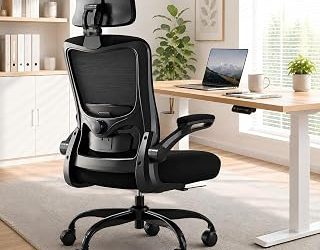
Fitting a desk chair to a shorter frame is one of those quiet design problems that most furniture brands ignore. Standard office seating is engineered around a 5’8″ to 6’0″ body, which means a shorter sitter ends up perched with dangling feet, a lumbar curve pressing between the shoulder blades instead of the low back, and a seat pan so deep it cuts circulation behind the knees. The result is not just discomfort — it’s a chair that quietly undermines posture eight hours a day.
This guide looks at compact, lower-rise task and executive chairs built specifically for petite proportions, judged on the measurements that actually matter: minimum seat height, seat depth, backrest geometry, and armrest drop. Below you’ll find our current shortlist, followed by a buying framework and reviews of the standout models for 2026.
As an Amazon Associate we earn from qualifying purchases.




How to Choose an Office Chair For Short People (2026)
- Minimum seat height: Aim for a chair that drops to 16 inches or lower. Your feet should rest flat with knees at roughly 90 degrees — if the lowest setting still leaves you reaching for the floor, no amount of lumbar padding will fix the posture.
- Seat depth: Look for a pan around 17 to 18 inches deep. Leave two to three fingers of clearance between the seat edge and the back of your knees, otherwise the chair pushes you forward and out of contact with the backrest.
- Lumbar placement, not just presence: A mid-back chair with a lower-set curve suits shorter torsos far better than a tall executive shell where the support lands mid-spine. Adjustable or height-shifting lumbar is the safest bet.
- Armrest range: Fixed arms set at a standard height force the shoulders up. Flip-up or height-adjustable armrests let you tuck them out of the way and keep elbows level with the desk surface.
- Upholstery and scale: PU leather reads more tailored in a living-room-adjacent workspace, while breathable mesh wins in warm rooms. Either way, check the overall footprint — a bulky base visually swallows a compact desk.
The Best Office Chairs For Short People (2026), Reviewed
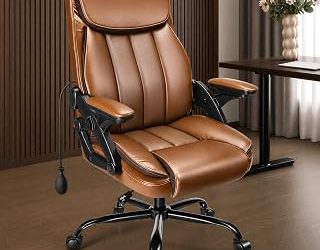
Brown Leather Swivel Chair with Lumbar Support
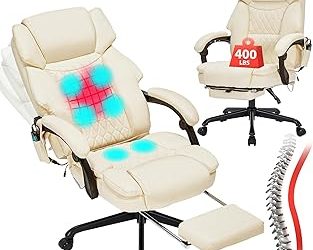
The most design-forward option here: a warm brown PU shell with padded arms that pairs convincingly with wood desks and mid-century interiors. The pronounced low-set lumbar bolster is the real draw, sitting exactly where a shorter back needs it rather than riding up between the shoulders.
PU Leather Home Computer Desk Chair
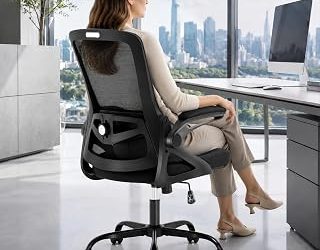
A genuinely compact silhouette with adjustable armrests and a low starting seat height, making it one of the easier picks for sitters under 5’3″. The trimmed-down back and narrow footprint suit small home offices, bedroom corners, and shared desk nooks.
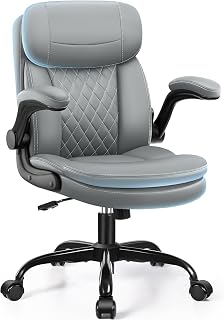
Upgraded PU Chair with Double-Layer Cushion and Neckrest, Grey
The dual-layer seat cushion is the upgrade that matters — it holds shape through long sessions instead of flattening into the board underneath. The added neckrest gives you somewhere to decompress on breaks, and the grey finish stays neutral in almost any room scheme.
Executive Chair with Lumbar Support and Flip-Up Armrest
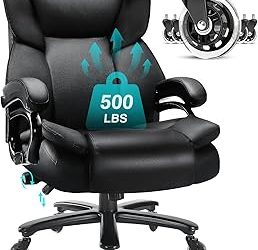
Our pick for anyone who tucks a chair under a low desk: the flip-up arms clear the way completely, and the lumbar support is positioned for shorter spines rather than borrowed from a full-size executive frame. Black PU keeps it unobtrusive on video calls.
Ylzyxal Office Desk Chair
The most adjustable option on the list, combining padded flip-up arms, movable lumbar support, and a tilt lock that lets you fix a comfortable recline angle instead of fighting spring tension. Best suited to sitters who want to fine-tune rather than accept a fixed setup.
Frequently Asked Questions
What seat height should a shorter person look for?
Most people between 4’11” and 5’4″ need a seat height of 15 to 17 inches. Measure from the floor to the crease behind your knee while seated with feet flat, then match that number to the chair’s lowest setting.
Can I use a footrest instead of buying a lower chair?
A footrest helps, but it’s a partial fix. It stabilizes your legs while leaving the backrest and armrests misaligned, so it works best as a supplement to a properly scaled chair, not a substitute.
Is a mid-back or high-back chair better?
Mid-back, in most cases. High-back shells built for taller frames place the headrest awkwardly behind the shoulders and push the lumbar curve too high, which encourages slouching rather than preventing it.
Do these chairs work at a standard 29-inch desk?
Yes, provided the chair adjusts high enough to bring your elbows level with the desktop. If it does, add a footrest to close the gap at the floor — that combination is more comfortable than raising the seat alone.
Final Thoughts
For most shorter sitters, the Brown Leather Swivel Chair delivers the best balance of low-set lumbar support and genuine design appeal. If long hours are the priority, the Upgraded PU Chair with Double-Layer Cushion holds up better over time, while the Ylzyxal Office Desk Chair is the one to choose if you want every dimension dialed in yourself.