Key takeaways
- Recline range and lock type: A 90°–135° range covers upright work and a genuine break. Infinite (stepless) locking beats fixed notches because you can stop exactly where your spine feels neutral instead of settling for the closest preset. Push past 155° only if you plan to nap in it.
- Footrest engineering: Retractable steel-framed footrests carry adult leg weight without flexing. Thin telescoping tubes on cheaper builds sag within months. Check that it stows fully flush so the chair still slides under a desk.
- Independent lumbar and headrest: Look for lumbar that moves in two directions — height and depth — so it meets the actual curve of your back. Headrests with tilt plus height travel matter more once you’re reclined, where a fixed pad pushes your chin toward your chest.
- Base material and rated capacity: Steel bases resist the leverage a reclined seat generates. Treat the stated rating as a durability signal, not just a limit: a 350–420 lb chair used by a 180 lb person simply flexes less over years of use.
- Upholstery for the room it lives in: Bonded and PU leather reads more like living-room furniture and wipes clean; mesh breathes far better in warm rooms and west-facing offices. Neutral black and warm brown both disappear into most interiors better than two-tone racing panels.
What's inside
A home office rarely gets a room to itself anymore. It shares a wall with the sofa, tucks into a bedroom alcove, or borrows the end of a dining table — which means the chair you sit in for eight hours is also furniture people see. Most reclining chairs with footrests are designed for only the first job. You end up choosing between a bulky gaming silhouette with glossy trim or a flimsy executive knockoff whose footrest rattles out from under the seat like an afterthought.
This guide judges these chairs on posture and proportion together. Below you’ll find what actually matters in a recline mechanism, how footrest construction differs between price tiers, and which materials survive a room that doubles as living space. Then we break down the strongest 2026 models across three categories: leather executive, breathable mesh, and heavy-duty big-and-tall.
As an Amazon Associate we earn from qualifying purchases.


How to Choose a Reclining Office Chair With Footrest (2026)
- Recline range and lock type: A 90°–135° range covers upright work and a genuine break. Infinite (stepless) locking beats fixed notches because you can stop exactly where your spine feels neutral instead of settling for the closest preset. Push past 155° only if you plan to nap in it.
- Footrest engineering: Retractable steel-framed footrests carry adult leg weight without flexing. Thin telescoping tubes on cheaper builds sag within months. Check that it stows fully flush so the chair still slides under a desk.
- Independent lumbar and headrest: Look for lumbar that moves in two directions — height and depth — so it meets the actual curve of your back. Headrests with tilt plus height travel matter more once you’re reclined, where a fixed pad pushes your chin toward your chest.
- Base material and rated capacity: Steel bases resist the leverage a reclined seat generates. Treat the stated rating as a durability signal, not just a limit: a 350–420 lb chair used by a 180 lb person simply flexes less over years of use.
- Upholstery for the room it lives in: Bonded and PU leather reads more like living-room furniture and wipes clean; mesh breathes far better in warm rooms and west-facing offices. Neutral black and warm brown both disappear into most interiors better than two-tone racing panels.
The Best Reclining Office Chair With Footrest (2026)s Reviewed
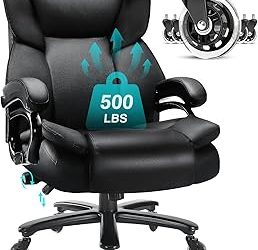
amseatec Big and Tall Executive Chair
The 20 spring packs under the seat are the real story here: they distribute weight the way a quality mattress does, which is why this holds up for longer sessions and larger frames better than standard foam. Infinite locking across 90°–135° and a 300 lb capacity make it the most refined pick for a leather-forward office.
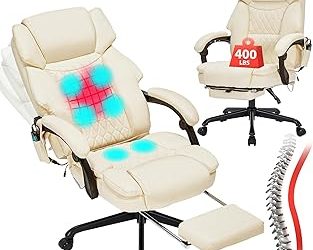
M30 Reclining Office Chair
At 170 degrees this goes essentially flat, backed by a 420 lb steel base — the most substantial hardware in this group. It’s the chair to buy if your office pulls double duty as a guest room or reading corner, though its footprint asks for real floor space.
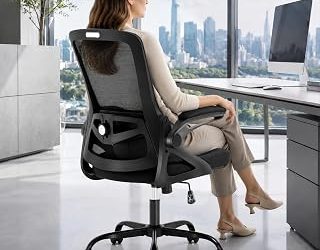
CYKOV Ergonomic Mesh Chair
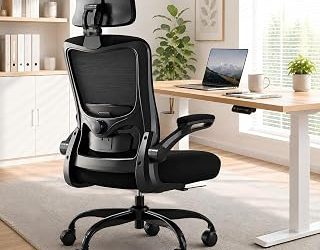
The adjustment range is unusually thorough for the category: a 4-way headrest with 4.72 inches of travel and 60 degrees of tilt, plus lumbar that moves both up and forward. Combined with a 350 lb rating and a five-year warranty, it’s the best value for anyone who fine-tunes their setup.
135° Reclining Mesh Chair With 3D Armrests
Three-dimensional armrests are the detail most chairs at this price skip, and they matter for keeping shoulders relaxed while reclined. The large steel base and 300 lb heavy-duty build give it a planted feel that belies the airy mesh look.
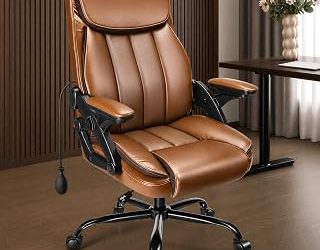
90-155° Thick Leather Executive Chair (Brown)
The widest recline sweep of the leather options, with padding generous enough to read as a lounge chair rather than task seating. Warm brown is the pick when the chair sits in view of the rest of your home.
Frequently Asked Questions
Does reclining hurt your posture?
No — sustained upright sitting loads your discs more than a slight recline. Working at roughly 100°–110° with lumbar support engaged is easier on the lower back than a rigid 90°.
Mesh or leather for a reclining chair?
Mesh wins on airflow and suits warm rooms or anyone who runs hot. Leather looks more finished in open-plan spaces and cleans faster, but traps heat during long reclined stretches.
Are these footrests strong enough to actually use?
Steel-framed retractable footrests on the models above support full leg weight. What they aren’t built for is standing or pushing off, which is the fastest way to bend the extension arms.
Do I need a big-and-tall model?
If you’re over roughly 250 lb or 6’2″, yes — seat width and base rating both change the experience. The 350 lb mesh option and the 420 lb M30 are the safest bets for taller frames.
Final Thoughts
For most home offices the CYKOV mesh chair offers the best balance of adjustability, capacity, and warranty coverage. Choose the amseatec big-and-tall if you want spring-pack comfort in a leather executive shape, or the M30 when near-flat recline and a 420 lb steel base are the priority.