Key takeaways
- Track type first: H, J, and L profiles are not interchangeable. H-type (Halo-style, three contacts) dominates the current market and gives you the widest head selection later. If you’re replacing an existing run, photograph the connector and match it before anything else.
- Beam angle over brightness: A 24° focused beam reads as intentional light — pooling on a countertop, washing a canvas. Wide 40°+ beams flatten everything into general illumination. For accent work, narrow wins; for whole-room coverage, add heads rather than widening the beam.
- CRI 90+ and honest color temperature: CRI below 85 makes wood look gray and food look dull. Aim for CRI 90+, and treat 3000K as the safe default for living spaces, 4000K for task-heavy kitchens, and 5000K+ for workshops and studios only.
- Dimmer compatibility: Integrated LED heads need a TRIAC or ELV dimmer rated for LED loads. Pairing a modern fixture with a decade-old incandescent dimmer is the most common cause of flicker and hum.
- Rail length and layout: Measure the run, then add a joint. Sectional 3.3 ft rails let you turn corners and stop short of cabinetry; a single long 13 ft run is cleaner but less forgiving of an off-center junction box.
What's inside
Track lighting has quietly become the most useful fixture category in contemporary interiors, and also the most confusing one to shop for. The listings blur together: identical-looking spotlight heads, acronyms like H-type and J-type buried in the specs, color temperatures printed in Kelvin with no visual reference, and rail lengths that may or may not reach the corner of your kitchen. Buyers end up choosing on price, then discover the beam is too wide to graze a gallery wall, the heads buzz on an existing dimmer, or the track connector doesn’t match the one already screwed into the ceiling.
This guide sorts the current field by what actually changes the room: beam control, color rendering, rail flexibility, and dimming behavior. Below you’ll find the systems worth specifying in 2026 — from long multi-head runs built for open-plan kitchens to sculptural flex track for curved ceilings and a low-voltage accent kit for art walls — plus a short framework for matching a system to your ceiling before you buy.
As an Amazon Associate we earn from qualifying purchases.


How to Choose a Track Lighting System (2026)
- Track type first: H, J, and L profiles are not interchangeable. H-type (Halo-style, three contacts) dominates the current market and gives you the widest head selection later. If you’re replacing an existing run, photograph the connector and match it before anything else.
- Beam angle over brightness: A 24° focused beam reads as intentional light — pooling on a countertop, washing a canvas. Wide 40°+ beams flatten everything into general illumination. For accent work, narrow wins; for whole-room coverage, add heads rather than widening the beam.
- CRI 90+ and honest color temperature: CRI below 85 makes wood look gray and food look dull. Aim for CRI 90+, and treat 3000K as the safe default for living spaces, 4000K for task-heavy kitchens, and 5000K+ for workshops and studios only.
- Dimmer compatibility: Integrated LED heads need a TRIAC or ELV dimmer rated for LED loads. Pairing a modern fixture with a decade-old incandescent dimmer is the most common cause of flicker and hum.
- Rail length and layout: Measure the run, then add a joint. Sectional 3.3 ft rails let you turn corners and stop short of cabinetry; a single long 13 ft run is cleaner but less forgiving of an off-center junction box.
The Best Track Lighting Systems Reviewed
White H-Type 8-Light System with Three 3.3 FT Rails
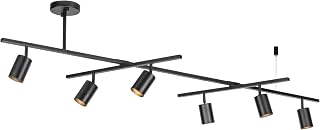
The most adaptable pick here: three short rails let you build an L, a T, or a straight run without cutting anything, and the 3CCT switch on each head means you can commit to 3000K, 4000K, or 5500K after the fixture is up and you can see it in context. With CRI 90+ and a 24° beam at 800 lumens, it’s genuinely good accent light rather than repurposed ceiling glare.
VANoopee 12-Light Kit with 13 FT Rail (White, 3000K)
Built for length — a full 13 feet of rail and a dozen heads, which is the right density for a galley kitchen or a long hallway gallery. The fixed 3000K temperature is a deliberate choice rather than a limitation: consistent warm output across all twelve heads, with no risk of mismatched settings drifting over time.
VANoopee 5-Color 12-Light Kit, 13 FT Rails (Black)
The same generous 13 ft footprint in matte black, with selectable color temperature across five settings — useful when a space shifts between prep work and evening hosting. Black rail disappears against dark or exposed ceilings far better than white, which tends to read as a bright stripe when it isn’t matched to the plaster.
Catalina Lighting 21904-000 Flex Track, 96″, Brushed Nickel
Flex track is the answer for curved walls, vaulted ceilings, and rooms where a straight line would look imposed. This 8-foot brushed nickel run bends into gentle arcs and carries six integrated LED heads, making it the most architecturally forgiving option on the list.
Tiella 800CBL5PN-LED Low-Voltage Accent Kit, Nickel
A low-voltage surface kit aimed squarely at art and object lighting, where scale matters as much as output. The heads are small, the polished nickel finish is refined rather than industrial, and the electronic transformer keeps dimming smooth — the right call for a study, a stairwell, or a collection wall.
Frequently Asked Questions
What’s the difference between H, J, and L track?
They refer to the internal contact geometry of the rail. H-type has three conductors and is the most widely supported standard in North America; J and L use different spacing and won’t accept H heads. Always match the system you already own.
How many heads do I need?
A practical rule is one head every 18 to 24 inches for continuous task lighting, or one per object for accent work. Twelve-head kits suit open kitchens; four to six heads handle a standard bedroom or home office.
Can I install track lighting myself?
Mounting the rail and clipping in heads is straightforward, but connecting to the junction box is electrical work. If your ceiling box isn’t already wired for a fixture, or if you’re adding a new dimmer circuit, bring in a licensed electrician.
Why do my LED track heads flicker?
Almost always a dimmer mismatch. Integrated LED fixtures require an LED-rated TRIAC or ELV dimmer; legacy incandescent dimmers deliver a waveform the driver can’t smooth out.
Final Thoughts
For most homes, the White H-Type 8-Light System with three 3.3 ft rails is the smartest starting point — configurable layout, selectable color temperature, and beam control that holds up in a design-led space. Scale up to the VANoopee 12-Light 13 FT Kit when you need to light a long run in one gesture, and reach for the Catalina Flex Track when the ceiling has a curve worth following rather than fighting.