Key takeaways
- Clean twice a year at minimum: once before first cool weather use, once at end of season before storage or covering.
- Match the cleaner to the coil. No-rinse foams are made for in-place work; skip acidic condenser-only chemicals on an indoor evaporator.
- Photograph the grille and screw positions before disassembly. Reassembly is where hidden clips get snapped.
- If a musty smell returns within days of a clean, the blower wheel is the likely culprit. Brush its individual blades, not just the coil.
What's inside
A window air conditioner is the least glamorous object in most rooms, and also the one doing the most work on the air you actually breathe. It sits in the frame where daylight enters, pulls dust off every soft surface you own, and quietly collects a felt of lint, pollen, and cooking residue across its coils. Left alone for a couple of seasons, that buildup turns into a smell you can’t place and a cooling bill you can’t explain.
The good news: a proper clean is a 45-minute job with a handful of inexpensive tools, and it pays you back in colder air, quieter operation, and a unit that lasts years longer. Below is the sequence I use on my own units, the products worth keeping in the utility closet for 2026, and the small details, drain pans, fin alignment, dry time, that separate a real clean from a wipe-down.
Our Recommended Picks
As an Amazon Associate we earn from qualifying purchases.




Start With Power, Not Product
Unplug the unit at the wall before anything else, and if it’s on a dedicated circuit, flip the breaker too. Then take a minute to learn the anatomy: a front grille and washable filter, an evaporator coil behind them, a blower wheel, a condenser coil facing outdoors, a drain pan below, and a sealed electrical box you never spray. Lightweight units (5,000 to 8,000 BTU) can be lifted out and cleaned in a bathtub or on a driveway. Anything heavier is safer to clean in place, with a second pair of hands if you do remove it.
Filter First, and Wash It Correctly
Slide the filter out and hold it up to a light. If the mesh is grey and closed, that alone can cost you double-digit airflow. Rinse it from the clean side outward under lukewarm water with a drop of dish soap, never hot water, which warps the plastic frame. Let it dry fully before it goes back in. A damp filter reintroduces exactly the mildew you’re trying to eliminate. Most manufacturers want this done every two to four weeks in peak season.
Coils Are Where the Real Grime Lives
Vacuum the evaporator fins gently with a brush attachment, then apply a no-rinse foaming cleaner and let chemistry do the scrubbing. The Arm & Hammer Biodegradable HVAC and Air Conditioner Coil Cleaner Foam is a sensible default: it expands to lift debris outward, it’s biodegradable, and the 19 oz can is right for one or two units. If you’re cleaning several units or a whole seasonal changeover, the larger Foaming AC Coil Cleaner in 38 oz or the deep-penetrating 57 oz version costs less per application and covers both evaporator and condenser sides. Spray, wait the dwell time on the label, and let condensation carry residue into the drain pan. Keep foam off the control board, motor, and wiring.
Contain the Mess When You Can’t Remove the Unit
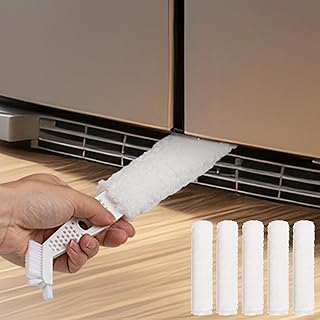
Cleaning in place is where most people give up, because water goes where you don’t want it. Two tools solve that. For reaching behind grilles and under the blower housing without disassembly, the Air Conditioner Cleaner Set with five replaceable brush cloths gets into the narrow gaps that vacuums miss, and doubles as an under-fridge tool. If you also run a mini split head anywhere in the house, the Oiktylr Mini Split Cleaning Kit with 2L pressure sprayer is the serious upgrade: a waterproof PVC catch bag plus sprayer that lets you flush coils on a wall-mounted unit and drain the runoff into a bucket. It’s sized for 38 to 48 inch mini splits rather than window units, so buy it for the mini split and treat window-unit use as a bonus.
Straighten the Fins, Clear the Drain, Then Dry
Bent aluminum fins choke airflow in a way no cleaner fixes. The 3-Piece Air Conditioner Fin Comb Cleaning Tools set gives you a comb sized to standard fin spacing plus a brush, and combing a crushed section back to parallel is oddly satisfying work. Finish by clearing the drain hole and pan of sludge so condensate exits instead of pooling, wipe the housing, and leave the unit open to air for two to four hours before restoring power. Running a wet unit is the fastest route back to odor.
Tips
- Clean twice a year at minimum: once before first cool weather use, once at end of season before storage or covering.
- Match the cleaner to the coil. No-rinse foams are made for in-place work; skip acidic condenser-only chemicals on an indoor evaporator.
- Photograph the grille and screw positions before disassembly. Reassembly is where hidden clips get snapped.
- If a musty smell returns within days of a clean, the blower wheel is the likely culprit. Brush its individual blades, not just the coil.
Frequently Asked Questions
How often should I clean a window AC?
Rinse the filter every two to four weeks during heavy use, and do a full coil, pan, and fin clean twice a year. Homes with pets, smokers, or nearby construction should move to quarterly deep cleans.
Can I use vinegar or dish soap instead of coil cleaner?
Diluted dish soap is fine for the housing and filter. For coils, purpose-made foam is worth it: it expands into fin gaps and is formulated not to corrode aluminum or leave a film that traps new dust.
Do I need to remove the unit from the window?
Not usually. With a catch bag or careful vacuuming plus no-rinse foam, in-place cleaning is effective and far safer than wrestling a heavy unit out of a second-floor frame.
Why is my AC leaking water indoors after cleaning?
Almost always a blocked drain path or a unit tilted the wrong way. Confirm the drain hole is clear and that the outdoor end sits very slightly lower than the indoor end.
Conclusion
Treat your window unit like any other finish in the room: something that responds to maintenance and looks and performs better for it. A foaming coil cleaner, a fin comb, a slim brush tool, and one careful afternoon will restore airflow you’d otherwise pay a technician to diagnose, and keep the air moving through your home genuinely clean.