Key takeaways
- Pocket-style sleeve dusters slip over the blade and clean top and bottom in a single pass. The DRQ Ceiling Fan Cleaner Duster and the FONUNO Ceiling Fan Cleaner Duster both use this design with telescoping poles that extend from roughly 13 to 50 inches, which covers standard eight- to nine-foot ceilings comfortably.
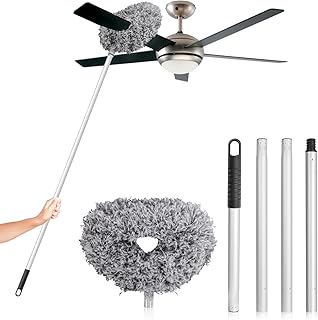
- Long-reach adjustable wands trade the enclosed sleeve for a pivoting microfiber head and more length. The Eyliden 68″ Adjustable Ceiling Fan Duster is the pick for vaulted ceilings, stairwell fans, and anything you currently need a ladder to reach. At three-quarters of a pound it stays controllable at full extension, which is where cheaper poles get wobbly.
- Flexible bendable brushes like the 3 Pcs Fan Cleaning Brush Bendable Cobweb Duster set are the detail option: they conform to blade curves, motor housings, air vents, and the awkward gap behind a light kit.
What's inside
A ceiling fan is one of the few objects in a home that spends its life horizontal, elevated, and largely unobserved. That combination makes it a magnet for the fine gray felt of household dust: skin cells, textile fibers, cooking aerosols, and whatever drifts in through an open window. The blades accumulate it slowly and evenly, which is precisely why most people don’t notice until they flip the switch in early summer and watch a season’s worth of sediment redistribute itself across the bedding.
Beyond the visual, there’s an air-quality argument. A loaded blade edge becomes a launch pad every time the motor spins up, and that matters if anyone in the house manages allergies or asthma. This guide covers the method that actually works from the floor, how to choose a tool that fits your ceiling height and blade span, the technique that keeps debris contained instead of airborne, and a realistic maintenance rhythm. No ladder gymnastics required.
As an Amazon Associate we earn from qualifying purchases.



Start With Containment, Not Cleaning
The single biggest determinant of whether this job feels satisfying or miserable is what happens in the sixty seconds before you touch the fan. Turn the fan off at the wall switch and give the blades time to stop completely. Then lay an old sheet or drop cloth across the bed, sofa, or dining table directly beneath. Some dust will escape any method, and catching it on fabric you can carry outside is far easier than vacuuming it out of upholstery. If the room has a hard floor, sweeping up afterward is trivial. If it’s carpeted, the sheet is non-negotiable.
Choose a Tool That Matches Your Ceiling and Your Blades
Ceiling fan dusters fall into two broad camps, and the right one depends on your architecture.
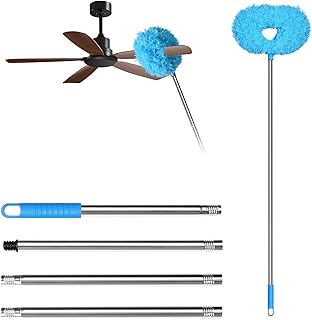
- Pocket-style sleeve dusters slip over the blade and clean top and bottom in a single pass. The DRQ Ceiling Fan Cleaner Duster and the FONUNO Ceiling Fan Cleaner Duster both use this design with telescoping poles that extend from roughly 13 to 50 inches, which covers standard eight- to nine-foot ceilings comfortably.
- Long-reach adjustable wands trade the enclosed sleeve for a pivoting microfiber head and more length. The Eyliden 68″ Adjustable Ceiling Fan Duster is the pick for vaulted ceilings, stairwell fans, and anything you currently need a ladder to reach. At three-quarters of a pound it stays controllable at full extension, which is where cheaper poles get wobbly.
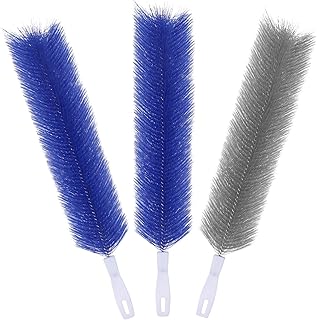
- Flexible bendable brushes like the 3 Pcs Fan Cleaning Brush Bendable Cobweb Duster set are the detail option: they conform to blade curves, motor housings, air vents, and the awkward gap behind a light kit.
If you want one tool that splits the difference, the Storystore Ceiling Fan Cleaner Duster extends to about 4.2 feet with a 13–50″ pole range and handles cobwebs, door frames, and window tops between fan sessions.
Work Blade by Blade, Pulling Inward
Position yourself so you’re pulling the duster from the blade tip toward the motor, not pushing outward. Inward strokes carry dust toward the center of your drop cloth rather than flinging it across the room. Slide the sleeve fully over the blade, apply light pressure on both surfaces, and draw it in one continuous motion. Repeat per blade. Resist the urge to scrub back and forth, which grinds grime into the finish and loosens dust into the air. Two clean passes beat ten aggressive ones.
Don’t Skip the Motor Housing and Pull Chains
Blades get the attention, but the housing collects a surprising amount, and the upper surface of the mounting canopy is usually the dirtiest part of the fixture. This is where a bendable brush earns its place. Wrap it around the housing, run it along the downrod, and give the pull chains a light pinch-and-slide. Light kits and glass shades deserve a pass too since dust on a diffuser measurably dims output.
Wash the Microfiber, or You’re Just Moving Dust
Microfiber traps particles electrostatically, and a saturated sleeve stops trapping and starts smearing. Every duster listed here has a removable, washable head. Rinse in cool water with a small amount of mild detergent, skip fabric softener entirely because it coats the fibers and kills the static charge, and air dry. A clean sleeve is the difference between dusting and streaking.
Tips
- Dust before you run the HVAC or open windows, so anything airborne settles instead of circulating.
- For sticky kitchen-adjacent fans, lightly mist the sleeve with a diluted all-purpose cleaner rather than spraying the blade directly.
- Check blade direction seasonally while you’re up there: counterclockwise for summer, clockwise on low for winter.
- Keep the duster on the pole and stored upright in a utility closet. A tool you can grab in ten seconds gets used.
Frequently Asked Questions
How often should I dust a ceiling fan?
Every four to six weeks in rooms you use daily, and monthly if you have pets, run the fan year-round, or manage allergies. Bedrooms benefit most from the shorter interval.
Can I use a damp cloth on the blades?
Yes, sparingly. Wipe with a barely damp cloth and dry immediately. Standing moisture can swell MDF-core blades and lift veneer at the edges over time.
Is a pocket duster better than a flat wand?
For blades, yes, because it cleans both faces at once and encloses the dust. Flat wands win on reach and versatility for walls, vents, and cobwebs.
Do I need to remove the blades?
Almost never. Full removal is only worth it for heavy grease buildup or before repainting, and it risks throwing the fan out of balance on reinstallation.
Conclusion
Good ceiling fan maintenance is less about effort than about sequence: cover what’s below, choose a duster sized to your ceiling, pull inward blade by blade, catch the housing, and wash the microfiber afterward. Pick one extendable tool for the fans and a flexible brush for the details, keep both within arm’s reach, and this becomes a five-minute habit rather than a spring-cleaning ordeal.