Key takeaways
- People sit longer and sit better. A backrest reduces the forward lean that makes a backless stool tiring after 15 to 20 minutes.
- Faux leather is the easiest kitchen upholstery to maintain: a damp cloth handles sauce, juice, and crayon in seconds, and it does not absorb odors the way fabric does.
- Adjustable height means one purchase covers a counter today and a bar-height island after a renovation.
- Swivel with a footrest lets sitters turn to face the room, which matters if the island sits between kitchen and living space.
- Pairs at $70 to $130 make outfitting a three- or four-seat island affordable compared with $200 plus per stool for wood or genuine leather.
- Low-back models tuck under a 12 to 15 inch overhang almost as neatly as backless stools.
What's inside
The Short Answer
Yes, if anyone sits at the island for more than 20 minutes at a stretch. That is the one condition. A backless stool is fine for a quick coffee, but once the island doubles as a homework desk, a laptop station, or the place where guests linger during dinner prep, a low or mid back turns a perch into a seat and stops people from slouching onto the counter. Leather, or more often faux leather at this price range, is a practical upholstery choice for a kitchen because it wipes clean, but it is the back support, not the leather, that decides whether you will actually use the stools.
If the island is purely a landing zone for groceries and a place to eat toast standing up, skip the back and keep the counter line clean.
As an Amazon Associate we earn from qualifying purchases at no extra cost to you. Product prices and availability are accurate as of the date shown and are subject to change.

What You Actually Get
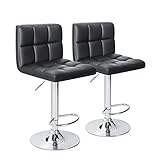
A typical leather bar stool with back support in the $70 to $130 per pair range is an adjustable swivel stool on a round chrome or black steel base, with a padded seat about 15 to 17 inches wide and a low backrest 8 to 12 inches tall. The gas lift usually spans a seat height of 24 to 32 inches, so the same stool works at a 36 inch counter and a 42 inch bar. Weight capacity on these entry-level models is normally listed at 250 to 300 pounds, and each stool weighs 15 to 20 pounds.
The upholstery is polyurethane (PU) faux leather in almost every case under $150 per stool. Genuine top-grain leather stools start around $200 each and climb past $500. PU looks similar on day one, resists spills, and wipes down with a damp cloth, but it is a plastic film over fabric and typically starts to crack or peel after three to five years, sooner in direct sun.
Back support on these stools comes in three heights. A low back of 8 to 10 inches supports the lumbar and disappears under most counters. A mid back of 12 to 16 inches supports the middle of the spine and encourages a more upright posture. A full back of 18 inches or more is essentially a tall dining chair and will not tuck under an overhang. Most kitchen buyers land on low or mid.
Pros
- People sit longer and sit better. A backrest reduces the forward lean that makes a backless stool tiring after 15 to 20 minutes.
- Faux leather is the easiest kitchen upholstery to maintain: a damp cloth handles sauce, juice, and crayon in seconds, and it does not absorb odors the way fabric does.
- Adjustable height means one purchase covers a counter today and a bar-height island after a renovation.
- Swivel with a footrest lets sitters turn to face the room, which matters if the island sits between kitchen and living space.
- Pairs at $70 to $130 make outfitting a three- or four-seat island affordable compared with $200 plus per stool for wood or genuine leather.
- Low-back models tuck under a 12 to 15 inch overhang almost as neatly as backless stools.
Cons
- PU leather has a finite life. Expect peeling on the seat edge and backrest within three to five years of daily use; genuine leather lasts 10 to 15 years but costs three to six times more.
- Gas-lift stools in this price range use unrated or class 2 cylinders that can start sinking after two to four years.
- A round steel base of 15 to 17 inches in diameter is stable but shows every scratch and dust ring on a dark floor.
- Backs add visual weight. Four mid-back stools in black make a small kitchen feel crowded compared with backless stools that vanish under the counter.
- Faux leather feels cold in winter and sticky on bare legs in summer.
- Low backs help posture but rarely support the shoulders; if someone plans to work at the island for hours, a proper task chair at a lower desk is the healthier setup.
Who Should Buy It
Buy leather bar stools with back support if your island is a daily dining or homework spot, if you have kids who will spill and climb, or if you want one stool that works at both 36 and 42 inch heights. They are also a sensible choice for renters and first apartments: at $35 to $65 per stool you get a seat that looks finished, cleans up instantly, and is not painful to leave behind. Anyone with lower back complaints who still wants to eat at the counter will notice the difference a 10 inch lumbar back makes.
Who Should Skip It
Skip them if the island is a pass-through with a tight aisle under 36 inches, where backs will snag hips every time someone walks by. Skip them if you sit on the stools for hours of remote work; the seat depth of 15 to 16 inches and the low back are not designed for that, and you will be happier with a chair at a desk. And skip faux leather specifically if you want a stool that will still look good in a decade, because a wood or genuine leather stool at $150 to $300 each is the longer-term buy. Finally, if the room gets strong afternoon sun through a south- or west-facing window, expect PU to fade and stiffen faster than fabric or wood.
Cheaper Alternatives
| Option | Cost | Trade-off |
|---|---|---|
| Backless PU swivel stools | $50 to $90 per pair | Tuck away fully, but sits limited to about 20 minutes; no lumbar support |
| Bare wood or metal stools with low back | $60 to $120 per pair | No upholstery to peel, but hard seat; add a $15 to $25 cushion |
| Fabric-upholstered stools with back | $80 to $150 per pair | Warmer and breathable, but stains and odors set in without a performance fabric |
| Add a clip-on or strap lumbar cushion to existing backless stools | $15 to $35 each | Improves comfort, looks improvised, slides on swivel seats |
| Replacement seat with attached low back on an existing base | $50 to $70 each | Only works if your base has a standard 4-bolt plate; color match may be off |
| Secondhand stools reupholstered in vinyl | $20 to $40 per stool plus material | Time and staple-gun work; frame condition is a gamble |
FAQ
Is faux leather good enough for kitchen bar stools?
For three to five years of daily use, yes. It wipes clean and costs a fraction of genuine leather. The trade is lifespan: PU eventually peels, especially on seat edges and in sun. If you want 10 plus years, budget $200 or more per stool for real leather or choose solid wood.
How tall should the backrest be on a counter stool?
A low back of 8 to 12 inches above the seat gives lumbar support while still sliding under a standard 12 to 15 inch overhang. Go to 14 to 16 inches if posture is the priority and you have room to leave the stools pulled out.
What seat height do I need?
For a 36 inch counter, set the seat at 24 to 26 inches. For a 40 to 42 inch bar, 28 to 30 inches. Adjustable stools covering 24 to 32 inches handle both; leave 10 to 12 inches between seat top and counter underside.
Do bar stools with backs take up more space?
Only when pulled out. Allow 26 to 30 inches per stool center to center and at least 36 inches of aisle behind them. A low-back model tucked in adds no more depth than a backless one, and in 2026 most compact designs keep the backrest within the seat’s 16 to 17 inch footprint.