Key takeaways
- Calculate cloth sizes for closed and extended tables, compare actual end and side drops, and label a practical pair for everyday and guest use.
What's inside
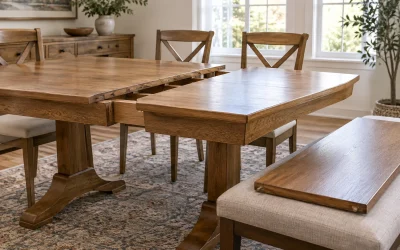
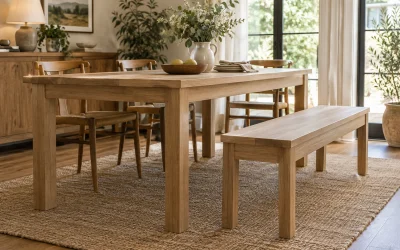
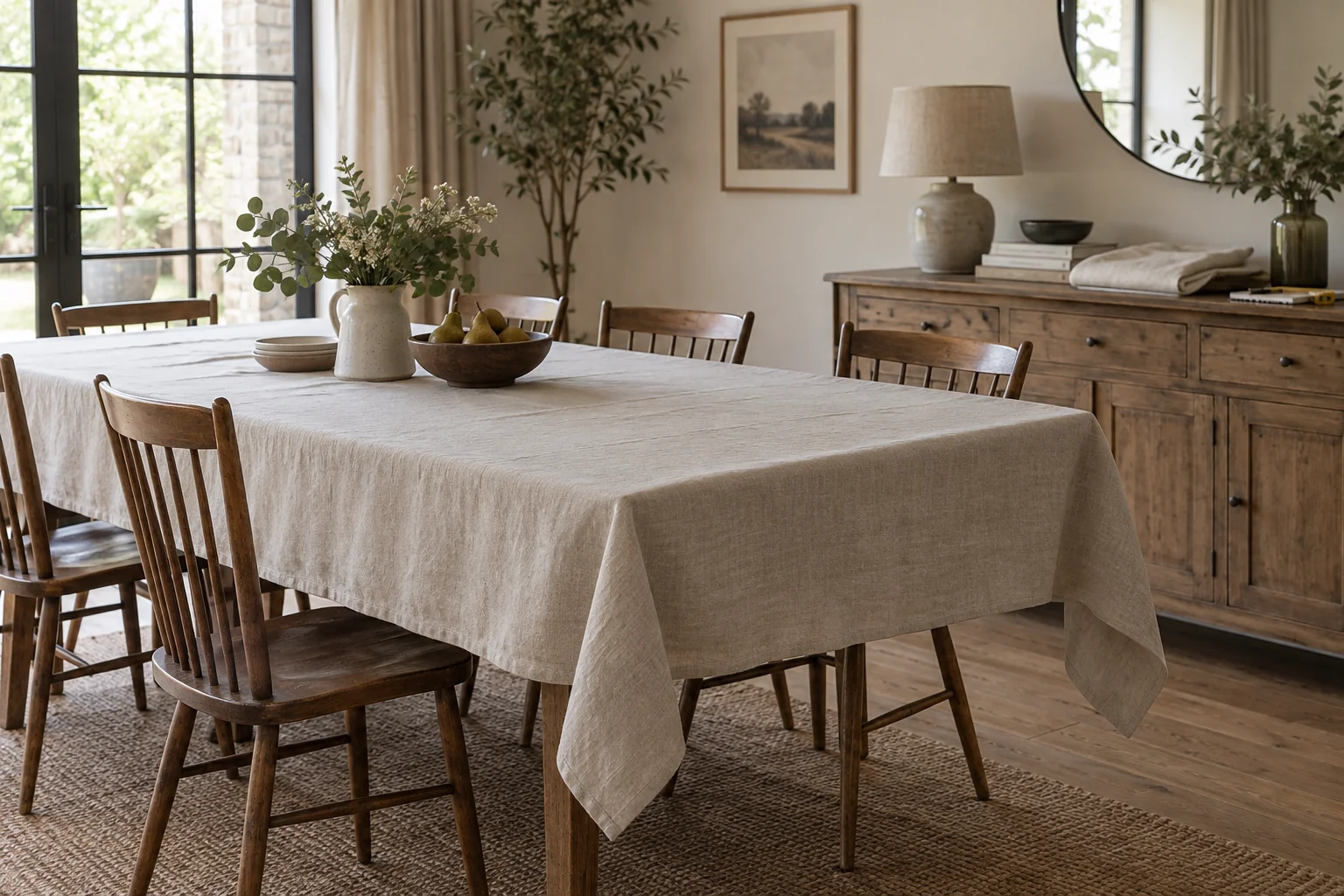
An expandable dining table often needs two tablecloth sizes because its width stays the same while its length changes. A cloth that hangs evenly with the leaves installed can have very long ends when the table is closed. Measure both configurations, decide the drop you actually want and compare the resulting end and side overhangs before buying.
The worksheet below is for finished tablecloths. It does not include sewing allowances. The worked measurements are illustrative, not specifications for a particular table or linen product. Keep inches and centimeters separate throughout your calculation.
Give each table configuration its own measurements
Set up the closed table exactly as you normally use it, then record its tabletop length and width. Repeat after installing the leaves you actually use for guests. If you sometimes use one leaf and sometimes two, add a third row. Do not rely only on a listing’s maximum length when your usual hosting arrangement is shorter.
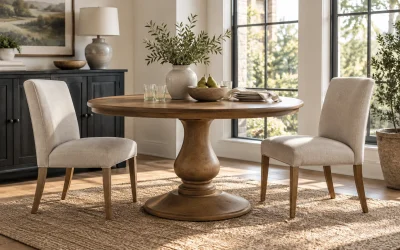
Also note the outline: rectangular, square, round or oval. A round table can become oval when extended, which changes the appropriate cloth shape as well as its size. The same bounding length and width do not guarantee the same corner drape on different outlines.
Vision Linens’ measuring guide advises arranging the extensions and any intended protector before measuring. It calculates cloth dimensions by adding twice the chosen drop to the tabletop measurements. Use that geometry with your own preferred overhang rather than treating a style recommendation as a mandatory dimension.
Choose a drop by trying the seating position
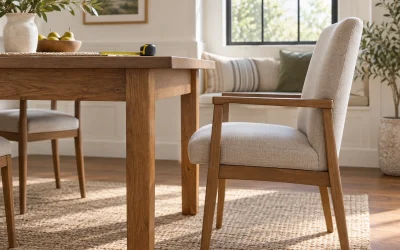
Drop is the cloth extending beyond the tabletop edge. Drape an existing cloth over one side to preview it. Sit in the actual chair, move in and out and see where the fabric meets your lap, armrests or bench. Repeat at an end seat because the available leg space and fabric position may differ.
Decide an acceptable range, not just an ideal number. For example, you may like an eight-inch drop but accept seven to nine inches. That range helps when shopping standard sizes. It is a personal fit decision, not a universal clearance rule. Avoid a length that drags into the walking route or is easily caught when a chair moves.
Use a two-size worksheet
| Record | Closed | Extended |
|---|---|---|
| Table shape and leaf count | Your everyday setup | Your intended hosting setup |
| Tabletop length and width | Measure both | Measure again |
| Preferred drop | Trial with everyday seats | Trial with all guest seats |
| Calculated cloth length | Table length + twice end drop | Table length + twice end drop |
| Calculated cloth width | Table width + twice side drop | Table width + twice side drop |
| Actual candidate size | Finished dimensions from label | Finished dimensions from label |
| Resulting overhang | Calculate ends and sides separately | Calculate ends and sides separately |
For a rectangular table with a centered rectangular cloth, end drop equals cloth length minus table length, divided by two. Side drop uses the widths in the same way. A negative result means the cloth does not cover that dimension of the tabletop.
Worked example: why one cloth changes character
Suppose a hypothetical rectangular table measures 60 by 36 inches closed and 84 by 36 inches extended. The household chooses an eight-inch drop on each edge. The calculated closed cloth is 76 by 52 inches. The extended cloth is 100 by 52 inches. These are calculated targets, not a promise that either is a standard retail size.
Put the 100-by-52-inch cloth on the closed table and its end drop becomes (100 − 60) ÷ 2 = 20 inches. Its side drop remains (52 − 36) ÷ 2 = 8 inches. The cloth covers the table, but the much longer ends may interfere with the end seats. Coverage and comfortable drape are different questions.
Now suppose the available closed-size option is 80 by 54 inches. Its end drop is ten inches and side drop is nine inches. Compare those actual results with your seating trial. Do not buy it simply because its package says “six-person table”; chair count does not supply the missing dimensions.
Handle shape changes and care information separately
For a round-to-oval table, record the closed diameter and the extended overall length and width. Ask the linen supplier about the cloth outline and how it will drape at the curved ends. A rectangular cloth may create longer corner points even when its centerline measurements seem suitable. Preview the actual shape before ordering a custom or nonreturnable item.
Read whether a product’s measurements describe its finished size and what its laundering instructions require. Do not add a guessed shrinkage percentage to every cotton or linen cloth. If dimensions after recommended washing are important, ask the supplier directly and keep the answer with your size record.
Label the pair for the next gathering
Store each cloth with a simple note: closed table, one leaf or two leaves; finished size; care instructions. Before a large meal, fit the chosen cloth on the fully assembled table and check every occupied seat. This catches a swapped size while the tabletop is still empty and turns future setup into a repeatable choice rather than another measuring session.