Key takeaways
- High Back Chairs: Because of the leverage exerted when a user leans back against a tall backrest, the joints where the seat meets the back experience substantial structural stress. If the frame is made of cheap particleboard or thin metal tubes, these joints can loosen or squeak by year three. However, if you purchase a well-constructed set, the primary wear point will be the upholstery. High backs have more surface area exposed to sunlight (which can fade fabric) and physical contact (which can wear down leather or fabric).
- Low Back Chairs: With a lower center of gravity and less leverage placed on the frame, low back chairs are incredibly durable structurally. They are less prone to wobbling over time. However, because they are often pushed completely under the table, the top edges of the backrests can bump against the underside of the table apron, leading to premature scuffing or tearing of the fabric by year four or five.
What's inside
When you are shopping for new dining room furniture, it is easy to get swept up in upholstery swatches, wood finishes, and leg styles. However, the most critical decision you will make regarding how your space actually functions comes down to a physical measurement: the height of the chair’s backrest. The debate between high back dining chair vs low back dining chair comfort is not just an aesthetic puzzle; it directly dictates how long your guests will linger at the table, how your spine feels after an hour of sitting, and how spacious your dining area feels.
Choosing the wrong backrest height can lead to a mismatched dining experience. A chair that is too tall can visually crowd a small room and feel overly restrictive, while a chair that is too low might leave your dinner guests slouching and searching for shoulder support before the dessert course is even served. To make the right choice, you must weigh your physical comfort needs against your daily lifestyle, your table’s dimensions, and the layout of your home.
As an Amazon Associate we earn from qualifying purchases at no extra cost to you. Product prices and availability are accurate as of the date shown and are subject to change.


Quick Verdict
If your primary goal is long-duration physical support for extended dinner parties, formal hosting, or working from home, a high back dining chair is your best option. High back chairs (typically measuring 32 to 40 inches in total height) provide crucial thoracic spine support, aligning the shoulders and neck for upright sitting.
Conversely, if you live in a smaller or open-concept space, prefer a casual “lounge” feel, and prioritize active sitting where you can easily twist, lean back, and move your upper body, a low back dining chair (typically 24 to 31 inches in total height) offers superior comfort. It keeps your pelvis supported while giving your upper torso complete freedom of movement, all while maintaining an airy, modern aesthetic.
Side by Side
To help you visualize how these two design philosophies stack up, here is a breakdown of the key physical and practical differences between high back and low back dining chairs:
| Feature | High Back Dining Chairs | Low Back Dining Chairs |
|---|---|---|
| Average Back Height | 32 to 42 inches | 24 to 31 inches |
| Primary Support Zone | Thoracic spine, shoulders, and full upper back | Sacrum, pelvis, and lower lumbar region |
| Seating Posture | Upright, structured, and formal | Casual, relaxed, and active/rotational |
| Visual Weight in Room | Substantial; acts as a visual anchor or barrier | Minimal; preserves sightlines, tucks under tables |
| Weight per Chair | Typically heavier (15 to 25 lbs) | Typically lighter (10 to 18 lbs) |
| Price Range (Per Chair) | $40 to $200+ | $35 to $150+ |
| Maintenance & Cleaning | More surface area; requires more vacuuming/wiping | Compact surface area; quick and easy to maintain |
| Best Dining Table Pairing | Large, heavy wooden tables (30″ standard height) | Round, glass-top, or minimalist mid-century tables |
Where High Back Dining Chair Wins
High back dining chairs excel in environments where comfort is defined by structured, head-to-toe physical support. For individuals who experience upper back fatigue, neck tension, or shoulder pain, sitting in a chair that stops mid-back can be incredibly uncomfortable. A tall backrest distributes the weight of your upper torso across a larger surface area, taking pressure off your lower spine and encouraging an elegant, upright posture.
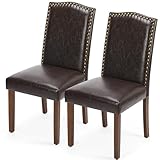
This category is dominated by plush, fully upholstered options that create a cozy “cocooning” effect. For instance, options like the HAPPYMONT Upholstered Dining Chair Set of 6, PU Leather Kitchen Chair ($259.99) showcase how a tall, supportive backrest paired with easy-to-clean polyurethane leather can offer both ergonomic support and functional utility for larger families. Similarly, the DUMOS Dining Chairs Set of 2, PU Leather Kitchen Chair, Brown ($84.99) provides a sturdy, high-profile backrest that keeps your posture aligned without requiring a massive financial investment.
High back chairs also win when it comes to draft protection and thermal comfort. In older, drafty homes or highly air-conditioned spaces, a tall backrest acts as a physical shield against cold air currents, keeping your back warm during long winter meals. Furthermore, if your dining table doubles as a home office, a high-back chair with a curved back like the COLAMY Upholstered Dining Chairs Set of 4, Modern Kitchen & Dining Room Chairs with Curved Back, Fabric Padded Seat and Solid Wood Legs, Side Chairs for Restaurant, Cafe & Home, Beige ($194.97) offers the structural integrity and thick padding needed to sit comfortably for an eight-hour workday.
Where Low Back Dining Chair Comfort Wins
While high back chairs focus on structural stillness, low back dining chairs focus on freedom of movement. If you are someone who fidgets, shifts positions frequently, turns around to speak to people in the adjacent kitchen, or likes to drape an arm over the back of the seat, a high back chair can feel like a cage. Low back chairs support the pelvis and the lower curve of your spine while leaving your shoulders and shoulder blades completely free.
This freedom of movement translates directly to a different kind of physical comfort: active sitting. By not forcing your upper back into a rigid vertical plane, low back chairs allow your core muscles to engage naturally, which can prevent the stiffness associated with sitting in an overly supportive chair for too long. They are also significantly lighter and easier to pull out, push in, and move around the home.
There is also a psychological component to comfort. In modern, open-concept homes, high back chairs can act like a visual wall, blocking light and making a room feel cramped and stressful. A low-profile option, such as the HomePop Low Back Dining Chair – Brown Boucle (Single Pack) ($85.55), sits below or flush with the dining table’s surface. This keeps sightlines open, allows natural light to flood the room, and creates a relaxed, lounge-like atmosphere that makes your entire home feel more inviting and comfortable to inhabit.
Cost Over 5 Years
When analyzing the cost of ownership over a five-year period, both high back and low back chairs present unique financial considerations. High back chairs require more raw materials to manufacture—more foam padding, more upholstery fabric, and longer internal support frames (whether steel or solid wood). This generally makes high-quality high back chairs slightly more expensive upfront.
Over five years, the wear and tear on these chairs differs significantly:
- High Back Chairs: Because of the leverage exerted when a user leans back against a tall backrest, the joints where the seat meets the back experience substantial structural stress. If the frame is made of cheap particleboard or thin metal tubes, these joints can loosen or squeak by year three. However, if you purchase a well-constructed set, the primary wear point will be the upholstery. High backs have more surface area exposed to sunlight (which can fade fabric) and physical contact (which can wear down leather or fabric).
- Low Back Chairs: With a lower center of gravity and less leverage placed on the frame, low back chairs are incredibly durable structurally. They are less prone to wobbling over time. However, because they are often pushed completely under the table, the top edges of the backrests can bump against the underside of the table apron, leading to premature scuffing or tearing of the fabric by year four or five.
Overall, a budget-friendly set of high back chairs (such as buying two sets of the DUMOS chairs or one HAPPYMONT set) will cost you roughly $170 to $260 upfront, translating to a incredibly low cost of $34 to $52 per year over a five-year lifespan. Investing in a premium low-back accent chair like the HomePop Boucle chair as a head-of-table statement piece offers excellent long-term durability because its compact frame experiences very little joint strain over half a decade of daily use.
Which One for Your Home
As we design spaces for 2026 and beyond, the boundary between the formal dining room and the multifunctional living area continues to blur. To determine which chair back height fits your specific lifestyle, consider these real-world household scenarios:
Small Apartment or Open-Concept Loft
If you are working with limited square footage, low back dining chairs are the undisputed winner. A set of high back chairs around a small table will swallow the room visually, making your apartment feel smaller than it is. Low back chairs can be tucked completely under the table when not in use, freeing up valuable physical walkway space and keeping your visual field clean and open.
Family with Kids and Pets
For busy households with young children and pets, the choice depends on safety and cleanliness. High back chairs have a higher center of gravity, meaning they can be tipped backward more easily if a toddler climbs up the backrest. However, if you choose a sturdy, high back option in wipeable PU leather, it prevents kids from wiping messy hands on the wall behind them. If tipping is a concern, opt for low back chairs with a wide, stable base; they are much harder for kids to knock over and have less fabric surface area to collect pet hair and spilled milk.
Rental Property or AirBnB
If you are furnishing a space where you do not know who will be sitting in the chairs from week to week, versatility is key. Mid-to-low back chairs are generally the safest bet for rentals. They accommodate a wider range of body types without forcing tall guests into an awkward head-forward posture, and they are much easier for guests of all ages to maneuver. They also fit under a wider variety of table heights, including tables with thick decorative aprons.
Your Forever, Long-Term Home
If you are established in your forever home and love to host formal, multi-course holiday meals where guests sit at the table for three or four hours sharing wine and conversation, invest in high-quality, cushioned high back dining chairs. The physical support they provide to the upper back and shoulders ensures your guests stay comfortable, relaxed, and engaged without developing lower back fatigue as the evening progresses.
FAQ
What is the standard height difference between high back and low back dining chairs?
High back dining chairs generally feature a total height of 32 to 42 inches from the floor to the top of the backrest, with the backrest itself rising 18 to 24 inches above the seat cushion. Low back dining chairs have a total height of 24 to 31 inches, with the backrest rising only 10 to 15 inches above the seat cushion, usually stopping around the mid-back or lumbar region.
Are high back dining chairs better for people with lower back pain?
Not necessarily. While high back chairs support the upper spine and shoulders, lower back pain relief depends entirely on lumbar support. A low back chair with a pronounced, ergonomic lumbar curve will support your lower back far better than a completely flat, straight-backed high back chair. Look for chairs with contoured backrests, regardless of their overall height.
Do low back dining chairs scrape or damage dining tables more easily?
Yes, they can. Because low back chairs are designed to slide completely under the dining table to save space, the top of the chair frame or the upholstery can frequently bump or rub against the table’s wooden apron. To prevent this, always measure the clearance between the top of the chair’s backrest and the bottom of your table’s apron before purchasing.
How do I choose the right chair back height based on my dining table style?
Proportion is everything. Heavy, solid wood tables, formal pedestal tables, and grand banquet tables pair beautifully with the visual weight of high back chairs. On the other hand, minimalist glass tables, mid-century modern tulip tables, and thin-legged metal industrial tables look best when paired with low back chairs that match their light, streamlined aesthetic.