Key takeaways
- Fully repairable. Knife scores, burns, and stains sand out with 120- and 220-grit paper in about 30 minutes. No other counter material can be restored to new at home.
- Kind to knives and dishes. Wood does not dull blades the way stone does, and a dropped glass has a far better chance of surviving.
- Low entry price. A solid wood island cart with a real butcher block top costs $150 to $400, less than a laminate island of similar size in many cases.
- Movable weight. A 36-inch butcher block cart weighs 60 to 90 pounds, heavy enough to feel stable yet light enough to roll for cleaning or parties.
- Naturally hygienic when maintained. Oiled hardwood is dense enough that spills sit on top where a wipe reaches them.
- Warmth and character. The grain hides minor wear and reads as intentional in both farmhouse and modern kitchens.
What's inside
The Short Answer
Yes, a butcher block top kitchen island is worth buying, on one condition: you are willing to oil it once a month and dry it every time it gets wet. If that sounds like a chore you will skip by February, choose a laminate or stone-look top instead, because a neglected wooden top will stain, crack at the glue lines, and look tired within two years. If a five-minute monthly wipe-down is no problem, butcher block gives you the most forgiving, most repairable, and warmest-looking island surface available at any price, and in 2026 it remains the cheapest way to get a solid wood work surface into a kitchen.
What You Actually Get
A butcher block top is a slab made of hardwood strips glued edge to edge, usually 1.5 inches thick on freestanding islands and carts, sometimes 1 inch on budget models. Maple, birch, acacia, rubberwood, and bamboo are the common species, roughly in descending order of hardness and price. The top is either finished at the factory with a food-safe oil or lacquer, or shipped unfinished so you can oil it yourself.
As an Amazon Associate we earn from qualifying purchases at no extra cost to you. Product prices and availability are accurate as of the date shown and are subject to change.
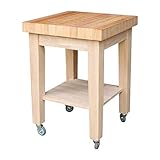
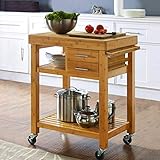
Islands that come with butcher block tops split into two groups. Solid wood island carts on casters, typically 30 to 48 inches wide, 18 to 24 inches deep, and 34 to 36 inches tall, run from about $150 to $450. The IC International Concepts unfinished solid wood cart with a butcher block top sits at the upper end at $391.99, while the Home Aesthetics bamboo rolling cart with drawers, shelves, a towel rack, and locking casters is $159.95. Fixed islands with cabinet bases and 60-inch or longer butcher block tops start around $500 and climb past $1,500. What you are paying for as price rises is thicker tops, harder wood, fully solid rather than veneered bases, and heavier hardware.
The top itself does three jobs a stone or laminate surface cannot: it is a cutting board you never have to put away, it can be sanded back to new wood when it gets ugly, and it is warm to the touch, which matters more than it sounds in a kitchen where people lean and gather.
Pros
- Fully repairable. Knife scores, burns, and stains sand out with 120- and 220-grit paper in about 30 minutes. No other counter material can be restored to new at home.
- Kind to knives and dishes. Wood does not dull blades the way stone does, and a dropped glass has a far better chance of surviving.
- Low entry price. A solid wood island cart with a real butcher block top costs $150 to $400, less than a laminate island of similar size in many cases.
- Movable weight. A 36-inch butcher block cart weighs 60 to 90 pounds, heavy enough to feel stable yet light enough to roll for cleaning or parties.
- Naturally hygienic when maintained. Oiled hardwood is dense enough that spills sit on top where a wipe reaches them.
- Warmth and character. The grain hides minor wear and reads as intentional in both farmhouse and modern kitchens.
Cons
- Monthly oiling is mandatory. Skip it and the wood dries, drinks in stains, and eventually splits along the joints.
- Water is the enemy. Standing water for a few hours leaves gray marks; a leaking pot left overnight can swell a joint permanently.
- It scratches and dents. Every knife mark and dropped can shows. Sanding fixes it, but the surface never stays pristine.
- Heat leaves marks. A pan straight from a 400-degree oven scorches oiled wood. Trivets are not optional.
- Lacquered tops cannot be used as cutting boards. Many budget islands have a clear coat that chips if you cut on it, removing the main advantage of wood.
- Softer woods dent easily. Rubberwood and some acacia tops mark from a dropped mug; maple and bamboo are noticeably tougher.
Who Should Buy It
Buy a butcher block island if you cook several times a week and want a large prep surface that doubles as a cutting board. It suits renters and anyone who moves often, because a rolling cart goes with you and needs no installation. It is the right pick for kitchens where the island will be a work surface first and a display surface second. Households that already keep up with a cast iron pan or a wooden cutting board will find the maintenance familiar. It also makes sense for anyone on a budget who wants solid wood, since a $160 to $400 cart is the only way to get a real hardwood work surface at that price.
Who Should Skip It
Skip it if your island is primarily a homework, mail, and laptop station where drinks sit for hours, since rings and moisture damage will accumulate. Skip it if you want a surface you can wipe with bleach spray and forget. Households with young children who spill constantly may prefer laminate or a stone-look top and save wood for a separate cutting board. If you plan to set hot pans down without thinking, or if the island sits under a sink or next to a dishwasher vent where steam and drips are constant, wood will lose that battle.
Cheaper Alternatives
| Option | Cost | Trade-off |
|---|---|---|
| Laminate-top rolling island cart | $90 to $200 | Zero maintenance and waterproof, but cannot be cut on, cannot be sanded, and chips at the edges show the particleboard core |
| Stainless steel top cart | $150 to $350 | Heat- and water-proof, but scratches visibly, shows fingerprints, and feels cold in a home kitchen |
| Bamboo butcher block cart | $130 to $220 | Harder and cheaper than maple, but thinner tops (often 1 inch) and glue lines are more visible; still needs oiling |
| Faux marble or stone-look top island | $150 to $400 | Easy to clean, but the surface is a thin laminate or resin that cannot be cut on and looks artificial up close |
| Add a large end-grain cutting board to an existing counter | $40 to $120 | Gives you the wood work surface without a new island, but no extra storage or seating |
| DIY: unfinished butcher block slab on a base cabinet | $150 to $300 for a 60-inch slab plus $100 to $250 for a stock cabinet | Bigger and cheaper per square foot than a ready-made island, but requires an afternoon of assembly and oiling |
FAQ
How often do I really need to oil a butcher block island?
Weekly for the first month after buying or sanding, then monthly. A quick test: flick water on the surface. If it beads, you are fine. If it soaks in and darkens within a minute, oil it that night. A 36 by 24 inch top uses about 1/4 cup of food-grade mineral oil per coat.
Can I cut directly on the island top?
Only if it is oil-finished. Run a fingernail across the surface; if it feels like bare wood, it is oiled and safe to cut on. If it feels glassy or plastic-like, it has a lacquer or polyurethane coat that will chip under a knife, so use a separate board.
Is bamboo as good as hardwood for a butcher block top?
Bamboo is harder than maple and resists dents well, and it is usually cheaper. The downsides are thinner tops on most carts and a more uniform, less natural look. It still needs oiling like any wood.
How long does a butcher block island last?
A 1.5-inch solid top that is oiled monthly and sanded every few years can last 20 years or more. The base usually wears out first: check that the cart uses solid wood legs and metal casters rated for at least 75 pounds each rather than plastic wheels.