Key takeaways
- Map a serving cart route, check its full footprint and understand the limits of diagonal calculations before testing the empty cart at home.
What's inside
A serving cart that passes straight through a doorway may still be unable to turn beside the dining table. Check its full footprint, the movement of its wheels, and the space needed for the person guiding it. A listed width is only the starting point.
Measure the cart in the form you will move
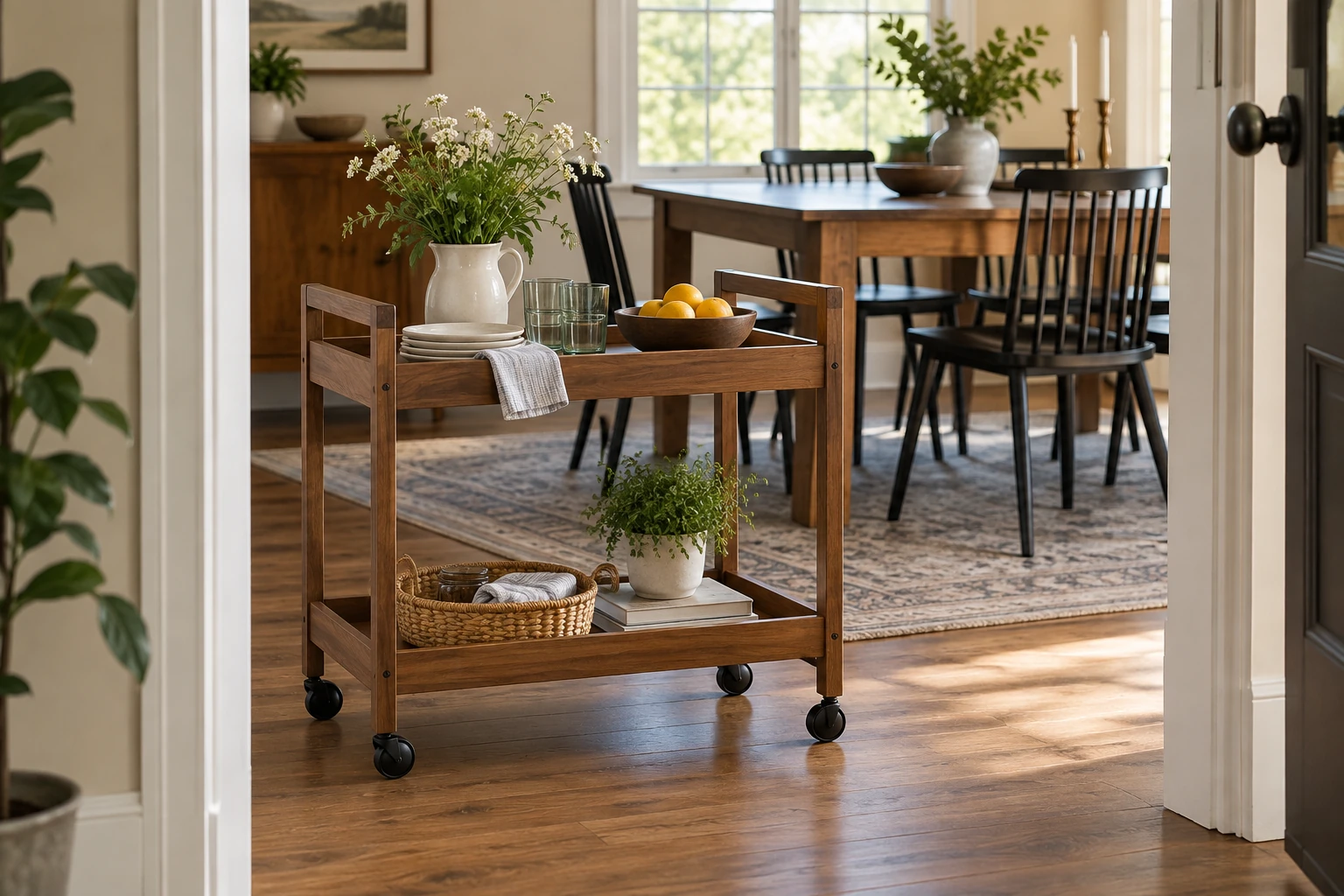
Use assembled dimensions that include handles, side rails, towel bars, and other fixed projections. If the cart has a drop leaf, decide whether it will be lowered for travel and confirm that the instructions allow your planned arrangement. Do not count removable parts as absent unless removing them is part of the approved setup.
As a reference, the IKEA RÅSKOG 305.867.83 has a published footprint of 13.75 by 17.75 inches and lockable castors. That does not provide a certified turning diameter. Product dimensions and wheel descriptions answer different questions, and neither should be expanded into a claim the manufacturer has not made.
Map a complete trip through the room
Draw the route from the cart’s parking spot to its serving position. Include the doorway, table corners, chair backs, sideboard handles, floor transitions, and the place where you stand while turning. Check the room with chairs in normal use, not only pushed tightly under the table.
Mark the point where each turn begins. A cart may need to start turning before it reaches the doorway, so the space on the approach matters. If you plan to pull it backward out of a narrow gap, include the return trip and your standing position on that trip too.
| Location | Record | Check |
|---|---|---|
| Parking space | Width, depth and handle access | Can you grasp it and begin moving? |
| Straight opening | Narrowest clear width | Does the full cart pass? |
| Corner | Free area before, during and after turn | Can the footprint rotate or reverse? |
| Chair zone | Normal occupied arrangement | Is the route still available? |
| Floor transition | Threshold, rug edge or uneven joint | Does the empty cart roll controllably? |
| Serving position | Brake access and remaining passage | Can people move around it? |
Use the diagonal as a geometric screen
For a rectangular footprint rotating around its center in an otherwise empty, level space, the corner sweeps a circle whose diameter equals the rectangle’s diagonal. Calculate that diagonal as the square root of length squared plus width squared. This is geometry, not a manufacturer’s wheel specification.
It is most useful for asking whether a completely clear square would accommodate an in-place rotation. It does not prove the cart can follow a real route through an L-shaped hallway. It also excludes hands, the person pushing, extra wheel sweep beyond the measured footprint, and anything hanging over the shelves.
Worked example: passing is not turning
For an illustrative cart measuring 24 by 18 inches overall, the diagonal is the square root of 576 plus 324: 30 inches. A clear 30-inch square would only accommodate the idealized rectangular footprint rotating about its center with zero extra allowance. It is not a practical recommended clearance.
Now imagine the cart passes through a 22-inch opening when its 18-inch side leads. That leaves four inches total in a straight passage, but it says nothing about the turn beyond the doorway. If a chair occupies part of the turning area, the cart may need several small movements or a different route. The straight-width calculation cannot settle that question.
Build a flat template, then try the empty cart
Cut paper or cardboard to the full footprint and mark which edge is the handle. Move it through the route, including rotations. A template that collides with furniture identifies a problem immediately. A successful template is only a preliminary check because it cannot simulate caster behavior, thresholds, or the user’s reach.
If you can test the actual cart, begin empty on the intended route. Release the brakes as directed, move slowly, and keep hands clear of pinch points. Notice whether it changes direction easily, needs a wider approach, or catches at floor transitions. Stop instead of pushing through a catch or tipping the cart to make it pass.
Only consider a working load after checking the cart’s assembly and load instructions. Keep objects within the shelves, account for the permitted load on each level, and avoid using hot liquids or fragile serving pieces for an initial movement check. Fit planning is not an excuse to overload a cart for a test.
Choose a route you can repeat
A layout that requires moving several occupied chairs every trip may not suit daily serving. Consider a smaller cart, a different parking position, or carrying dishes to a stationary surface instead. Record the arrangement that worked, including which chairs were occupied and where the cart was parked.
The successful result is a repeatable trip with room to guide and park the cart. Save the worksheet with its exact model and dimensions so a later purchase substitution does not quietly invalidate your route plan.