Key takeaways
- Confirm table pad sections, hinge directions and finished folded dimensions before ordering a custom protector or choosing its storage space.
What's inside
Before ordering a custom table pad, ask for a drawing that distinguishes the separate pad sections from the folds within each section. The tabletop’s extension joints and the pad’s hinges do not necessarily occupy the same positions. Confirm how the pad covers each table configuration and how the finished pieces fit into your intended storage space.
Separate a section joint from a fold
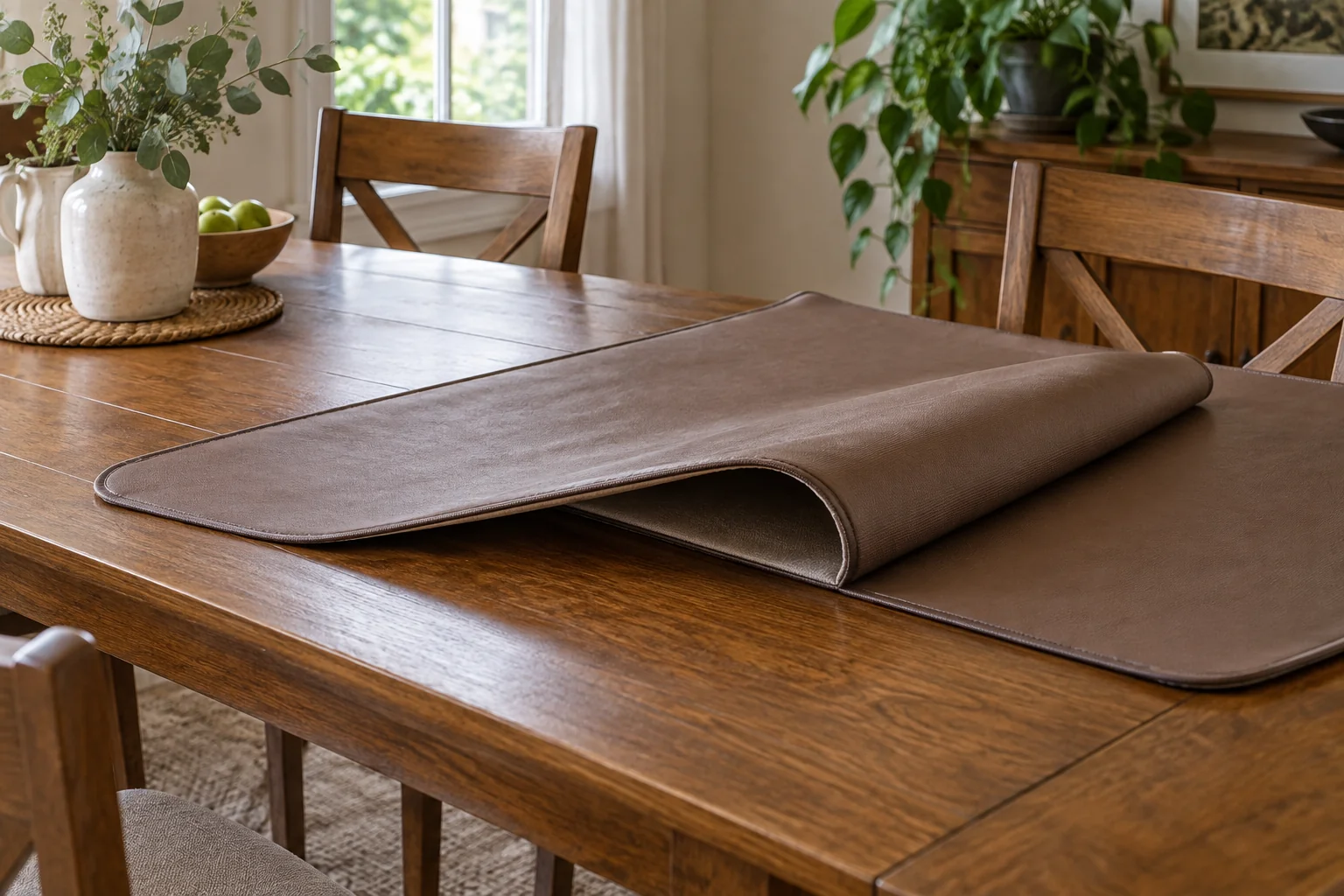
A section is an individual piece that can be removed. A fold allows one piece to close for storage. On your order sketch, use one line style for the boundary between pieces and another for the fold within a piece. Label the difference in words so a simple diagram cannot be misread by the supplier.
Pioneer Table Pad Company explains that it can make separate pads for the main table and extension leaves, with pieces commonly folding like a book. It also describes different section and fold arrangements for larger tables. These examples show why you should obtain the plan for your actual order. They do not establish that every custom pad will have a particular number or orientation of hinges.
Draw the table configurations first
Record the table closed, with the leaf arrangement you use most often, and at its maximum intended extension if that differs. Label the main tabletop sections and each leaf. Include the actual outline, especially where a round table becomes oval or the ends have a shaped profile.
Use the pad manufacturer’s measuring or template procedure. Do not assume a simple length-and-width rectangle captures curved corners, shaped ends or a beveled edge. Ask where the manufacturer wants measurements taken and whether an existing pattern is confirmed for your exact model. A similar table name is not enough to establish an identical outline.
| Order question | Information to put on the drawing | Confirmation to request |
|---|---|---|
| Closed table | Outline and verified dimensions | Which pad sections cover this configuration? |
| Extended table | Each leaf and its position | Which additional pad pieces are supplied? |
| Piece boundaries | Clearly labeled section joints | How are neighboring pieces kept aligned? |
| Fold lines | Direction and position within each piece | Which face folds inward? |
| Storage | Clear opening and usable interior space | Actual finished folded dimensions and thickness |
| Table contact | Table material and finish information | Approved backing, use and storage instructions |
Ask for folded dimensions, not half a guess
A flat outline does not fully describe the folded object. The pad’s construction, hinge allowance and thickness can affect the finished package. Request the actual folded length, width and thickness of each section from the maker rather than halving whichever dimension looks convenient.
Measure the storage opening as well as the space behind it. A wide interior behind a narrow door frame may not accept the folded pad as planned. Check that storing it there is consistent with the manufacturer’s orientation and environmental instructions. Do not bend a rigid section into an extra fold to make it fit.
Illustrative example: two plans for one outline
Imagine a fictional pad section measuring 30 by 40 inches when flat. A drawing showing a fold across the 40-inch dimension suggests a nominal 30-by-20-inch footprint before construction allowances. A different fold direction suggests 15 by 40 inches. Those shapes have the same unfolded area but very different storage implications.
Suppose the proposed cabinet opening is only 32 inches wide. The first nominal outline may be a candidate for checking, while the second cannot be treated as equivalent merely because both pads fold in half. The buyer requests finished dimensions and checks the complete entry path. These invented numbers are a geometry example, not a manufacturing specification or permission to choose the hinge location independently.
For an extending table, add a separate line for each leaf pad. Do not assume it will nest inside a main pad or fit in the table’s built-in leaf compartment. Ask the pad maker and table maker about the intended storage arrangement before committing to it.
Review the plan in its everyday configuration
Mark where people normally sit and where serving items will be placed, then ask the supplier how the approved sections meet and lie flat. The aim is to understand the product you will receive, not to demand that every pad fold line coincide with a tabletop seam. Let the manufacturer explain any necessary construction constraints.
Keep surface-protection claims separate from fold geometry. A convenient hinge plan does not establish heat resistance or compatibility with a particular finish. Obtain the actual use and care guidance, including whether the pad is meant to remain in place or be removed after use. Do not invent a heat limit from its thickness.
Check the delivered pieces against the approved drawing
Before using the pad, compare its sections, orientation and outline with the order record following the maker’s unpacking instructions. Report a mismatch, unexpected fold or damaged hinge rather than trimming or forcing the pad into the expected shape. Keep the packing labels and photographs until the issue is resolved.
Store the approved drawing with the care sheet. Label pieces using a method the maker permits, so future setup does not depend on remembering which near-identical section belongs where. A complete order record makes the pad useful in both its working and stored forms, without assuming that the word custom settles every folding detail.