Key takeaways
- Check serving-cart wheel brakes, swivel locks and control access separately with a caster map and a practical seller-question worksheet.
What's inside
A serving cart described as having locking casters can still leave an important question unanswered: does the control stop the wheel rolling, the caster swiveling, or both? Before buying, record the function of each fitted caster and how you reach its control in the cart’s intended parking position. A pedal in a photograph is not enough to answer those questions.
Separate rolling from steering
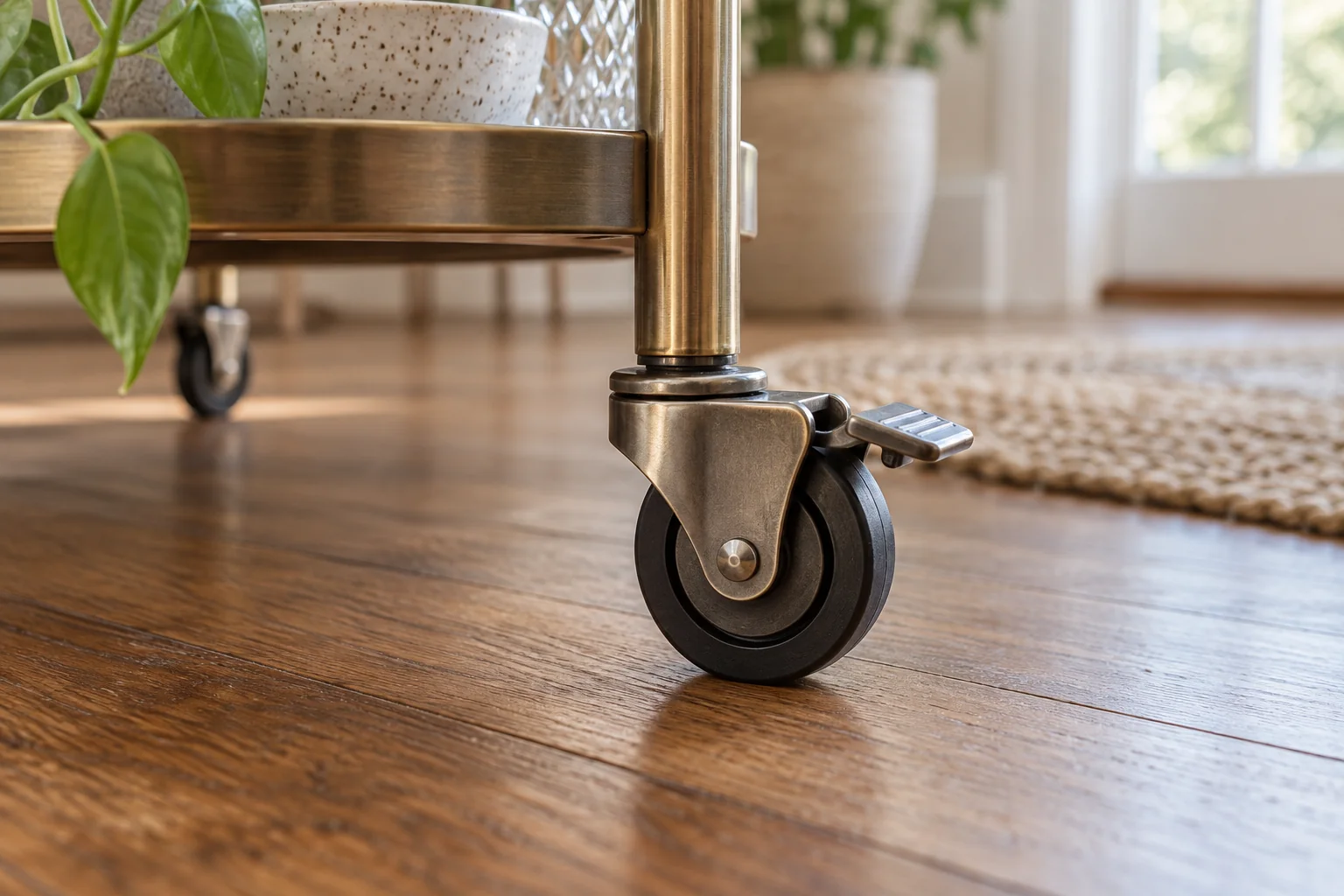
The wheel turns around its axle as the cart travels. A swivel caster also turns around a vertical steering axis, allowing the wheel to point in different directions. Stopping one movement does not necessarily stop the other. A fixed caster does not swivel, but its wheel can still roll.
Blickle’s manufacturer guide to brake systems distinguishes wheel-and-swivel braking from directional locking. Its directional-lock examples fix the steering orientation for straight travel. That is different from holding the wheel against rolling. These are component examples, not evidence that a particular domestic serving cart uses those systems.
Translate a seller’s terms into plain questions. Ask whether wheel rotation stops, whether swivel rotation stops and which wheels are affected. If a listing uses “total lock,” ask for the supplied caster’s documented function rather than assuming every seller uses the phrase identically.
Map the cart’s actual wheel arrangement
Draw the cart as seen from above and mark the handle or usual pushing side. Label each corner A through D. Record fixed or swivel, brake present or absent, and the confirmed brake function. A statement such as “two locking wheels” gives a quantity but does not identify their locations or steering behavior.
Match that drawing to the assembly instructions and the exact variant being sold. Similar carts in one range may use different wheel arrangements. A promotional photograph can show an earlier version or omit the side where the pedals are fitted. Unclear or conflicting evidence belongs in the questions column.
| Check | Candidate A | Candidate B |
|---|---|---|
| Exact cart and revision | Record model and listing date | Record model and listing date |
| Caster arrangement | Fixed/swivel at each corner | Fixed/swivel at each corner |
| Wheel braking | Which wheels stop rolling? | Which wheels stop rolling? |
| Swivel locking | Which steering heads stop turning? | Which steering heads stop turning? |
| Control access | Pedal position in parking space | Pedal position in parking space |
| Operating limits | Maker’s floor, load and use instructions | Maker’s floor, load and use instructions |
| Evidence | Manual page or written reply | Manual page or written reply |
Check access where the cart will actually park
A control can work correctly yet be inconvenient behind a low shelf or next to a cabinet. Record whether you can reach it without moving the cart out of its intended position. Include any tablecloth, hanging towel or stored item that could obscure the control. Do not put a foot beneath a loaded cart to investigate an uncertain pedal.
Ask the seller to demonstrate the controls on the showroom unit according to its instructions. Observe which parts move when released and what the documented locked state looks like. Keep your hands clear of wheels and moving parts. This is a feature demonstration, not a strength test: pushing hard against an applied brake does not establish a safe holding rating.
Illustrative comparison: the same count, different functions
Imagine two four-wheel carts, each advertised with two locks. Candidate A’s manual identifies two wheel brakes. Candidate B’s documentation states that two controls stop both wheel rotation and swivel movement. The headline count is identical, but the confirmed functions are different.
Now suppose Candidate B’s controls face the wall in the only practical parking position. Its additional function does not answer the access problem. The comparison sheet should retain both facts: the brake function is documented, and control access remains unresolved. A larger number of named features does not automatically make the cart a better fit.
This example is fictional. It does not establish that two brakes are sufficient for every cart, load or floor. Use the assembled cart manufacturer’s specified arrangement and operating restrictions. Do not replace the supplied layout with a generic rule about how many locks a cart ought to have.
Keep braking separate from other suitability checks
A lock does not increase shelf capacity, prove floor compatibility or make a cart a stable workbench. Confirm the intended use of the cart independently. Serving, storage and food preparation may place different demands on a product, and a shopping description should not silently become permission to lean on it.
Likewise, do not infer suitability for a slope, threshold or uneven floor from the word “locking.” Ask the maker about the actual location. If that use is excluded, choose a different location or product instead of adding wedges or improvising caster modifications.
Save a usable operating note
Once the cart is selected, keep its wheel map, manual and any seller confirmation together. Note the normal parking position and the controls required by the instructions. If a wheel, pedal or attachment later appears damaged or the cart does not hold as documented, stop relying on that function and contact the maker.
The useful buying result is a clear answer about movement and access: which wheels roll, which heads swivel, what each control changes and whether those controls remain reachable. That record is more informative than a product photograph with two visible pedals.