Key takeaways
- Your dining table sits in an open plan and you regularly turn to interact with a kitchen, TV, or balcony view.
- You or family members have limited mobility, back or knee issues, and pushing back a heavy chair is difficult.
- You have a pedestal or round table where legs don’t block the swivel base.
What's inside
- When Swivel Dining Chairs Make Sense — And When They Don’t
- The 3 Swivel Mechanism Types You Will Actually Find
- Stability and Weight Limits: What to Check Before You Buy
- Floor Clearance and Room-Size Fit: Real Measurements
- Material and Construction Trade-Offs
- Decision Matrix: Which Swivel Chair Matches Your Situation
- Assembly, Moving and Long-Term Maintenance
- Final Check Before You Order
Swivel dining chairs are worth choosing when you need easy access in tight spaces, want to turn to talk or watch another area, and have hard floors or low-pile rugs that allow smooth rotation; skip them if you have a very compact dining area, thick carpet, or young children who will spin constantly.
- When Swivel Dining Chairs Make Sense — And When They Don’t
- The 3 Swivel Mechanism Types You Will Actually Find
- Stability and Weight Limits: What to Check Before You Buy
- Floor Clearance and Room-Size Fit: Real Measurements
- Material and Construction Trade-Offs
- Decision Matrix: Which Swivel Chair Matches Your Situation
- Assembly, Moving and Long-Term Maintenance
- Final Check Before You Order
As an Amazon Associate we earn from qualifying purchases at no extra cost to you.

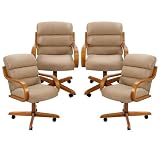
When Swivel Dining Chairs Make Sense — And When They Don’t
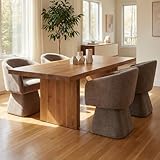
Unlike a standard four-leg dining chair, a swivel dining chair rotates 360 degrees or 180 degrees on a central base, which solves one specific problem: getting in and out without dragging the chair. That is a major advantage for banquette-style layouts, pedestal tables, and open-plan kitchens where you turn to face an island or living room.
Choose them if:
- Your dining table sits in an open plan and you regularly turn to interact with a kitchen, TV, or balcony view.
- You or family members have limited mobility, back or knee issues, and pushing back a heavy chair is difficult.
- You have a pedestal or round table where legs don’t block the swivel base.
Avoid or reconsider if:
- Your dining area is tightly packed. A swivel base needs extra floor clearance to rotate without hitting table legs or other chairs.
- You have plush, high-pile carpet. Most swivel mechanisms sink and drag.
- You need stackable or lightweight chairs for frequent moving. Swivel chairs are heavier and never stack.
The 3 Swivel Mechanism Types You Will Actually Find
Product listings often just say “360° swivel” but the hardware underneath determines how smooth, stable, and durable the chair will be.
1. Ball-Bearing Swivel Plate
The most common mechanism in 2026. A low-profile steel plate with ball bearings sits between the seat frame and the base. It offers a full 360-degree turn, is relatively quiet, and allows for auto-return options where the seat springs back to center when you stand up. Found on most upholstered cross-leg and four-leg swivel dining chairs usually $250–$550 per chair. Weak point: bearings wear if grit gets in, causing squeaking or wobble after 2-3 years in daily use.
2. Memory Swivel with Auto-Return
A ball-bearing plate plus a tension spring that automatically returns the chair to its forward-facing position. Essential for a tidy look when chairs are tucked under a table, especially for pedestal bases and metal disc bases. The return action adds tension, so the swivel feels slightly stiffer than a free-spinning plate. Ideal for formal dining sets where alignment matters.
3. Column/Barrel Swivel on a Disc or Pedestal Base
A central steel column rotates inside a weighted base, similar to a counter stool. Common on faux-leather or bouclé barrel chairs and mid-century style chairs with a single pedestal foot. This type is the most stable for heavier users and gives the smoothest glide, but it is also the heaviest (often 30–45 lbs per chair) and requires perfect floor flatness. Cheaper versions use a plastic bushing instead of bearings and will develop play within a year.
| Mechanism Type | Rotation | Typical Weight Capacity | Base Diameter Needed | Noise & Maintenance |
|---|---|---|---|---|
| Ball-Bearing Plate | 360° free spin | 250–300 lbs | 18–22 inches | Low hum; vacuum bearings yearly, tighten center bolt every 6 months |
| Memory Swivel with Auto-Return | 360° with spring return | 250–300 lbs | 18–24 inches | Slight spring sound; spring may loosen after 3+ years |
| Column / Disc Pedestal | 360° smooth glide | 300–350 lbs | 20–26 inches | Near silent; check floor levelers, heaviest to move |
Stability and Weight Limits: What to Check Before You Buy
Swivel chairs are rated like office chairs, not like static dining chairs. Always check the spec sheet for two numbers: static weight capacity and base width.
- Weight capacity: Most upholstered swivel dining chairs are rated for 250 to 300 lbs. Models with a solid steel disc base or a four-star metal base often go up to 350 lbs. If the listing does not list a limit, assume 250 lbs and avoid it for daily heavy use.
- Base footprint vs. seat width: A stable chair has a base diameter at least 2 inches narrower than the seat width, but not much narrower. A 20-inch wide seat on a 14-inch base will feel tippy when you lean. Look for a base that is 18 inches or wider.
- Center of gravity: Low, wide barrel chairs are more stable than tall, narrow chairs with high backs. If the seat height is over 19.5 inches and the back is over 34 inches high, the chair needs a heavier base to prevent tipping when you swivel and lean.
- Floor levelers: Four adjustable levelers are better than a single flat disc on uneven tile or hardwood. Without levelers, the chair will rock slightly and the swivel will wear unevenly.
For households with kids, an auto-return memory swivel is safer because the chair does not stay angled into the walkway, and a 4-leg swivel base resists tipping better than a single pedestal when a child climbs.
Floor Clearance and Room-Size Fit: Real Measurements
Swivel chairs need more room than you think, not for the chair itself but for the arc of the base and your knees as you turn.
- Chair to table clearance: Leave 12–14 inches between the seat edge and the table apron for comfortable entry. Standard dining table height is 28–30 inches; standard swivel dining seat height is 18–19 inches. If your table is 30 inches high, a 19-inch seat leaves about 11 inches of knee clearance, which is tight for taller people.
- Chair to chair spacing: For swivel, allow 28–32 inches from center to center of each chair (versus 24–26 inches for fixed chairs). This prevents elbows and bases from colliding when someone turns.
- Chair to wall or sideboard: You need at least 36 inches from the table edge to the wall to swivel and push back comfortably, 42–48 inches if you need a walkway behind an occupied chair.
- Rug size: The entire swivel base must stay on the same surface. If the base catches a rug edge, it will jerk or scratch. For a 72 x 42 inch rectangular table with four swivel chairs, use a rug at least 96 x 60 inches. For a 48-inch round table with four chairs, use an 8-foot round or 8 x 10 foot rectangular rug.
- Room fit example: In a common 10 x 12 foot dining room with a 60 x 36 inch table, four swivel chairs will fit but will feel tight. You will have about 36 inches of clearance on the long sides if centered, which is the absolute minimum. Six swivel chairs in that room will require you to stagger or leave one end against a wall. In the same room, four fixed chairs are comfortable, six is tight.
- Floor type: On hardwood, tile, and luxury vinyl, add felt pads under the base. On carpet, choose a low-pile rug under 0.5 inch or place chairs directly on hard flooring. Thick carpet over 0.75 inch will block most swivel plates.
Material and Construction Trade-Offs
The swivel mechanism gets the attention, but the frame and upholstery determine how long the chair actually lasts in a dining setting with food and daily use.
| Feature | Best For | Watch Out For | Durability in Dining Use |
|---|---|---|---|
| Solid Wood Frame (rubberwood, oak, ash) | Long-term stability, repair possible | Heavier, usually $400–$700 per chair | 8–12 years; joints can be re-glued |
| Engineered Wood / Plywood Frame | Lower price, lighter weight | Swivel plate screws strip more easily, not moisture resistant | 3–6 years of daily swivel use |
| Metal Base (powder-coated steel) | Highest weight limit, modern look | Can scratch floors, cold to touch | Very high; check welds and powder coat chips |
| Performance Fabric (polyester blend, olefin) | Kids, pets, frequent spills | Less breathable than natural fibers | Stain resistant, 40,000+ double rubs ideal |
| Bouclé / Teddy Fabric | Texture and warmth | Snags and holds crumbs, harder to spot clean | Shows wear first on arm edges |
| Faux Leather / Vegan Leather | Wipe-clean convenience | Can peel after 2–4 years near heat vents | Cracks if placed in direct sun |
| Foam Density | Comfort vs. sag | Foam under 1.8 density sags quickly | Look for 1.8–2.2 lb/cu ft density, or HR foam |
Decision Matrix: Which Swivel Chair Matches Your Situation
| Your Situation | Recommended Swivel Type | Why |
|---|---|---|
| Small apartment, round 36–42 inch table | Compact 4-leg ball-bearing swivel, no arms, seat width 19–20 inches | Narrow base fits tight spacing, armless allows tucking fully under table |
| Family with kids and pets | Auto-return swivel with performance fabric and metal or solid wood frame | Returns to neat position, fabric resists stains, stronger frame handles climbing |
| Renters who move often | Lightweight engineered-wood frame with detachable swivel plate, under 25 lbs | Easy to disassemble, fits through narrow doorways |
| Back pain or limited mobility | Swivel with arms, padded back, seat height 19 inches, 360° free spin | Arms help push up, swivel eliminates twisting your spine to exit |
| Open-plan dining that faces living room | Barrel or pedestal swivel with 360° column glide | Smooth turn to join conversation without moving the whole chair |
| Formal dining room with rug | Disc-base memory swivel with felt pads, low-profile base | Stays aligned, protects rug and floors, looks orderly |
Assembly, Moving and Long-Term Maintenance
Swivel dining chairs rarely arrive fully assembled. Understanding what is in the box prevents damage and frustration.
- Box weight and size: Expect 28–50 lbs per box, with two chairs per box being common. Cartons are usually 26–30 inches wide, so measure your doorway (standard interior door is 28–30 inches) and elevator before delivery. Barrel swivel chairs often ship in single boxes that are larger than the chair itself.
- Assembly reality: Most models require attaching the swivel plate to the seat with 4–8 bolts, then attaching the legs or base. You will need two people to hold the seat while aligning the plate. Tighten all bolts by hand first, then fully tighten in a star pattern. Over-tightening with a power drill will strip engineered wood. Allow 15–25 minutes per chair.
- What wears first: The swivel plate center nut loosens, felt pads flatten, and front leg joints take the most stress from spinning and leaning. Check and re-tighten the large center nut and leg bolts every 6 months.
- Daily care: Vacuum fabric and the gap around the swivel plate weekly — crumbs in the bearing race are the main cause of squeaks. For metal bases, wipe with a damp cloth and dry immediately to prevent rust at weld points. For faux leather, keep at least 3 feet from radiators and direct sun to prevent peeling.
- Preventing floor damage: Use 1-inch thick felt pads rated for the chair weight. Replace them every 6–12 months. On hardwood, consider a clear plastic chair mat under the base if the chair is used daily; the constant rotation wears finish faster than a fixed chair.
- When to replace the mechanism: If the chair wobbles side-to-side more than 0.25 inch, squeaks after cleaning and tightening, or does not return smoothly, the swivel plate itself is worn. Replacement plates in standard 7–8 inch sizes are widely available and usually cost $15–$35, and swapping one takes about 10 minutes with a wrench.
Final Check Before You Order
Measure your table height, chair-to-wall distance, and rug size first, then match the swivel type to how you actually eat and entertain. If you can answer that you have 36 inches of pull-back space, a hard or low-pile surface, and a base rated 25 lbs above the heaviest user, a swivel dining chair will make daily dining noticeably easier. If any of those three measures fail, a fixed chair with a lightweight frame will be more comfortable long term.