Key takeaways
- Pressure versus flow: PSI breaks the bond between dirt and paint; GPM carries it away. For automotive work, a machine around 1,800–2,100 PSI with 1.7 GPM or better will rinse faster and more safely than a high-PSI unit with a thin stream.
- Power source: Corded electric gives you unlimited runtime and lower cost per unit of pressure. Battery platforms buy you freedom from outlets and extension cords, which matters if you wash on a shared drive or away from the house.
- Foam delivery: A dedicated foam cannon lays down thick, clinging soap that does the lifting before the brush touches anything. Onboard soap tanks are more convenient; detachable cannons produce better foam.
- Storage and form: Measure your actual garage wall before you buy. Upright cart designs stack neatly in a corner; wall-mounted reels keep the floor clear entirely and stop the hose-tangle ritual.
- Nozzle set and wand quality: Look for a steel wand and at least three interchangeable tips. Anything narrower than 25 degrees stays off your paint — reserve those for concrete and fence board.
What's inside
A car parked in the driveway is part of your home’s exterior composition, whether you planned it that way or not. It sits in the same sightline as your entry, your hardscape, and whatever you’ve done with the planting beds — and a film of road grime undoes a lot of careful work. The trouble is that most homeowners inherit their cleaning setup by accident: a garden nozzle that dribbles, a bucket that grinds dirt into clear coat, or a rented gas unit powerful enough to strip paint off a fence rail.
An electric pressure washer solves this at the right scale. Modern units land in the 1,800 to 2,500 PSI range, which is enough to lift brake dust and pollen without shredding trim, and they store in a footprint smaller than a laundry hamper. This guide covers what actually matters when you’re shopping — flow rate, hose reach, storage form factor, soap delivery — and reviews the models worth your driveway in 2026, from cordless grab-and-go units to a wall-mounted system that disappears into the garage wall.
As an Amazon Associate we earn from qualifying purchases.


How to Choose a/an Auto Pressure Washer (2026)
- Pressure versus flow: PSI breaks the bond between dirt and paint; GPM carries it away. For automotive work, a machine around 1,800–2,100 PSI with 1.7 GPM or better will rinse faster and more safely than a high-PSI unit with a thin stream.
- Power source: Corded electric gives you unlimited runtime and lower cost per unit of pressure. Battery platforms buy you freedom from outlets and extension cords, which matters if you wash on a shared drive or away from the house.
- Foam delivery: A dedicated foam cannon lays down thick, clinging soap that does the lifting before the brush touches anything. Onboard soap tanks are more convenient; detachable cannons produce better foam.
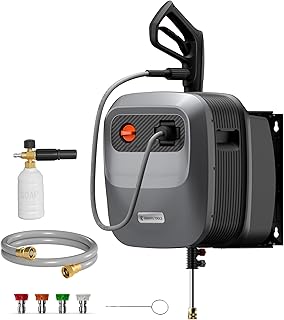
- Storage and form: Measure your actual garage wall before you buy. Upright cart designs stack neatly in a corner; wall-mounted reels keep the floor clear entirely and stop the hose-tangle ritual.
- Nozzle set and wand quality: Look for a steel wand and at least three interchangeable tips. Anything narrower than 25 degrees stays off your paint — reserve those for concrete and fence board.
The Best Auto Pressure Washers (2026) Reviewed
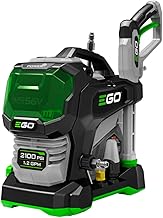
EGO Power+ HPW2100
The cleanest solution if you’re already on EGO’s battery platform: 2,100 PSI, no cord, and a variable-trigger design that lets you dial pressure down for wheels and door jambs. Battery and charger sell separately, so price it accordingly before you commit.
Sun Joe SPX3000
The value benchmark, and it has earned that position through sheer durability rather than spec-sheet drama. Twin detergent tanks let you keep wheel cleaner and body soap loaded simultaneously, which is a genuinely useful convenience for anyone who details more than twice a season.
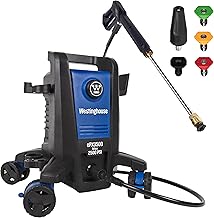
Westinghouse ePX3500
The most complete package here — 2,500 max PSI, 1.76 max GPM, a five-nozzle set, and an anti-tipping base that keeps the unit upright when you tug the hose from around a corner. The pro-style steel wand feels a tier above what this price usually buys.
Westinghouse ePX3100v
A trimmed-down sibling built for people who mostly wash cars: same 1.76 max GPM, gentler 2,100 max PSI, and a detachable foam cannon that produces genuinely thick lather. The integrated carry handle makes it the easiest of these to move up a step or into a truck bed.
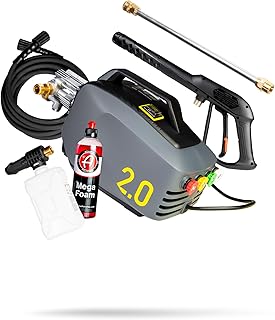
Adam’s Active Pressure Washer 2.0
Purpose-built for automotive finishes at 1,800 PSI and 2.0 GPM, and bundled with Mega Foam soap so you’re not guessing at chemistry on day one. It’s the lightest and most portable unit in this group, which shows in build heft, but the paint-safe pressure-to-flow balance is exactly right.
Frequently Asked Questions
How much PSI is safe on car paint?
Stay between 1,200 and 2,000 PSI at the nozzle, use a 40-degree tip, and hold the wand a foot or more from the panel. Damage comes from close, narrow, concentrated spray far more often than from a machine’s headline rating.
Do I need a foam cannon or is a soap tank enough?
Onboard tanks are fine for a maintenance rinse. If you want a true touchless pre-soak that loosens grit before contact, a foam cannon is the meaningful upgrade.
Can these run off a rain barrel or portable tank?
Most electric units require pressurized supply and will starve without it. Check the manual for gravity-feed or siphon compatibility before improvising.
What about winter storage?
Drain the pump fully and run pump antifreeze through it if your garage drops below freezing. Trapped water expanding inside the pump head is the single most common way these machines die.
Final Thoughts
For most homeowners, the Westinghouse ePX3500 offers the best balance of pressure, accessories, and build quality, while the Sun Joe SPX3000 remains the smartest entry point if you’re testing whether you’ll actually use one. If your garage is the organized kind — or you want it to be — the Giraffe Tools G20 wall-mounted system with its 65-foot retractable reel is the version of this tool that never clutters a floor again.