Key takeaways
- Tooth count: Match the count to the work. 80 to 100 teeth gives near-polished crosscuts in hardwood, veneered ply, and moldings. Around 40 to 60 teeth cuts faster and clears chips better on thick stock, framing, and rough dimensioning. Very high counts on deep cuts can generate heat if you rush the feed.
- Grind and hook angle: An alternate top bevel (ATB) grind slices wood fibers cleanly and is the standard for finish crosscutting. A low or slightly negative hook angle keeps a sliding miter saw from self-feeding into the cut, which matters for both safety and edge quality.
- Kerf width: Thin-kerf blades remove less material, ease the load on smaller motors, and stretch pricey lumber further. Full-kerf discs are stiffer and resist deflection on long bevel cuts. Consider what your saw’s motor can comfortably pull.
- Carbide quality: The grade of carbide and the brazing determine how many cuts you get before the edge dulls. Denser micrograin carbide holds a keener edge and survives more resharpenings, which lowers the real cost per cut over a few years of shop use.
- Arbor and plate finish: Nearly all 12-inch saws use a 1-inch arbor, so confirm before ordering. Look for laser-cut expansion slots and an anti-friction coating; both reduce vibration and pitch buildup that otherwise show up as burn on cherry and maple.
What's inside
A miter saw is only as good as the disc spinning on its arbor. Anyone who has trimmed baseboard, mitered a picture frame, or crosscut walnut for a floating shelf knows the frustration: burn marks along the cut line, fuzzy edges that need three passes of sanding, tearout on the veneer face that shows up only after the glue has cured. Nine times out of ten the saw is not the problem. The factory blade is. Most 12-inch saws ship with a 32- or 40-tooth general-purpose disc built for framing lumber, not for furniture-grade joinery where a gap of a few thousandths reads as sloppy craftsmanship.
This guide looks at the 12-inch blades worth putting on a furniture-making saw in 2026, from ultra-fine 100-tooth finish blades to thin-kerf all-rounders that leave more of your expensive stock in the workpiece. We cover tooth count, hook angle, kerf, and carbide quality, then walk through the specific blades that deliver clean, glue-ready edges on hardwood, plywood, melamine, and trim.
As an Amazon Associate we earn from qualifying purchases.


How to Choose a 12-Inch Miter Saw Blade (2026)
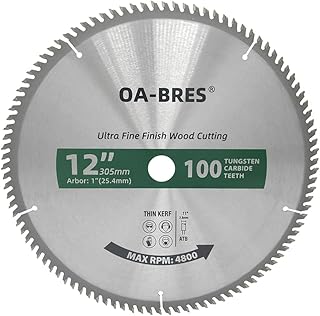
- Tooth count: Match the count to the work. 80 to 100 teeth gives near-polished crosscuts in hardwood, veneered ply, and moldings. Around 40 to 60 teeth cuts faster and clears chips better on thick stock, framing, and rough dimensioning. Very high counts on deep cuts can generate heat if you rush the feed.
- Grind and hook angle: An alternate top bevel (ATB) grind slices wood fibers cleanly and is the standard for finish crosscutting. A low or slightly negative hook angle keeps a sliding miter saw from self-feeding into the cut, which matters for both safety and edge quality.
- Kerf width: Thin-kerf blades remove less material, ease the load on smaller motors, and stretch pricey lumber further. Full-kerf discs are stiffer and resist deflection on long bevel cuts. Consider what your saw’s motor can comfortably pull.
- Carbide quality: The grade of carbide and the brazing determine how many cuts you get before the edge dulls. Denser micrograin carbide holds a keener edge and survives more resharpenings, which lowers the real cost per cut over a few years of shop use.
- Arbor and plate finish: Nearly all 12-inch saws use a 1-inch arbor, so confirm before ordering. Look for laser-cut expansion slots and an anti-friction coating; both reduce vibration and pitch buildup that otherwise show up as burn on cherry and maple.
The Best 12-Inch Miter Saw Blade (2026)s Reviewed
DEWALT DWA112100 100-Tooth Fine Finish
A dependable finish blade that lands right where most furniture builders need it: 100 ATB teeth, tough carbide, and a plate that runs true out of the box. Excellent on painted trim, poplar, and prefinished flooring where a chipped edge is unforgivable.
Diablo D1280X 80-Tooth Fine Finish
The 80-tooth count is a smart compromise, clearing chips faster than a 100-tooth disc while still leaving a surface that needs little more than a scuff sand. The high-density carbide and Perma-Shield coating keep resin from building up on repeat cuts in pine and MDF.
Makita B-67000 100-Tooth Max Efficiency
Built around a thinner plate and optimized tooth geometry, this one cuts with noticeably less motor strain than a standard full-kerf finish blade. A strong choice for sliding saws and long production runs of case parts or table aprons.
Freud LU86R012 48-Tooth Thin Kerf
The workhorse of this list. At 48 teeth and thin kerf, it crosscuts and rips well enough for general shop duty, spinning easily on smaller motors while leaving a respectable edge. Keep it on the saw for breakdown work and swap to a finish blade for final cuts.
FOXBC 100-Tooth Polished Finish
A value option that punches above its price on softwoods, plywood, and trim, with a mirror-smooth cut when the feed rate stays slow and steady. Reasonable to keep as a spare or a dedicated melamine blade.
Frequently Asked Questions
How many teeth do I need for furniture work?
For crosscutting hardwood, veneered plywood, and molding, 80 to 100 teeth is the sweet spot. Drop to 40 to 60 teeth when cutting thick or wet stock so the gullets can clear chips instead of packing and burning.
Why does my blade burn the wood?
Usually pitch buildup, a dull edge, or pausing mid-cut. Clean the blade with a dedicated resin remover, let the saw reach full speed before contact, and move through the cut at a consistent pace.
Can I cut aluminum or laminate with these?
High-tooth finish blades handle laminate and melamine well. Non-ferrous metal calls for a blade designed for it, with a negative hook and proper lubrication. Using a wood blade on aluminum is unsafe.
Is resharpening worth it?
On quality carbide blades, yes. A professional sharpening typically costs a fraction of replacement and can be repeated several times before the teeth run short.
Final Thoughts
For most furniture and trim work, the DEWALT DWA112100 is the easy default: clean cuts, fair price, widely available. Choose the Makita B-67000 if you run a sliding saw or cut all day and want the lighter load of its thin plate, and keep the Freud LU86R012 mounted for breakdown and general shop tasks where speed matters more than polish.