Key takeaways
- Rip capacity: Anything under 24 inches means you’ll be breaking down plywood with a circular saw first. A 30-plus inch fence lets you rip a 4×8 sheet down the middle in one pass — the difference between a weekend build and a two-day one.
- Fence quality: This is the single biggest predictor of clean joinery. Look for a rack-and-pinion system that stays parallel when you lock it down; a fence that racks even slightly will burn edges and ruin glue-ups.
- Stand and mobility: If your saw lives in a shared garage, a rolling stand that collapses upright is worth paying for. Folding leg stands save money but mean lifting 50-plus pounds every session.
- Blade size and depth of cut: Ten-inch blades give you roughly 3-1/8 inches at 90 degrees, enough for thick hardwood and 4×4 stock. An 8-1/4 inch saw trades that headroom for real weight savings — fine for cabinet-grade sheet goods and dimensional lumber.
- Dust collection: Check for a shrouded blade guard with a rear port sized to a standard shop vac hose. Indoor woodworkers feel this feature more than any spec on the label.
What's inside
The table saw is the tool that separates a wobbly bookshelf from a piece you’d actually put in your living room. For DIYers building furniture at home, the frustration is rarely ambition — it’s the gap between a saw that cuts square every time and one that drifts a sixteenth of an inch across a long rip, leaving joints that never quite close. Add a garage that doubles as parking, a budget that has to stretch across lumber and hardware, and the decision gets murky fast.
This guide looks at portable and jobsite table saws through a furniture-making lens: how accurately they hold a fence, how much sheet goods they can handle solo, how quickly they fold away, and where the dust actually ends up. Below you’ll find the models worth your attention in 2026, plus the specs that genuinely change your results and the ones that just look good on a box.
As an Amazon Associate we earn from qualifying purchases.



How to Choose a Table Saw For Diyers (2026)
- Rip capacity: Anything under 24 inches means you’ll be breaking down plywood with a circular saw first. A 30-plus inch fence lets you rip a 4×8 sheet down the middle in one pass — the difference between a weekend build and a two-day one.
- Fence quality: This is the single biggest predictor of clean joinery. Look for a rack-and-pinion system that stays parallel when you lock it down; a fence that racks even slightly will burn edges and ruin glue-ups.
- Stand and mobility: If your saw lives in a shared garage, a rolling stand that collapses upright is worth paying for. Folding leg stands save money but mean lifting 50-plus pounds every session.
- Blade size and depth of cut: Ten-inch blades give you roughly 3-1/8 inches at 90 degrees, enough for thick hardwood and 4×4 stock. An 8-1/4 inch saw trades that headroom for real weight savings — fine for cabinet-grade sheet goods and dimensional lumber.
- Dust collection: Check for a shrouded blade guard with a rear port sized to a standard shop vac hose. Indoor woodworkers feel this feature more than any spec on the label.
The Best Table Saw For Diyers (2026)s Reviewed
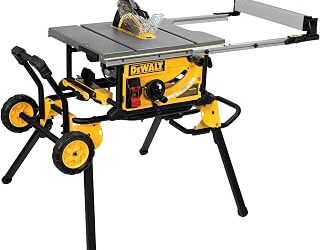
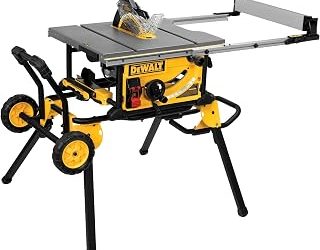
DEWALT DWE7491RS 10-Inch with Rolling Stand
The 32-1/2 inch rip capacity and rack-and-pinion fence make this the most furniture-friendly portable saw on the market — you can crosscut wide panels and rip full sheets without an outfeed helper. The rolling stand deploys in seconds and rolls over a threshold, which matters more than you’d think when your shop is also a garage.
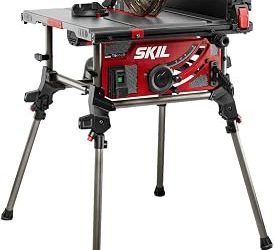
SKIL TS6307-00 15 Amp Portable Jobsite Saw
SKIL’s rack-and-pinion fence tracks impressively true for the price, and the folding stand keeps the whole package light enough to move alone. A smart entry point if you’re building your first few pieces and want accuracy without a premium outlay.
DEWALT DWE7485 8-1/4 in. Compact Saw
Trading two inches of blade for meaningful portability, this compact model still delivers a 24-1/2 inch rip and DEWALT’s precise fence action. Best suited to apartment workshops and anyone hauling the saw between locations regularly.
SKIL SPT99-11 Worm Drive Table Saw
The worm drive gearing puts serious torque behind the blade, so thick hardwood and wet lumber don’t bog it down mid-cut. It’s the heaviest option here, but for DIYers milling their own stock it’s the closest thing to cabinet-saw behavior in a portable frame.
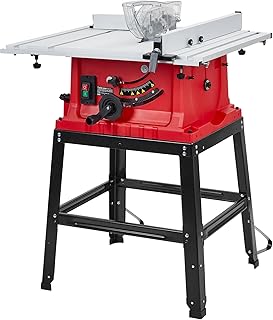
10-Inch 5000 RPM Table Saw with Stand and Cover
A generous 36 x 25 inch tabletop gives you real support surface for panel work, with full 0–45 degree bevel range and adjustable depth. The included protective cover is a genuinely useful touch for saws that sit idle between projects.
Frequently Asked Questions
Do I need a 10-inch blade for furniture building?
Not strictly, but it helps. Ten inches gives you the depth to cut 4×4 legs and thick tabletop stock in a single pass, while 8-1/4 inch saws handle sheet goods and standard lumber comfortably.
How accurate are portable table saws really?
Modern rack-and-pinion fences hold tolerances tight enough for cabinet work. Spend an hour aligning the blade to the miter slot and the fence to the blade when you unbox it — that setup determines your results far more than the price tag.
Can I use one indoors?
Yes, with a shop vac connected to the dust port and a blade guard shroud in place. Expect to still sweep afterward; no portable saw captures everything.
Is a rolling stand worth the extra cost?
If you set up and break down every session, absolutely. Rolling stands turn a two-person lift into a one-person wheel-out, which directly affects how often you actually use the saw.
Final Thoughts
For most DIYers building furniture, the DEWALT DWE7491RS is the safest investment — its rip capacity and fence precision cover nearly every project you’ll take on. Choose the SKIL TS6307-00 if you want that same accuracy on a tighter budget, or the SKIL SPT99-11 if you’re working thick hardwood and want torque to spare.