Key takeaways
- Wattage: Higher wattage generally heats faster and produces steadier steam. Typical home models are listed from about 1,000 to 1,800 watts.
- Tank capacity: Determines runtime. Look for the maker’s stated continuous steam time.
- Heat-up time: Stated by the maker; real times depend on water and mains voltage.
- Steam head: Wide plates smooth more fabric but can be awkward on collars; some models include a fabric brush.
- Cord and hose length: Longer reaches help in bedrooms or closets.
- Weight: Handhelds above one kilogram can tire the wrist.
A handheld steamer suits renters, travelers, and anyone who touches up a few shirts a week, while an upright (standing) steamer with a larger tank suits households that steam whole wardrobes, curtains, and heavy fabrics. Match the type to how many garments you steam per session, since tank size and heat-up time decide how often you stop to refill.
Our top picks



As an Amazon Associate we earn from qualifying purchases at no extra cost to you.
Garment Steamers at a Glance
| Type | Best for | Typical stated specs | Limits |
|---|---|---|---|
| Compact handheld | Travel, quick touch-ups | Small tank, short heat-up time listed by maker | Runs out fast; less steam per minute |
| Larger handheld | Weekly shirts, blouses | Bigger tank, adjustable steam levels | Heavier in the hand |
| Upright steamer (Jiffy J-2000, Rowenta X-Cel, Conair ExtremeSteam style) | Whole wardrobes, curtains | Tank in liters, hose, hanger, continuous steam | Bulky; needs storage |
| Steam iron with vertical function | Households with one appliance | Soleplate plus vertical steam | Heavier; slower on hanging garments |
| Commercial-style steamers | Boutiques, frequent use | Large tank, higher output | Cost and size |
Handheld or Upright?
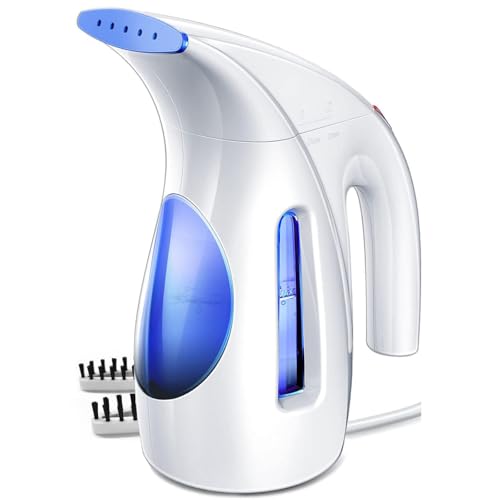
Handhelds heat quickly and fold into a suitcase. Many makers advertise a ready time under a minute, though the listed figure varies by model. The tradeoff is a small tank, often in the range of 100 to 300 milliliters, which can empty in under 10 minutes of continuous use.
Uprights use tanks measured in liters and a hose with a steam head. Reviewers often note that the hose can sag and spit water if not kept lower than the head, and that the pole adds stability for long sessions. If you steam more than five or six garments in one go, an upright saves refills.
Specs That Matter
- Wattage: Higher wattage generally heats faster and produces steadier steam. Typical home models are listed from about 1,000 to 1,800 watts.
- Tank capacity: Determines runtime. Look for the maker’s stated continuous steam time.
- Heat-up time: Stated by the maker; real times depend on water and mains voltage.
- Steam head: Wide plates smooth more fabric but can be awkward on collars; some models include a fabric brush.
- Cord and hose length: Longer reaches help in bedrooms or closets.
- Weight: Handhelds above one kilogram can tire the wrist.
Fabrics and What Steam Can Do
Steamers relax wrinkles in cotton, linen, polyester, and wool blends. Delicate fabrics such as silk and velvet may spot or flatten, so follow the garment’s care label and the steamer manual. Steam does not provide crisp creases or pleats the way a pressing iron can; reviewers commonly say a steamer is faster but less sharp than ironing. Thick items like denim and heavy curtains need more steam and more time.
Steam is also sometimes marketed as a freshener. Makers may say it helps remove odors, but it is not a substitute for washing, and sanitizing claims should be read in the manual’s own words.
Water, Scale, and Maintenance
Hard water leaves scale that can clog the steam path. Many makers recommend distilled or demineralized water; others permit tap water in soft-water areas. Read the manual, because using the wrong water can void the warranty. Empty the tank after use, let the unit cool, and follow the descaling instructions, which often involve a vinegar-and-water solution if the maker allows it.
Safety
- Steam is very hot and can scald. Never point the head at people, pets, or yourself.
- Do not steam a garment while someone is wearing it unless the maker says it is safe to do so; most manuals advise against it.
- Keep cords away from wet floors, and plug into an outlet suited to the rated wattage.
- Let the unit cool before refilling or storing. Some models state auto shut-off or a boil-dry feature; rely on it only if the maker lists it.
- Do not use extension cords unless the manual allows it.
Budget Tiers
Budget
Small handhelds and basic uprights from makers such as PurSteam, Steamfast, and Conair. Expect smaller tanks, plastic parts, and shorter warranties. These suit occasional use.
Mid-range
Larger handhelds and uprights such as the Jiffy J-2000 (often listed as a long-running commercial-style model), Rowenta’s X-Cel line, and Levoit or Tefal units. Look for adjustable steam levels, a larger tank, and an included hanger.
Premium
Professional or boutique-level uprights, as well as brands such as Philips and Miele. They typically offer higher output, longer hoses, and tougher builds.
Pick X If You Want…
| Pick this | If you… |
|---|---|
| Compact handheld | Travel often or have a tiny closet |
| Large handheld | Steam a few shirts weekly |
| Upright with large tank | Steam many garments or curtains |
| Steam iron | Want crisp creases and one appliance |
| Commercial-style steamer | Run a boutique or steam daily |
Alternatives
- Steam iron: Better for pleats and collars; heavier on delicate fabrics.
- Bathroom steam: Hanging clothes in a steamy bathroom relaxes light wrinkles without equipment.
- Dryer wrinkle-release cycles: Use the machine’s steam or tumble setting if available.
- Wrinkle-release sprays: Quick, but results are inconsistent and fabric care labels apply.
Buying Checklist
- Decide how many garments you steam per session.
- Check tank size and continuous steam time.
- Read the water type recommended by the maker.
- Look at weight, hose length, and cord length.
- Confirm voltage and plug type if you travel abroad; some travel models are dual voltage.
- Check the warranty and descaling instructions.
Frequently Asked Questions
Is a steamer better than an iron?
It is faster and gentler on many fabrics, but less able to produce sharp creases. Many households keep both.
Can I use tap water in a garment steamer?
Some makers allow it, others require distilled water. Follow the manual, since hard water scale can shorten the life of the unit.
How long does a handheld steamer run on one fill?
Makers state runtimes, often in the range of 8 to 15 minutes for compact units. Larger tanks and uprights run longer.
Can I steam delicate fabrics like silk?
Often yes, but with caution. Check the garment label, keep the head a short distance away, and test a hidden area first.
Does steam remove odors or kill germs?
It can freshen fabrics, but it does not replace washing. Treat any sanitizing claim as the maker’s statement and read its conditions.
How do I descale a steamer?
Follow the maker’s instructions. Many suggest a diluted vinegar solution or a supplied descaler, followed by rinsing with fresh water.
More from Amazon
Programs that pair well with the guide above. Offers and eligibility are set by Amazon and may change.
Collect the home and kitchen items you want in one registry that guests can shop from.
Create a wedding registrySet up recurring deliveries of everyday items on eligible products. Terms and savings are set by Amazon.
Explore Subscribe & SaveFree shipping on eligible items, Prime Video and more. Eligible new members can start with a free trial.
Start a Prime free trialAudiobooks and podcasts to listen to on the go. Eligible new members can start with a free trial.
Try Audible freeAs an Amazon Associate we earn from qualifying purchases.