Key takeaways
- Format: Rolls give you seamless, wall-to-wall coverage and hide slab imperfections well. Interlocking tiles handle uneven concrete better, let you mix colors, and can be pulled up individually if one section gets damaged. Containment mats are purpose-built to trap snowmelt and drips under a single vehicle.
- Thickness and load rating: For PVC rolls, 2.2mm is the practical minimum and anything near 2.8mm resists tire scuffing noticeably better. Tiles should publish a rolling load figure — 40,000 lbs and up means jack stands and loaded toolboxes won’t crater the surface.
- Drainage versus barrier: Open-grid tiles let water, dust, and debris fall through to the slab so the surface dries fast. Solid rolls and mats do the opposite, sealing moisture out of the concrete. Choose based on whether you’re protecting the floor or managing what lands on it.
- Chemical resistance: Brake fluid, gear oil, and de-icer are the real test. Look for explicit oil and stain resistance rather than generic “waterproof” claims, and confirm the material won’t soften where hot tires park.
- Measure with margin: A two-car bay usually needs 20 to 24 feet of width. Note where the door track lands and account for floor drains and slope before ordering, since rolls are far less forgiving of a bad measurement than tiles are.
What's inside
Garage floors live a hard life. Concrete drinks in oil, road salt etches it over a few winters, and hot tires lift whatever coating you rolled on last spring. Meanwhile the garage itself has quietly become an extra room in most homes: a workshop, a lifting platform, a landing zone for muddy cleats and cargo bikes. The slab underneath rarely gets an upgrade to match, so it stays the one surface in the house nobody wants to look at.
Covering it is cheaper and faster than resurfacing it, and the current crop of mats, rolls, and interlocking tiles has closed most of the quality gap with poured coatings. This guide breaks down the three formats worth your money, what separates commercial-grade tile from the lookalikes, and which products hold up under real vehicle weight. Below you’ll find our picks for 2026 along with the specs that actually predict longevity.
As an Amazon Associate we earn from qualifying purchases.



How to Choose a Flooring For Garage (2026)
- Format: Rolls give you seamless, wall-to-wall coverage and hide slab imperfections well. Interlocking tiles handle uneven concrete better, let you mix colors, and can be pulled up individually if one section gets damaged. Containment mats are purpose-built to trap snowmelt and drips under a single vehicle.
- Thickness and load rating: For PVC rolls, 2.2mm is the practical minimum and anything near 2.8mm resists tire scuffing noticeably better. Tiles should publish a rolling load figure — 40,000 lbs and up means jack stands and loaded toolboxes won’t crater the surface.
- Drainage versus barrier: Open-grid tiles let water, dust, and debris fall through to the slab so the surface dries fast. Solid rolls and mats do the opposite, sealing moisture out of the concrete. Choose based on whether you’re protecting the floor or managing what lands on it.
- Chemical resistance: Brake fluid, gear oil, and de-icer are the real test. Look for explicit oil and stain resistance rather than generic “waterproof” claims, and confirm the material won’t soften where hot tires park.
- Measure with margin: A two-car bay usually needs 20 to 24 feet of width. Note where the door track lands and account for floor drains and slope before ordering, since rolls are far less forgiving of a bad measurement than tiles are.
The Best Flooring For Garage (2026)s Reviewed
Swisstrax Ribtrax PRO Garage Floor Tiles, 24-Pack
This is the tile that turns a garage into a showroom, with commercial-grade polypropylene, a ribbed top texture, and a snap-together system that needs no adhesive. The Pearl Grey reads as a deliberate design choice rather than a floor covering, and the 15.75-inch format means fewer seams across a large bay.
RaceDeck Free-Flow Interlocking Tiles, 48-Pack
The open-grid design is the point here: meltwater, sand, and shop dust drop straight through instead of pooling under your tires. An 80,000-pound rolling load rating and US manufacturing make this the pick for anyone who actually works on cars rather than just parking them.
8×20 FT Diamond Plate Garage Floor Mat
At 2.8mm, this PVC roll is thicker than most in its price range, and the diamond plate texture keeps footing secure when the surface is wet. The 20 included tape strips let you anchor edges without a separate hardware run, making this the most straightforward single-bay upgrade on the list.
VEVOR Garage Floor Roll, 7.5 x 20 ft
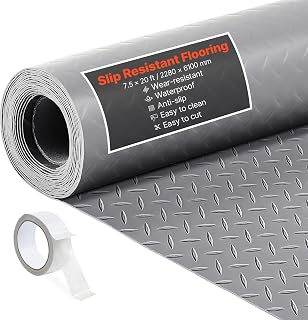
The silver-grey finish brightens a dim garage considerably, which matters more than people expect in a space lit by one overhead fixture. At 2.2mm with double-sided tape included, it’s a sensible middle ground: enough substance to protect the slab, light enough for one person to unroll and trim.
Armor All Jumbo XXL Garage Floor Mat
Built for the winter problem specifically, this 22-by-8’10” mat absorbs and contains snowmelt and oil drips instead of letting them reach the concrete. It’s the right call for a single vehicle in a salt-belt climate, and the raised-edge containment keeps runoff off the rest of the floor.
Frequently Asked Questions
Do I need to prep my concrete first?
Sweep and degrease it, then let it dry fully. You don’t need to grind or etch the way you would for epoxy, but trapped grit will telegraph through a thin roll and shorten its life.
Will hot tires damage PVC rolls?
Quality PVC handles normal driving fine. Pull in after a long highway run and give tires a few minutes to cool before parking, and avoid the thinnest budget rolls if you park daily in a hot climate.
Are tiles or rolls easier to install?
Tiles, in most garages. They snap together without adhesive, tolerate uneven slabs, and can be laid around obstacles. Rolls install faster in an empty bay but require accurate measuring and clean trimming.
Can I use this flooring as a gym surface?
Yes for bodyweight work and cardio equipment. For dropped barbells, add dedicated rubber platforms on top — no garage flooring product on this list is designed to absorb that kind of impact.
Final Thoughts
If you want the garage to look intentional, the Swisstrax Ribtrax PRO tiles deliver a finish that holds up visually and structurally. Working garages are better served by the RaceDeck Free-Flow grid, which keeps the surface dry and takes real abuse, while the 8×20 diamond plate roll remains the fastest, most affordable way to cover a single bay properly.