Key takeaways
- Match the plane to the frequency: Store seasonal and archival items overhead, weekly items at eye level on wall shelves, and heavy or awkward items on freestanding tiers near the door. Storing daily-use gear on the ceiling guarantees you’ll stop using the rack.
- Measure ceiling drop, not just ceiling height: Overhead racks hang 22 to 40 inches below the joists. Subtract the drop from your ceiling height, then confirm clearance for garage door tracks, opener rails, and the roofline of a taller SUV.
- Read capacity per shelf, not per unit: A 2,400 lb freestanding rack means roughly 480 lb across five tiers. Distributed load is the honest number, and it should be double whatever you plan to put there.
- Verify what you’re anchoring into: Overhead and wall racks need to land in wood joists or studs. Finished ceilings, trusses at wide spacing, or concrete require different hardware, so locate framing before ordering.
- Choose the finish for your climate: Powder-coated steel handles humidity and road salt best. Structural plastic resists moisture and won’t rust, but it flexes under concentrated point loads, so keep it for lighter, bulkier goods.
What's inside
The garage is the last room in the house to get design attention, and it shows. Bikes lean against drywall, holiday bins stack into towers that nobody dares to unstack, and the car slowly gets exiled to the driveway. The problem is rarely a shortage of square footage. It’s that garages are built as one big open volume, and open volume without structure just collects things. The fix is thinking in planes: the ceiling, the walls, and the floor each have a job, and clutter happens when everything defaults to the floor.
This guide looks at garage storage racks through that lens. We compare overhead ceiling racks that reclaim dead air above the hood of your car, wall-mounted floating shelves that keep the perimeter walkable, and freestanding tiered units for the gear you reach for weekly. Below you’ll find the racks worth your money in 2026, plus a short framework for matching capacity, mounting method, and clearance to the garage you actually have.
As an Amazon Associate we earn from qualifying purchases.


How to Choose a Garage Storage Rack (2026)
- Match the plane to the frequency: Store seasonal and archival items overhead, weekly items at eye level on wall shelves, and heavy or awkward items on freestanding tiers near the door. Storing daily-use gear on the ceiling guarantees you’ll stop using the rack.
- Measure ceiling drop, not just ceiling height: Overhead racks hang 22 to 40 inches below the joists. Subtract the drop from your ceiling height, then confirm clearance for garage door tracks, opener rails, and the roofline of a taller SUV.
- Read capacity per shelf, not per unit: A 2,400 lb freestanding rack means roughly 480 lb across five tiers. Distributed load is the honest number, and it should be double whatever you plan to put there.
- Verify what you’re anchoring into: Overhead and wall racks need to land in wood joists or studs. Finished ceilings, trusses at wide spacing, or concrete require different hardware, so locate framing before ordering.
- Choose the finish for your climate: Powder-coated steel handles humidity and road salt best. Structural plastic resists moisture and won’t rust, but it flexes under concentrated point loads, so keep it for lighter, bulkier goods.
The Best Garage Storage Racks of 2026, Reviewed
FLEXIMOUNTS 4×8 Overhead Ceiling Rack
The most consistently trustworthy overhead rack on the market, with a 750 lb rating, a genuine 22 to 40 inch adjustable drop, and hardware quality that makes the install feel deliberate rather than improvised. If you want one rack to swallow every bin you own and free the floor entirely, start here.
5-Tier Adjustable Steel Garage Shelving, 72″ x 40″ x 20″
A clean, boltless steel workhorse with a 2,400 lb distributed rating and shelves that reposition as your storage needs change. The 20-inch depth is the smart detail here, deep enough for totes but shallow enough to keep a two-car garage from feeling narrow.
FLEXIMOUNTS 2×6 Wall-Mounted Shelves, 2-Pack
Two 24-by-72-inch floating shelves that read almost architectural once mounted, holding 1,400 lb combined while leaving the floor beneath completely clear for a workbench, bikes, or a trash enclosure. This is the pick for garages where sightlines and sweepability matter.
4×8 ft Overhead Rack, 750 lb Capacity
A well-executed value alternative in the overhead category, with reinforced framing that resists mid-span sag and a rust-resistant coating that holds up in damp garages. The 26 to 40 inch adjustment range is slightly shallower than premium rivals, which actually helps in garages with lower ceilings.
Connectable Overhead Rail System, 4 Sets
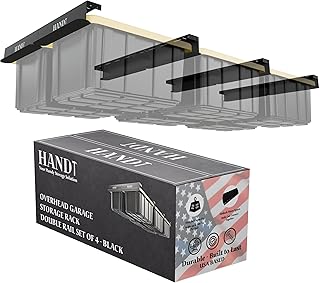
Rather than a solid platform, this system runs ceiling rails that cradle up to six totes, so bins slide out individually instead of forcing you to unstack. It’s the most flexible overhead option for anyone whose storage is already standardized around matching containers.
Frequently Asked Questions
How much weight can a garage ceiling actually hold?
Most residential garage ceilings framed with 2×6 or larger joists on 16-inch centers handle a properly mounted 600 to 750 lb rack. Engineered trusses are a different story, since they aren’t designed for suspended loads, so consult a structural professional before hanging anything from them.
Can I install an overhead rack alone?
You can assemble the frame solo, but lifting and holding it against the ceiling while driving lag bolts is genuinely a two-person job. Budget about two to three hours, and locate every joist with a stud finder before you start.
Is plastic shelving a mistake in a garage?
Not at all, if you use it correctly. Units like the CX Craftsman 5-Tier plastic shelving handle roughly 200 lb per shelf, never rust, and suit damp basements and coastal garages well, though steel remains the better answer for engine parts and dense tool storage.
Wall shelves or a freestanding rack?
Wall shelves preserve floor space and look far tidier, but they demand solid stud mounting. Freestanding racks require no drilling and hold more total weight, which makes them the better choice for renters and finished-wall garages.
Final Thoughts
For most garages, the FLEXIMOUNTS 4×8 Overhead Rack does the heaviest lifting by turning unused ceiling volume into real storage, and pairing it with the FLEXIMOUNTS 2×6 wall-mounted shelves gives you a complete system without a single item touching the floor. If you’d rather skip drilling altogether, the 5-Tier Adjustable Steel Shelving delivers the most capacity per dollar and can be reconfigured as your storage evolves.