Key takeaways
- Adjustment method: Hand cranks are quieter, cheaper, and immune to power outages, but they ask for 20 to 30 turns per full travel. Choose a crank if you set a height and leave it for weeks; look at powered columns if you switch between seated detail work and standing assembly several times a day.
- Load rating versus real load: Ratings between 2,000 and 2,500 pounds are common and largely theoretical for home use. What matters more is whether that figure applies while the bench is raised and rolling, or only when it is locked at its lowest setting with feet planted. Read the fine print.
- Top material and thickness: Rubberwood is the sweet spot for most rooms — dense enough to take abuse, warm enough to look intentional in a living space. Laminated oak reads more furniture-like and resists dents better. Anything under one inch will telegraph vibration through precision work.
- Feet or casters: Levelling feet win on rigidity and are the right call for a permanent station on uneven concrete. Lockable casters win on flexibility. If you rearrange your space seasonally or need access to all four sides, mobility is worth the small loss in stiffness.
- Integrated storage and power: Built-in outlets and a pegboard back panel save you from running extension cords and drilling wall anchors. Drawers keep small tools off the surface, which is the single biggest factor in whether a bench stays usable day to day.
What's inside
The workbench problem is rarely about strength. Most benches sold today can hold more weight than a home shop will ever ask of them. The trouble is height. A surface fixed at 34 inches is fine for hammering and miserable for soldering, and it turns any task that lasts longer than an hour into a slow negotiation with your lower back. Anyone who has spent an afternoon hunched over a fretsaw, or stood on tiptoe to reach the far edge of a glue-up, already knows the fixed-height bench is a compromise nobody actually chose.
This guide looks at the current crop of height-adjustable workbenches through a design lens as much as a workshop one, because these tables have quietly migrated out of the garage. They now live in spare rooms, studio corners, and open-plan kitchens where they double as prep counters and cutting tables. Below you will find the models worth your attention in 2026, what separates a genuinely useful crank mechanism from a novelty one, and how to match capacity, footprint, and finish to the way you actually work.
As an Amazon Associate we earn from qualifying purchases.


How to Choose a Height-Adjustable Workbench (2026)
- Adjustment method: Hand cranks are quieter, cheaper, and immune to power outages, but they ask for 20 to 30 turns per full travel. Choose a crank if you set a height and leave it for weeks; look at powered columns if you switch between seated detail work and standing assembly several times a day.
- Load rating versus real load: Ratings between 2,000 and 2,500 pounds are common and largely theoretical for home use. What matters more is whether that figure applies while the bench is raised and rolling, or only when it is locked at its lowest setting with feet planted. Read the fine print.
- Top material and thickness: Rubberwood is the sweet spot for most rooms — dense enough to take abuse, warm enough to look intentional in a living space. Laminated oak reads more furniture-like and resists dents better. Anything under one inch will telegraph vibration through precision work.
- Feet or casters: Levelling feet win on rigidity and are the right call for a permanent station on uneven concrete. Lockable casters win on flexibility. If you rearrange your space seasonally or need access to all four sides, mobility is worth the small loss in stiffness.
- Integrated storage and power: Built-in outlets and a pegboard back panel save you from running extension cords and drilling wall anchors. Drawers keep small tools off the surface, which is the single biggest factor in whether a bench stays usable day to day.
The Best Height-Adjustable Workbenches (2026), Reviewed
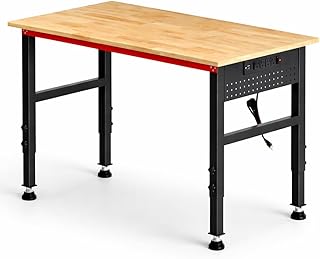
70″ Adjustable Height Workbench with Power Outlets & Pegboard
At nearly six feet wide, this is the bench for people who have outgrown the idea of clearing space before starting a project — the rubberwood top handles full-sheet layout, and the integrated outlets plus pegboard turn one wall into a complete station. Best suited to a dedicated garage or workshop bay, since the footprint is genuinely substantial.
FLEXISPOT 47.2″ Workbench with Hand Crank & Drawer
The most livable option here, and the one I would put in a shared room without hesitation: compact proportions, a clean steel-and-rubberwood palette, and lockable casters that let it tuck away when the work is done. The hand crank is smooth and predictable, though the single drawer will fill fast if you own more than a starter tool kit.
48″ Heavy Duty Workbench with Laminated Oak Top
A 1.2-inch laminated oak surface on a reinforced steel frame gives this one the most furniture-grade look of the group, and the levelling feet make it the stiffest platform for anything requiring precision. Choose it if the bench will stay put and you care how it photographs.
FLEXIMOUNTS 47.2″ Workbench with Drawers & 360° Wheels
Essentially the versatility pick — rubberwood top, multiple drawers, and full-swivel casters that make it equally at home as a studio table, kitchen prep island, or workshop station. The hand crank travel covers seated to standing comfortably for most users.
48″ Work Bench with Drawers, Wheels & Power Outlets
This one bundles the three features people usually add later: drawers, mobility, and onboard power. For a 48-inch footprint it is a lot of function, and it suits mixed-use spaces where the bench needs to earn its keep at several different jobs.
Frequently Asked Questions
What height should I set my workbench to?
For general assembly and hand tools, aim for wrist height when standing with arms relaxed — usually 36 to 39 inches. Drop to 28 to 30 inches for power tool work where you need to see over the piece, and to seated desk height for electronics or fine detail.
Are hand-crank benches slow to adjust?
They take roughly 20 to 40 seconds for a full range change. That is fine for occasional repositioning and tedious if you plan to change heights repeatedly within a single session.
Can these double as a desk or kitchen prep surface?
Yes, and the rubberwood and oak models look the part. Seal the top if it will meet food or moisture regularly, and confirm the low end of the height range reaches standard desk height before committing.
Do casters compromise stability?
Slightly. Locked casters are secure enough for sawing and sanding, but for hammering, chiselling, or anything requiring absolute rigidity, a bench on levelling feet will feel noticeably more planted.
Final Thoughts
For a full workshop wall, the 70″ rubberwood bench with pegboard and outlets is the most complete answer. For a room that has to serve more than one purpose, the FLEXISPOT 47.2″ crank bench strikes the best balance of footprint, finish, and mobility, while the 48″ laminated oak model is the pick if rigidity and a furniture-grade look matter more than rolling it around.